
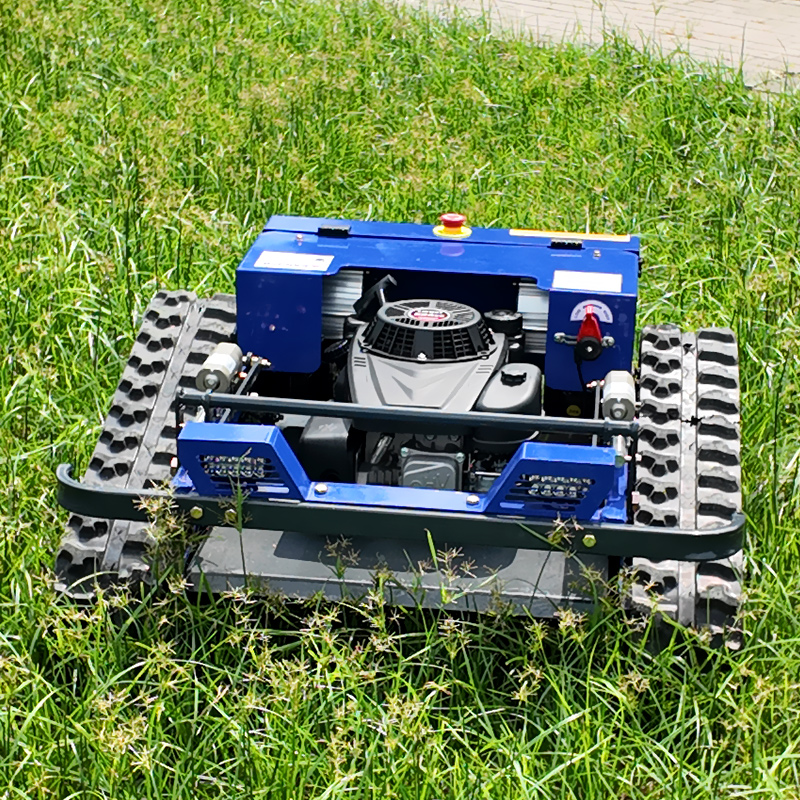
1. Introduction: Why Utility Corridors Need Reliable Vegetation Management
Utility corridors are essential infrastructure areas used for electricity transmission, gas pipelines, water supply systems, telecommunications and other public services.
These corridors often extend across large areas and may pass through fields, hillsides, woodland edges, drainage areas and undeveloped land. Grass, weeds, shrubs and other vegetation can grow quickly, creating additional maintenance requirements for infrastructure operators and contractors.
For professional maintenance companies, vegetation management is not simply about keeping an area visually clean. It is part of a broader infrastructure maintenance program.
Uncontrolled vegetation may:
- Restrict access to inspection routes.
- Obstruct maintenance personnel and service vehicles.
- Make infrastructure inspections more difficult.
- Increase the workload during scheduled maintenance.
- Create additional vegetation-control requirements around designated access areas.
Traditional mowing equipment may be suitable for open and relatively level sections. However, utility corridors can also include steep slopes, narrow access routes, uneven ground and areas where large machinery is difficult to position.
A remote control lawn mower for utility corridors can provide an alternative solution for suitable vegetation maintenance tasks.
By allowing an operator to control the mower remotely, this equipment can help contractors manage certain difficult-to-access grass areas without requiring the operator to ride directly on the machine.
For B2B buyers, the key is to identify the correct machine configuration for the terrain, vegetation, access conditions and project requirements.
This guide explains how remote control mowing equipment can support professional utility corridor maintenance and what buyers should consider before purchasing.
Remote Control Lawn Mower for Roadside Maintenance Contractors
2. What Are Utility Corridors?
Utility corridors are designated land areas used to accommodate and maintain infrastructure networks.
They may be owned, managed or accessed by utility companies, government departments, infrastructure operators and contracted maintenance organizations.
Common examples include:
2.1 Electrical Transmission and Distribution Corridors
Power line corridors may contain grass-covered land, access roads, sloped terrain and vegetation-control zones.
Maintenance requirements vary according to voltage level, infrastructure design, local regulations and utility company procedures.
Vegetation management around electrical infrastructure must follow the relevant utility’s clearance standards and electrical safety requirements.
Remote control mowing equipment may be considered for suitable grass-maintenance sections, but it does not replace specialized tree clearance or vegetation work near energized conductors.
2.2 Pipeline Right-of-Way Areas
Pipeline rights-of-way are maintained to provide access for inspection, monitoring and maintenance activities.
Vegetation may grow along the corridor, access roads and surrounding slopes.
For pipeline operators, the maintenance program should consider surface conditions, access restrictions, buried infrastructure and the location of inspection equipment.
Before mowing, contractors must identify buried utilities and follow the pipeline operator’s approved ground-disturbance and access procedures.
2.3 Water Supply and Drainage Infrastructure
Water pipelines, drainage systems and related infrastructure may pass through fields, embankments and undeveloped land.
Vegetation management helps keep designated access routes and inspection areas usable.
Depending on the terrain, compact remote control mowing equipment may be considered for suitable grass-covered sections.
2.4 Telecommunications and Fiber Optic Corridors
Telecommunications infrastructure may include equipment access paths, remote communication facilities and cable routes.
Maintenance contractors may need to control vegetation around access areas while avoiding damage to cables, cabinets, markers and other infrastructure components.
2.5 Renewable Energy and Power Distribution Facilities
Solar farms, substations and renewable energy installations may contain large vegetation management areas.
These sites can include uneven terrain, perimeter slopes, access roads and equipment clearance zones.
A remote control mower may help maintain suitable grass areas as part of a broader site maintenance program.
Remote Control Lawn Mower for Solar Farms and Renewable Energy Sites
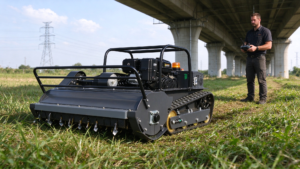
3. Common Vegetation Management Challenges in Utility Corridors
Utility corridors create several challenges for contractors responsible for maintaining long and sometimes difficult-to-access areas.
3.1 Long and Narrow Working Areas
Unlike ordinary lawns or parks, utility corridors may extend for considerable distances while remaining relatively narrow.
Maintenance teams must plan how equipment will be transported, positioned and moved between working sections.
Machine width, turning radius and access arrangements are important purchasing considerations.
3.2 Uneven Terrain and Sloped Sections
Some corridors cross hillsides, embankments and irregular ground.
Conventional ride-on mowers may not be suitable for every section.
Tracked remote control mowers may offer useful traction characteristics on suitable terrain, but contractors must assess slope angle, surface condition, moisture and machine operating limits before use.
3.3 Mixed Vegetation Conditions
A single utility corridor may contain several types of vegetation:
- Short grass along access routes.
- Tall grass in less frequently maintained sections.
- Dense weeds around perimeter areas.
- Light brush along selected boundaries.
- Vegetation near drainage structures.
The cutting system must be selected according to the vegetation that the machine is actually designed to process.
Do not assume that a standard lawn mower can handle woody brush or heavy vegetation.
3.4 Restricted Access and Infrastructure Obstacles
Utility corridors may contain inspection markers, cable cabinets, poles, drainage structures, fences and other obstacles.
These objects can restrict machine movement and require more careful mowing plans.
For contractors, compact dimensions and remote maneuverability may be useful when maintaining suitable areas around obstacles.
However, the operator must maintain adequate visibility and avoid approaching protected infrastructure without authorization.
3.5 Seasonal Maintenance Requirements
Vegetation growth changes throughout the year.
During warmer or wetter seasons, grass and weeds may grow more rapidly, increasing the frequency of maintenance work.
Contractors should consider seasonal workloads when selecting equipment capacity and planning their maintenance fleet.
4. How Remote Control Lawn Mowers Support Utility Corridor Maintenance
Remote control lawn mowers can help contractors manage suitable vegetation areas through a combination of remote operation, tracked mobility and mechanical cutting.
4.1 Remote Operation
The operator controls the machine using a handheld transmitter rather than riding on the mower.
This operating method can help position the operator away from certain difficult working areas.
It is important to understand that remote operation does not automatically make a hazardous area safe. Operators still need to maintain visibility, follow the manufacturer’s instructions and comply with the infrastructure owner’s safety procedures.
4.2 Tracked Mobility
Many commercial remote control slope mowers use crawler tracks.
Compared with conventional wheels, tracks can provide a larger contact area and distribute machine weight across a wider surface.
Depending on the machine design and ground conditions, this may help with traction on suitable uneven terrain.
Buyers should compare:
- Track width and length.
- Ground clearance.
- Machine weight.
- Track material.
- Turning performance.
- Maintenance accessibility.
4.3 Cutting Performance for Routine Vegetation Control
A suitable cutting deck can help maintain grass-covered areas along infrastructure access routes and designated maintenance zones.
The required cutting width and cutting height depend on the project specification.
For recurring contracts, consistent cutting performance can help contractors establish a more predictable maintenance schedule.
4.4 Flexible Equipment Deployment
A remote control mower may be transported between multiple project locations.
For companies maintaining several utility corridors, equipment transportability and setup time can influence the total operating cost.
Contractors should consider the dimensions and weight of the mower, loading arrangements and the availability of suitable transport vehicles.
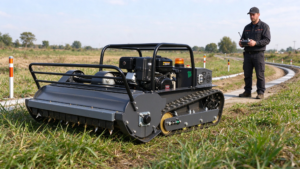
5. Key Applications Across Different Utility Projects
Remote control mowing equipment can be considered for several vegetation maintenance applications.
The following examples focus on suitable grass-covered areas rather than specialized high-risk infrastructure work.
5.1 Grass Maintenance Along Power Line Access Routes
Some power line corridors include open ground and designated vehicle or personnel access routes.
Remote control mowers may be considered for routine grass cutting in approved areas.
The equipment should remain outside prohibited electrical clearance zones and must not be used as a substitute for specialist vegetation clearance near energized conductors.
5.2 Pipeline Right-of-Way Grass Cutting
Pipeline corridors may require regular grass maintenance to keep approved inspection and access areas usable.
Contractors should confirm the location of buried pipelines and associated facilities before starting work.
Any excavation, ground penetration or activity that could disturb the pipeline protection system must follow the operator’s authorization procedures.
5.3 Vegetation Management Around Water Infrastructure
Water supply facilities, drainage corridors and irrigation infrastructure may include grass-covered slopes and narrow access routes.
A compact remote control mower may be suitable for some of these areas, depending on the ground conditions and available working space.
5.4 Substation Perimeter Grass Maintenance
Substation sites often require controlled vegetation management around designated perimeter areas.
Only authorized personnel should enter restricted electrical facilities.
Mowing equipment must be operated according to the facility owner’s access requirements and electrical safety rules.
5.5 Communication Infrastructure Access Areas
Remote telecommunications facilities may be located in rural or undeveloped areas.
Grass maintenance around approved access paths and equipment compounds can help keep these locations accessible for service teams.
The mower configuration should be selected according to site dimensions, access restrictions and vegetation type.
6. How to Choose the Right Remote Control Mower for Utility Corridors
For B2B procurement teams, equipment selection should start with the actual work requirements.
6.1 Measure the Working Width
Utility corridors may have narrow paths or large open sections.
A wider cutting deck can reduce the number of mowing passes in suitable open areas, while a compact machine may be easier to position in restricted spaces.
Consider:
- Corridor width.
- Available turning space.
- Obstacle locations.
- Transport access.
- Required mowing finish.
6.2 Evaluate Terrain and Slope Conditions
Some utility corridors are relatively flat, while others cross uneven hillsides.
Assess the actual terrain before comparing maximum climbing angles.
Important factors include:
- Maximum slope.
- Cross-slope exposure.
- Soil firmness.
- Wet-weather conditions.
- Loose gravel or stones.
- Drainage and erosion.
- Machine operating orientation.
Manufacturer-listed gradeability should be treated as a reference figure under specified conditions, not a universal safe operating limit.
6.3 Select the Appropriate Cutting System
Different projects require different vegetation-control approaches.
| Vegetation Type | Equipment Consideration |
|---|---|
| Routine grass | Standard grass-cutting configuration |
| Tall grass | Suitable cutting deck and power |
| Dense weeds | Confirm blade and deck capabilities |
| Light brush | Check manufacturer-approved vegetation limits |
| Woody vegetation | Specialized equipment may be required |
For many routine grass-maintenance contracts, a rotary cutting configuration may be appropriate.
For some tougher vegetation applications, buyers may evaluate a flail-style cutting system.
Remote Control Flail Mower vs Rotary Mower
6.4 Check Remote-Control Functions
Remote-control performance is particularly important when working in long corridors or areas with obstacles.
Ask the manufacturer about:
- Advertised remote-control range.
- Emergency stop functionality.
- Signal-loss response.
- Operating visibility requirements.
- Control-system durability.
- Availability of replacement transmitters.
Actual remote-control performance may vary with obstacles, terrain, interference and environmental conditions.
6.5 Compare Engine and Drive Systems
For commercial use, engine and drive-system selection affects operating requirements and maintenance planning.
Review:
- Engine manufacturer and model.
- Engine displacement.
- Fuel consumption information.
- Drive motor configuration.
- Cooling and ventilation.
- Service access.
- Replacement parts availability.
6.6 Consider Transportation Requirements
Utility corridor contractors may move equipment between multiple locations.
Before ordering, confirm:
- Machine overall dimensions.
- Operating weight.
- Loading and unloading arrangements.
- Trailer compatibility.
- Transportation restrictions.
- Available lifting or loading equipment.
7. AWY Remote Control Lawn Mower Options for Commercial Buyers
AWY offers several remote control lawn mower configurations that may be considered for suitable commercial vegetation management applications.
The following models provide different cutting widths and power configurations.
7.1 AWY-550H: Compact Configuration for Restricted Areas
The AWY-550H is a compact mower option for buyers who need equipment for smaller or more restricted working areas.
Listed reference specifications:
- Cutting width: 550 mm.
- Engine: 224 cc gasoline engine.
- Walking drive: Dual 750 W brushless motors.
- Stated remote-control range: Up to 500 m.
- Cutting height: 20–150 mm.
- Listed maximum gradeability: Up to 45°.
Potential applications include suitable grass areas around access routes, smaller infrastructure maintenance sections and restricted working spaces.
Its compact cutting width may be useful where machine dimensions and maneuverability are important.
7.2 AWY-800S: Wider Cutting Width for Larger Maintenance Areas
The AWY-800S provides a wider cutting configuration for contractors working on larger grass-covered areas.
Listed reference specifications:
- Cutting width: 800 mm.
- Machine weight: Approximately 360 kg.
- Listed maximum gradeability: Up to 55°.
- Stated mowing capacity: Approximately 1,500 m²/h.
- Engine options: 459 cc gasoline or diesel configurations.
- Walking drive: 850 W brushless motor.
- Stated remote-control range: Up to 500 m.
This configuration may be considered for larger open sections where the available access and working width are suitable.
Actual productivity depends on vegetation conditions, terrain, turning time and operator experience.
7.3 AWY-900: Higher-Capacity Equipment for Professional Contractors
The AWY-900 is a larger configuration for buyers comparing equipment for more demanding mowing workloads.
Listed reference specifications:
- Cutting width: 900 mm.
- Listed maximum gradeability: Up to 55°.
- Stated mowing capacity: Approximately 2,000 m²/h.
- Engine options: LONCIN 452 cc, 608 cc or 764 cc configurations.
- Walking drive: Two 1,500 W brushless motors.
- Remote-adjustable cutting height: 2–20 cm.
- Travel speed: 0–6 km/h.
- Fuel tank capacity: 6 L.
The AWY-900 may be considered for larger grass-maintenance areas where its dimensions and working configuration match the project.
For infrastructure projects, buyers should confirm the machine’s suitability against the site owner’s operating requirements.
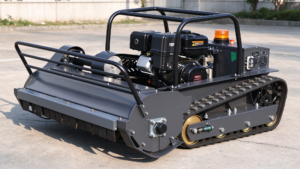
8. Safety Requirements Around Utility Infrastructure
Utility corridor mowing involves risks that are different from ordinary landscaping work.
Contractors must follow the infrastructure owner’s safety procedures and applicable local regulations.
8.1 Identify Infrastructure Before Starting Work
Before mowing, identify:
- Buried pipelines.
- Underground electrical cables.
- Fiber optic routes.
- Inspection chambers.
- Utility markers.
- Above-ground equipment.
- Restricted access areas.
Do not assume that a visible grass area is free of buried infrastructure.
Where required, obtain utility maps, site authorization and clearance information before work begins.
8.2 Follow Electrical Safety Requirements
Electrical infrastructure can present serious hazards.
Mowing work near power lines and substations must follow the utility owner’s approved clearance and access procedures.
Remote control operation does not authorize a contractor to enter restricted electrical zones or work near energized conductors without appropriate controls.
8.3 Protect Buried Pipelines and Cables
A mower should not be used in a way that could damage pipeline coatings, cable protection systems, marker posts or underground infrastructure.
Avoid unauthorized excavation, digging or ground disturbance.
Where the route or infrastructure location is uncertain, stop work and seek confirmation from the responsible operator.
8.4 Assess Ground Conditions
Inspect the site for:
- Soft or waterlogged soil.
- Erosion.
- Hidden holes.
- Loose stones.
- Exposed roots.
- Steep or unstable edges.
- Drainage structures.
Do not operate on terrain that exceeds the manufacturer’s approved operating conditions.
8.5 Maintain Operator Visibility
The operator should be able to monitor the machine and its surroundings.
A safe operating position should provide sufficient visibility without exposing the operator to unstable ground, traffic or other hazards.
8.6 Establish an Emergency Procedure
Before starting work, confirm:
- Emergency stop operation.
- Signal-loss response.
- Safe stopping procedure.
- Operator communication.
- Exclusion-zone boundaries.
- Recovery arrangements.
Every operator should receive appropriate training before using the equipment.
9. How Contractors Can Improve Utility Corridor Maintenance Productivity
The productivity of a utility vegetation management project depends on more than cutting speed.
Project planning, transportation and equipment maintenance also influence operating costs.
9.1 Divide Long Corridors into Work Sections
For long infrastructure routes, divide the project into manageable sections.
This makes it easier to assign operators, track progress and schedule repeat maintenance.
9.2 Match Machine Size to the Site
A compact mower may be more appropriate for narrow access areas, while a wider machine may be more productive on open grass sections.
Contractors with diverse projects may benefit from evaluating more than one machine configuration.
9.3 Plan Seasonal Maintenance Schedules
Vegetation growth varies according to weather and location.
A planned schedule can help contractors manage workload, allocate machines and avoid unnecessary emergency maintenance.
9.4 Monitor Equipment Condition
Regular inspections can help reduce unexpected downtime.
Important inspection areas include:
- Crawler tracks.
- Cutting blades.
- Cutting deck.
- Engine oil and filters.
- Cooling components.
- Drive motors.
- Remote-control transmitter.
- Electrical connections.
9.5 Train Operators and Standardize Procedures
Companies operating across several utility sites should establish consistent procedures for:
- Pre-operation inspections.
- Site hazard identification.
- Remote-control operation.
- Emergency response.
- Daily maintenance.
- Equipment transportation.
Standardized procedures can make it easier to manage a larger maintenance fleet.
Remote Control Lawn Mower for Rental Businesses
10. Procurement Considerations for Utility Companies and Maintenance Contractors
B2B buyers should evaluate the supplier as well as the machine.
A reliable purchasing process can help reduce the risk of selecting equipment that does not match the project.
10.1 Prepare a Project Specification
Before requesting quotations, prepare a clear description of the working environment.
Include:
- Infrastructure type.
- Approximate mowing area.
- Corridor width.
- Terrain and slope conditions.
- Vegetation type.
- Required cutting height.
- Expected working frequency.
- Transportation requirements.
- Destination country.
Photographs and videos can help suppliers understand the actual working environment.
10.2 Request Complete Technical Documentation
Ask the supplier for:
- Product specifications.
- Overall machine dimensions.
- Operating weight.
- Engine information.
- Cutting system details.
- Remote-control documentation.
- Operating instructions.
- Maintenance schedule.
- Spare-parts information.
For government and utility procurement, additional technical documentation may be required.
10.3 Evaluate Spare Parts and After-Sales Support
Commercial equipment buyers should consider long-term service requirements.
Discuss:
- Track replacement.
- Cutting blade availability.
- Engine maintenance components.
- Remote-control accessories.
- Technical support.
- Warranty terms.
- Spare-parts delivery arrangements.
10.4 Calculate Total Cost of Ownership
The purchase price does not represent the complete cost of operating a commercial mower.
| Cost Category | Procurement Consideration |
|---|---|
| Purchase | Initial equipment price |
| Shipping | Freight and delivery |
| Operation | Fuel and routine operating costs |
| Maintenance | Filters, blades and wear components |
| Labor | Operator and maintenance staffing |
| Downtime | Repair and parts availability |
| Service life | Long-term durability |
For contractors bidding on recurring maintenance projects, total cost of ownership is an important part of equipment planning.
10.5 Confirm Delivery and Configuration Requirements
Before placing an order, confirm the selected engine, cutting configuration, accessories, packaging, delivery schedule and warranty terms.
Distributors should also discuss product training and technical support for their local customers.
11. Frequently Asked Questions
Q1: Can a remote control lawn mower be used in utility corridors?
Yes, suitable remote control lawn mowers can be used for certain grass-maintenance tasks in utility corridors. Their use depends on terrain, vegetation, access conditions and the infrastructure owner’s operating requirements.
Q2: Can a remote control mower cut grass beneath power lines?
Only where the work area is approved and the utility owner’s electrical safety and clearance procedures are followed. Remote operation does not remove electrical hazards or replace specialist vegetation-clearance procedures.
Q3: Are tracked remote control mowers suitable for pipeline corridors?
They may be suitable for certain grass-covered sections, provided that the route has been identified and the equipment can operate without disturbing buried infrastructure or protective systems.
Q4: What cutting width is suitable for utility corridor maintenance?
The appropriate cutting width depends on the corridor dimensions, access restrictions, vegetation and required productivity. Compact machines may be useful in restricted areas, while wider machines may suit open sections.
Q5: Can remote control mowers handle dense weeds?
Some commercial machines can handle certain dense grass and weed conditions. Buyers should confirm the approved vegetation limits and cutting-system specifications with the manufacturer.
Q6: What is more important: engine power or cutting width?
Both are important, but neither should be considered independently. A suitable machine must balance power, cutting width, terrain capability, transport requirements and maintenance needs.
Q7: What should a contractor provide when requesting a quotation?
Provide the working area, vegetation type, terrain conditions, access width, desired cutting configuration and destination country. Site photographs or videos are useful for preliminary equipment recommendations.
Q8: Can one mower be used across several infrastructure projects?
Potentially, if the different sites have compatible terrain, vegetation and operating requirements. Contractors should verify suitability for each location before deployment.
12. Conclusion: Selecting the Right Mowing Equipment for Utility Corridor Projects
Utility corridor vegetation management requires equipment that can meet the practical demands of infrastructure maintenance.
For power line access routes, pipeline rights-of-way, drainage areas and telecommunications facilities, remote control lawn mowers may offer a useful option for suitable grass-cutting applications.
The right purchasing decision should consider machine dimensions, cutting width, terrain conditions, remote-control functions, maintenance requirements and supplier support.
For contractors and distributors, choosing equipment that matches the actual project can help improve maintenance planning and long-term fleet utilization.
AWY provides different remote control lawn mower configurations for commercial vegetation management applications.
Looking for a remote control lawn mower for utility corridors, infrastructure access routes or commercial vegetation maintenance?
Contact AWY with your project details, terrain photographs and equipment requirements. Our team can help you compare available configurations for your application.
Request a Quote from AWY
Website: https://awymachine.com/
Related Articles
- Remote Control Lawn Mower for Roadside Maintenance Contractors
- Remote Control Lawn Mower for Solar Farms and Renewable Energy Sites
- Remote Control Lawn Mower for Riverbanks and Embankments
- Remote Control Flail Mower vs Rotary Mower: Which Is Better?
- Crawler vs Wheel Remote Control Lawn Mower: Which Is Better?