1. Why Remote Control Lawn Mowers Are an Opportunity for Equipment Dealers
The demand for specialized vegetation management equipment is expanding across landscaping, agriculture, construction, municipal maintenance, property management, and land maintenance.
For equipment dealers and distributors, this creates an opportunity to add remote control lawn mowers to their product portfolios.
Unlike conventional walk-behind or ride-on lawn mowers, remote-controlled machines are designed for applications where operators may need to control the equipment from a separate position.
Tracked configurations can also provide an additional equipment option for customers working on uneven terrain and selected slopes.
For dealers, however, selling remote control lawn mowers requires more than simply listing a machine online.
Customers often want detailed technical information, configuration recommendations, spare parts, warranty support, operating instructions, and reliable communication with the manufacturer.
Therefore, choosing the right manufacturer is an important part of building a successful remote control mower business.
2. Who Can Sell Remote Control Lawn Mowers?
Remote control lawn mowers can be marketed through several B2B distribution channels.
2.1 Landscaping Equipment Dealers
Landscaping equipment dealers already serve contractors who purchase commercial mowing machinery.
Adding remote control mowers can provide another solution for customers working on difficult terrain.
Potential customers include:
- Landscaping contractors
- Grounds maintenance companies
- Estate maintenance companies
- Commercial property managers
- Resort maintenance contractors
2.2 Agricultural Equipment Dealers
Agricultural machinery dealers may also find applications for remote control vegetation management equipment.
Potential customers may need to maintain:
- Orchard grass
- Farm boundaries
- Sloped agricultural land
- Access roads
- Field edges
- Vegetated drainage areas
The dealer should ensure that the mower configuration is suitable for the intended agricultural application.
2.3 Construction Equipment Dealers
Construction contractors often manage vegetation around development projects, embankments, industrial properties, and infrastructure sites.
A dealer already selling compact construction equipment or tracked machinery may find remote control mowers a natural addition to its portfolio.
Remote Control Lawn Mower for Construction Companies
2.4 Municipal Equipment Suppliers
Companies supplying equipment to municipalities and government contractors may also consider remote control mowing equipment.
These customers may require machines for:
- Parks
- Roadside maintenance
- Public green spaces
- Drainage channels
- Embankments
- Infrastructure facilities
Remote Control Lawn Mower for Government Contractors
3. Why Dealers Should Consider Remote Control Mowers
Dealers should evaluate a product according to its market potential, customer demand, after-sales requirements, and long-term business value.
3.1 A Specialized Product Category
Remote control mowers occupy a specialized position between conventional landscaping equipment and more advanced terrain-management machinery.
This can help dealers differentiate their product portfolio.
Instead of competing only on conventional mower pricing, dealers can focus on specific applications and customer problems.
3.2 Multiple Customer Segments
One product category can potentially serve several industries.
A dealer may sell remote control mowers to:
- Landscaping companies
- Construction contractors
- Agricultural businesses
- Municipal contractors
- Facility management companies
- Property maintenance companies
- Land management companies
This allows distributors to develop several customer channels around the same equipment category.
3.3 Higher-Value B2B Equipment
Commercial remote control mowers are typically more specialized than basic residential lawn equipment.
For dealers, this creates opportunities to provide additional services such as:
- Equipment consultation
- Delivery
- Installation
- Operator training
- Spare parts
- Maintenance
- Technical support
The exact business model depends on the dealer’s market and supplier agreement.
3.4 Repeat Sales Opportunities
A remote control mower sale can potentially generate additional revenue through:
- Spare parts
- Cutting components
- Tracks
- Maintenance kits
- Accessories
- Additional machines
- Fleet expansion
This is particularly relevant for commercial customers who operate equipment frequently.
4. What Dealers Should Look for in a Remote Control Mower Manufacturer
Choosing a manufacturer is one of the most important decisions for a distributor.
A low purchase price alone does not necessarily create a successful dealership.
4.1 Product Range
A manufacturer offering several configurations can help dealers serve different customer requirements.
For example, a product portfolio may include compact machines for restricted areas and larger machines for commercial mowing applications.
A broader product range can reduce the need to work with multiple suppliers.
4.2 Manufacturing Capability
Dealers should understand the manufacturer’s production capability.
Ask about:
- Factory facilities
- Production capacity
- Quality control
- Assembly procedures
- Product testing
- Lead times
- Export experience
4.3 Spare Parts Support
Spare parts availability is especially important for distributors.
Before signing a cooperation agreement, ask which components are regularly stocked.
Common replacement items may include:
- Tracks
- Cutting blades
- Belts
- Filters
- Batteries
- Remote controls
- Drive components
- Electrical components
A dealer should understand both the normal replacement cycle and emergency parts process.
4.4 Technical Documentation
Professional dealers need accurate technical information.
A manufacturer should ideally provide:
- Product specifications
- User manuals
- Maintenance instructions
- Product photographs
- Technical drawings where available
- Spare parts information
- Warranty documentation
This information can also help dealers create better product listings and sales materials.
4.5 After-Sales Communication
When a dealer sells a machine locally, the end customer may contact the dealer first when an issue occurs.
Therefore, fast communication between dealer and manufacturer can be extremely valuable.
Ask about:
- Technical response time
- Troubleshooting support
- Warranty procedures
- Spare parts identification
- Replacement component ordering
- Product training
5. Understanding Wholesale Remote Control Mower Pricing
Price is an important factor, but dealers should calculate the complete business cost.
The wholesale price should not be viewed as the final cost of bringing the product to the customer.
5.1 Factory Purchase Price
The first number dealers normally evaluate is the manufacturer’s quotation.
However, the quotation should clearly specify:
- Exact model
- Engine configuration
- Cutting system
- Standard accessories
- Optional accessories
- Packaging
- Warranty
- Minimum order quantity
5.2 Shipping Cost
International shipping can significantly affect landed cost.
Dealers should calculate:
Landed Cost = Product Cost + Shipping + Insurance + Import Duties + Taxes + Local Handling Costs
Actual taxes and duties depend on the destination market and applicable regulations.
5.3 Local Distribution Costs
Additional costs may include:
- Warehouse storage
- Local transportation
- Product assembly
- Demonstration
- Marketing
- Sales commissions
- After-sales service
5.4 Dealer Margin
A dealer should establish a realistic selling price after calculating all costs.
Do not simply add a fixed percentage to the factory price.
Instead, evaluate:
- Competitor pricing
- Local customer demand
- Service costs
- Warranty exposure
- Marketing expenses
- Customer acquisition costs
6. MOQ: How Many Machines Should a Dealer Buy?
Minimum order quantity is a common concern for new distributors.
A large initial order may reduce the unit purchase price but increase inventory risk.
A small order may reduce inventory pressure but may provide less favorable pricing.
Dealers should evaluate three factors.
Market Demand
Estimate how many potential customers can realistically purchase the machine.
Inventory Turnover
Determine how quickly the machines can be sold.
Product Demonstration
For specialized equipment, keeping one machine available for demonstration may help generate sales.
A dealer may choose to purchase one demonstration unit first and then expand inventory after validating local demand.
The appropriate strategy depends on the market and supplier terms.
7. AWY Remote Control Lawn Mower Models for Dealers
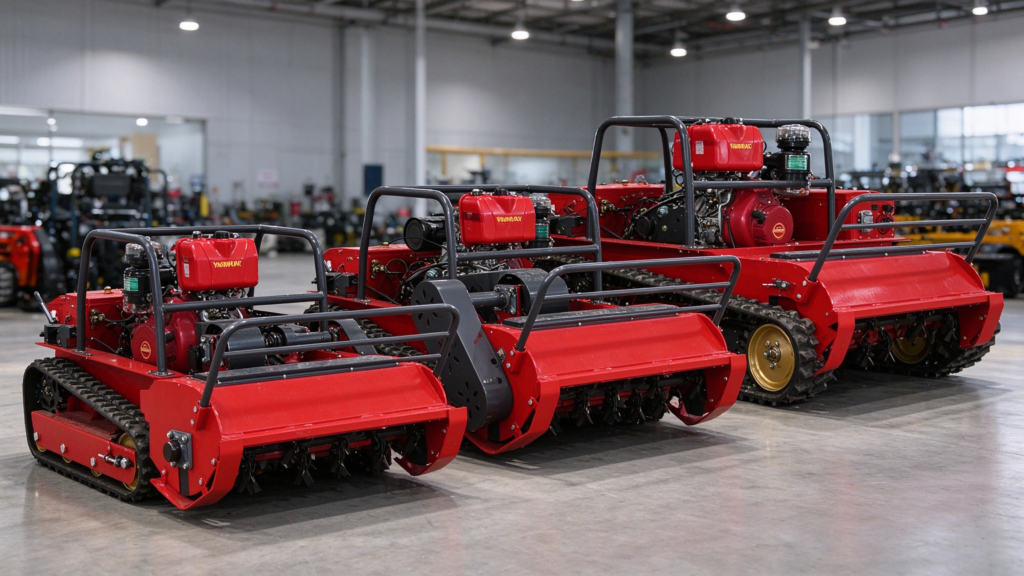
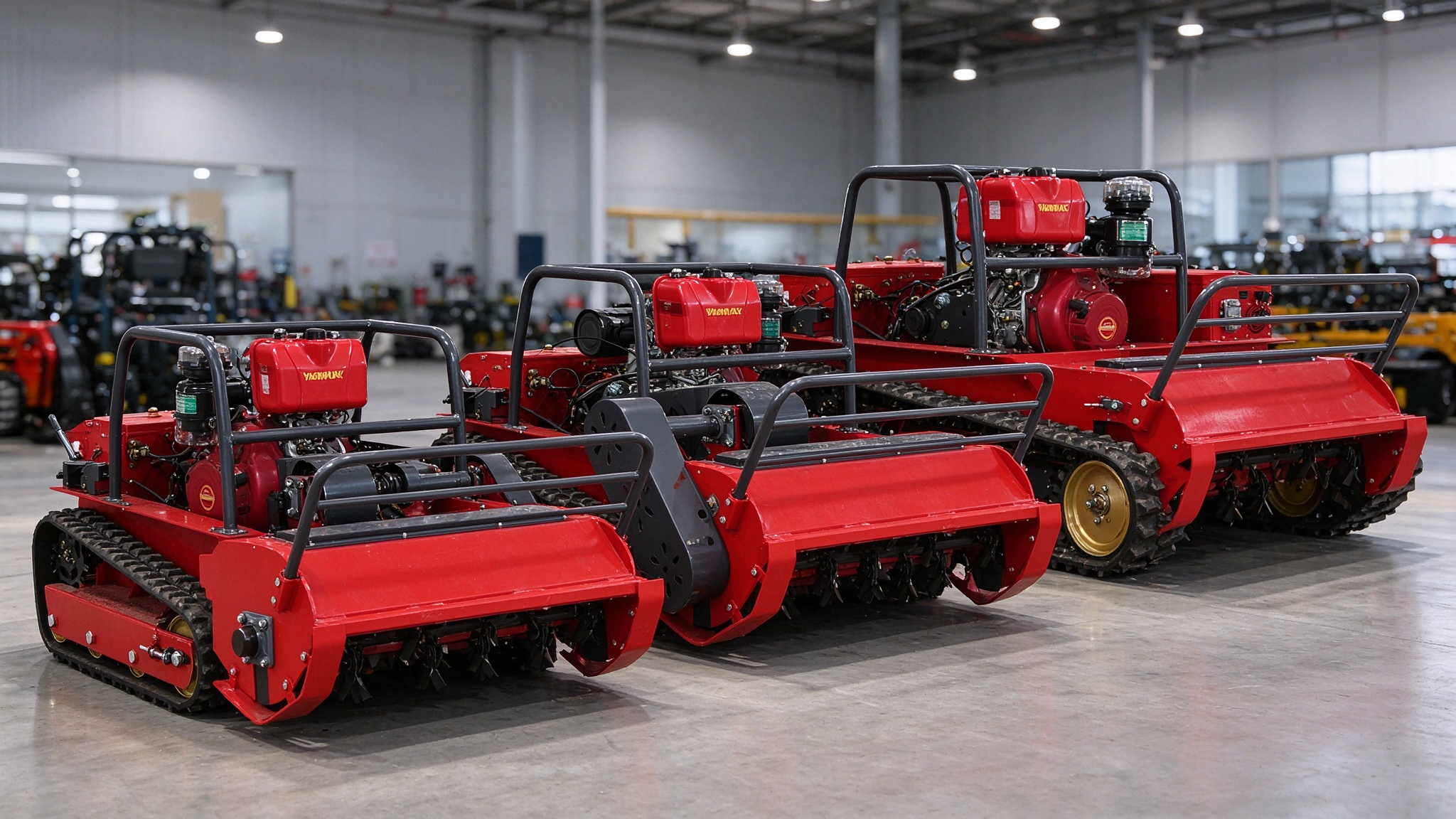
AWY offers different tracked remote control lawn mower configurations that can be considered for commercial distribution.
The following specifications are reference information and should be confirmed with AWY before publication in a formal quotation.
AWY-550H
Listed specifications:
- Cutting width: 550 mm
- Engine displacement: 224 cc
- Walking motors: Dual 750 W brushless motors
- Listed remote control range: Up to 500 m
- Cutting height: 20–150 mm
- Advertised maximum gradeability: Up to 45°
The compact configuration may be suitable for dealers targeting customers who require equipment for smaller working areas and selected difficult-access locations.
AWY-800S
Listed specifications:
- Cutting width: 800 mm
- Machine weight: Approximately 360 kg
- Listed mowing capacity: Approximately 1,500 m²/h
- Engine options: 459 cc gasoline or diesel configurations
- Walking motor: 850 W brushless motor
- Listed remote control range: Up to 500 m
- Advertised maximum gradeability: Up to 55°
The AWY-800S provides a wider cutting configuration for customers managing larger vegetation maintenance areas.
AWY-900
Listed specifications:
- Cutting width: 900 mm
- Listed mowing capacity: Approximately 2,000 m²/h
- Engine options: LONCIN 452 cc, 608 cc, or 764 cc
- Walking motors: Dual 1,500 W brushless motors
- Cutting height: 20–200 mm
- Travel speed: 0–6 km/h
- Fuel tank: 6 L
- Advertised maximum gradeability: Up to 55°
The AWY-900 can be considered for dealers targeting professional contractors and customers who require a wider cutting deck and higher-capacity configuration.
Actual productivity depends on vegetation, terrain, operating speed, cutting conditions, and operator experience.
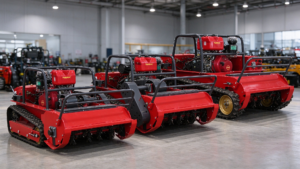
AWY Remote Control Lawn Mower Range
8. How Dealers Can Build a Remote Control Mower Product Line
A successful dealer should avoid offering only a machine.
Instead, build a complete product solution.
Basic Package
The basic package can include:
- Remote control mower
- Remote controller
- Standard cutting system
- Standard tools
- User documentation
Professional Package
A professional package may include:
- Additional cutting components
- Spare track components
- Maintenance parts
- Additional remote batteries
- Recommended service kit
Fleet Package
For larger customers, dealers can offer:
- Multiple machines
- Spare parts package
- Operator training
- Maintenance support
- Delivery arrangements
- Technical assistance
The exact package should be based on the manufacturer’s available configurations.
9. How to Market Remote Control Lawn Mowers Locally
Dealers should focus marketing on customer problems rather than only technical specifications.
9.1 Target Professional Customers
Instead of targeting general consumers, dealers can focus on:
- Landscaping contractors
- Municipal maintenance companies
- Construction companies
- Agricultural contractors
- Property maintenance companies
- Infrastructure contractors
9.2 Use Application-Based Marketing
Marketing content should demonstrate where the equipment can be used.
Examples include:
Slope Maintenance
Show the machine operating on a suitable grass-covered slope.
Construction Site Maintenance
Show vegetation control around an industrial or construction property.
Roadside Maintenance
Show professional vegetation management along an appropriate roadside work zone.
Orchard Maintenance
Show the machine working between suitable orchard rows.
Application-based content helps potential customers understand the equipment’s practical value.
9.3 Demonstration Videos
Specialized equipment is often easier to sell when customers can see it operating.
Dealers can create videos showing:
- Remote control operation
- Steering
- Track movement
- Cutting performance
- Terrain handling
- Loading and transportation
- Routine maintenance
Avoid making unsupported claims about maximum slope performance or productivity.
10. Why Product Demonstrations Matter for Dealers
Remote control lawn mowers are not always products that customers purchase without research.
A demonstration can help customers understand:
- Machine size
- Remote control response
- Cutting system
- Track movement
- Operating workflow
- Noise level
- Transport requirements
For dealers, one demonstration machine can become a sales tool.
A dealer can invite several contractors to evaluate the machine instead of sending individual customers directly to the manufacturer.
This can also help the dealer build local expertise around the product category.
11. Spare Parts and After-Sales Support
After-sales service can determine whether a distributor builds long-term customer relationships.
Recommended Spare Parts Inventory
Dealers may consider stocking frequently needed components such as:
- Cutting blades
- Belts
- Filters
- Track components
- Bearings
- Remote control batteries
- Electrical components
- Common engine service parts
The exact inventory should be determined using manufacturer recommendations and local customer demand.
Warranty Handling
Before becoming a distributor, understand:
- Warranty duration
- Covered components
- Excluded damage
- Claim procedures
- Required evidence
- Replacement part process
- Labor responsibility
Clear warranty procedures reduce misunderstandings between the dealer, manufacturer, and end customer.
12. How Dealers Can Reduce Inventory Risk
One of the biggest challenges for specialized equipment distributors is inventory management.
A practical strategy is to separate inventory into three levels.
Level 1: Demonstration Unit
Keep one machine for:
- Customer demonstrations
- Local exhibitions
- Video production
- Dealer training
Level 2: Fast-Moving Models
Stock models that have already demonstrated local demand.
Level 3: Special-Order Models
For less common configurations, accept customer orders before importing inventory.
This approach can reduce the amount of capital tied up in slow-moving equipment.
13. Dealer Training and Product Knowledge
A dealer’s sales team should understand the machine before selling it.
Training should cover:
Product Features
Sales staff should understand the main specifications and differences between models.
Application Limits
Sales teams should know where the machine can and cannot be recommended.
Remote Control System
Staff should understand normal operation and basic troubleshooting.
Maintenance
Dealers should know routine inspection requirements.
Customer Qualification
Salespeople should ask customers:
- What type of vegetation are you cutting?
- How large is the working area?
- Is the terrain flat or sloped?
- What is the approximate slope condition?
- How frequently will the machine be used?
- How will the machine be transported?
- How many machines are required?
This information helps prevent unsuitable recommendations.
14. Questions Dealers Should Ask Before Signing a Distribution Agreement
Before committing to a supplier relationship, ask:
- What is the wholesale price structure?
- Is there a minimum order quantity?
- Are demonstration units available?
- Are dealer discounts available for larger orders?
- What models are available?
- Can products be customized?
- What spare parts are available?
- How are warranty claims handled?
- What technical training is provided?
- Can marketing materials be supplied?
- What is the normal production lead time?
- What export markets does the manufacturer already serve?
- Can the supplier support local dealer marketing?
- Are territory or exclusivity arrangements available?
- What are the payment and shipping terms?
15. Private Label and Customization Opportunities
Some distributors may prefer to develop their own brand.
Depending on the manufacturer’s capabilities, customization may include:
- Product color
- Branding
- Packaging
- Labels
- Product configuration
- Accessories
- Documentation
However, customization requirements should be discussed before placing an order.
Dealers should confirm minimum quantities, additional costs, production lead times, and applicable regulatory requirements.
16. Remote Control Lawn Mower Wholesale Buying Checklist
Before placing a wholesale order, use the following checklist.
Product
-
Model confirmed
-
Cutting width confirmed
-
Engine configuration confirmed
-
Cutting system confirmed
-
Remote control specification confirmed
-
Machine dimensions confirmed
-
Operating weight confirmed
Commercial
-
Unit price confirmed
-
MOQ confirmed
-
Payment terms confirmed
-
Production lead time confirmed
-
Shipping terms confirmed
-
Warranty confirmed
After-Sales
-
Spare parts list received
-
Maintenance documentation received
-
Warranty process confirmed
-
Technical support process confirmed
-
Recommended spare parts package confirmed
Marketing
-
Product photographs available
-
Technical specifications available
-
Product videos available
-
User manual available
-
Marketing materials available
17. Frequently Asked Questions
Q1: Can I become a remote control lawn mower distributor?
Yes. Equipment dealers and distributors can contact manufacturers to discuss wholesale purchasing, dealer cooperation, or distribution opportunities.
Q2: What type of company is suitable for selling remote control lawn mowers?
Landscaping equipment dealers, agricultural machinery dealers, construction equipment distributors, municipal equipment suppliers, and commercial machinery distributors may all find potential applications.
Q3: What is the minimum order quantity?
MOQ depends on the manufacturer, model, configuration, and cooperation arrangement. Contact AWY for current wholesale requirements.
Q4: Can I buy one machine for testing?
A demonstration or trial order may be possible depending on the commercial arrangement. Ask the manufacturer about available purchasing options.
Q5: Can I sell AWY machines under my own brand?
Private-label or customized arrangements depend on order quantity, configuration, branding requirements, and production conditions. Discuss the requirements with AWY before ordering.
Q6: Does AWY provide spare parts?
Spare parts availability depends on the model and component. Dealers should request a recommended spare parts list before placing a wholesale order.
Q7: Can AWY provide product photos and marketing materials?
Dealers can ask the AWY sales team which product photographs, technical information, videos, and marketing materials are available for commercial use.
Q8: Can I become an exclusive distributor?
Territory exclusivity depends on market conditions, order volume, cooperation terms, and agreement between the distributor and manufacturer. It should be discussed directly with AWY.
Q9: How should I choose which model to stock?
Start with the customer applications you expect to serve. Compare cutting width, machine size, terrain requirements, transport conditions, and expected demand before selecting inventory.
Q10: What information should I include in a wholesale inquiry?
Provide your company profile, target market, estimated annual purchase quantity, preferred models, intended applications, destination country, and whether you require dealer, wholesale, or private-label cooperation.
18. Build a Long-Term Remote Control Mower Distribution Business with AWY
Selling specialized equipment requires more than finding a low-cost supplier.
Dealers need reliable products, clear specifications, spare parts, technical support, and consistent communication.
For this reason, the manufacturer should be evaluated as a long-term business partner rather than simply a product source.
AWY provides different tracked remote control lawn mower configurations for commercial vegetation management applications.
If you are an equipment dealer, distributor, wholesaler, landscaping machinery supplier, or construction equipment company looking to expand your product portfolio, you can contact AWY to discuss available models and cooperation options.
When contacting AWY, provide:
- Company name
- Country or target market
- Current product categories
- Distribution channels
- Estimated annual purchase volume
- Preferred mower models
- Intended customer groups
- Spare parts requirements
- Private-label requirements, if applicable
Visit AWY: https://awymachine.com