
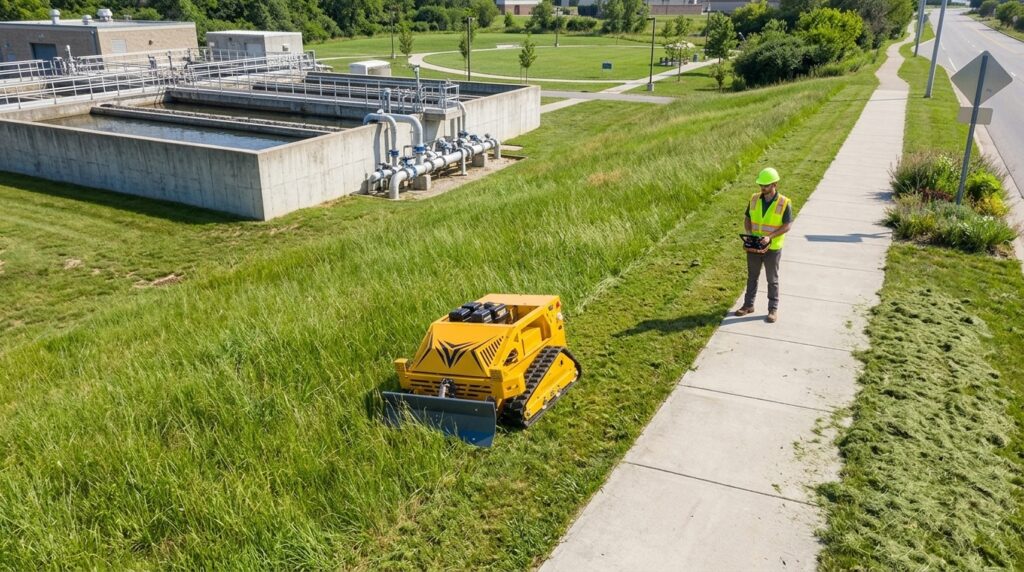
1. Introduction: The Growing Need for Efficient Government Vegetation Management
Government contractors are responsible for maintaining a wide range of public and infrastructure-related areas. These projects may include roadside green spaces, public parks, drainage channels, embankments, utility facilities, vacant public land, and other outdoor environments.
Vegetation management is an ongoing responsibility. Grass, weeds, and unwanted plants continue to grow throughout the year, requiring contractors to organize regular maintenance operations.
For companies working under government contracts, equipment selection affects more than mowing performance. It can also influence labor planning, project scheduling, operating costs, maintenance arrangements, and service quality.
Traditional mowing equipment remains useful for many applications. However, certain maintenance areas may involve steep slopes, uneven ground, restricted access, or locations where keeping an operator directly on the machine is inconvenient.
A remote control lawn mower for government contractors offers an additional equipment option for these working environments.
With remote operation and suitable cutting configurations, this type of machine can support selected vegetation management tasks across municipal, infrastructure, and public facility projects.
For contractors, the key is to select equipment that meets the actual project requirements and can be supported throughout its service life.
2. Common Challenges Faced by Government Maintenance Contractors
Government maintenance projects often involve multiple locations and different types of terrain. Contractors need equipment that can adapt to changing working conditions.
2.1 Large Maintenance Areas
Public land, roadside green belts, utility corridors, and municipal facilities can cover extensive areas.
Contractors may need to maintain several sites according to a fixed schedule.
For these applications, cutting width, mowing capacity, fuel consumption, and transport arrangements are important purchasing considerations.
2.2 Difficult-to-Reach Locations
Some public maintenance areas have limited vehicle access or irregular ground conditions.
Examples include narrow drainage banks, roadside slopes, and grass-covered areas around infrastructure facilities.
A suitable remote control mower may help contractors work in selected locations without requiring the operator to ride directly on the machine.
2.3 Repeated Maintenance Requirements
Government contracts often require recurring vegetation maintenance rather than a single mowing operation.
Contractors must consider equipment durability, routine maintenance, replacement parts, and machine availability.
A mower that is easy to inspect and service may be valuable when planning long-term maintenance operations.
2.4 Different Project Specifications
Not every government contract has the same technical requirements.
One project may focus on roadside vegetation, while another may involve public parks, drainage areas, or industrial infrastructure.
Contractors should avoid choosing a machine based only on price or one advertised specification.
2.5 Documentation and Procurement Requirements
Government-related procurement may involve technical specifications, product documentation, supplier qualifications, warranty conditions, and delivery commitments.
Contractors should prepare these requirements before requesting equipment quotations.
3. Where Government Contractors Can Use Remote Control Lawn Mowers
Remote control lawn mowers can support several types of public maintenance work when the machine configuration matches the site conditions.
3.1 Municipal Green Space Maintenance
<AsyncImage query=”tracked remote control lawn mower mowing large municipal public green space professional grounds maintenance photorealistic” aspectRatio=”16:9″ width=”100%”/>
Municipal green spaces require regular mowing to maintain appearance and accessibility.
Remote control mowing equipment may be considered for selected grass-covered areas that are difficult to maintain with larger conventional equipment.
Typical applications:
- Public green belts
- Municipal facility surroundings
- Grass-covered open spaces
- Selected landscaped slopes
- Public property boundaries
Remote Control Lawn Mower for Municipal Parks
3.2 Roadside and Highway Vegetation Maintenance
Roadside maintenance contractors often need to manage grass and weeds along road shoulders, embankments, and selected infrastructure boundaries.
A remote control mower may be useful for suitable grass-covered areas where direct operator access is inconvenient.
Typical applications:
- Roadside grass maintenance
- Highway embankments
- Road boundary vegetation
- Selected drainage slopes
- Infrastructure access areas
Contractors must establish appropriate traffic management, work-zone protection, and exclusion zones before operating near public roads.
Remote Control Lawn Mower for Roadside Vegetation Management
3.3 Drainage Channels and Water Management Facilities
<AsyncImage query=”remote control tracked lawn mower maintaining grassy drainage channel embankment water management facility photorealistic” aspectRatio=”16:9″ width=”100%”/>
Drainage channels and water management facilities may have grass-covered banks and uneven ground.
These areas can require regular vegetation control to maintain access for inspection and maintenance.
Before using machinery, contractors should assess soil stability, water proximity, erosion risks, and any environmental restrictions.
Typical applications:
- Drainage channel banks
- Stormwater facilities
- Water management property boundaries
- Grass-covered embankments
- Selected flood-control infrastructure areas
Remote Control Lawn Mower for Riverbanks and Embankments
3.4 Public Utility and Infrastructure Facilities
<AsyncImage query=”tracked remote control lawn mower maintaining vegetation around electrical utility infrastructure fenced facility photorealistic commercial photography” aspectRatio=”16:9″ width=”100%”/>
Public utility facilities may contain grass-covered boundaries, access routes, and outdoor maintenance areas.
Contractors should check the facility’s access rules, electrical clearances, underground utilities, and equipment restrictions before deployment.
Typical applications:
- Utility facility surroundings
- Public infrastructure boundaries
- Communication facility grounds
- Industrial public-service sites
- Selected energy facility landscapes
3.5 Vacant Public Land and Development Areas
<AsyncImage query=”remote control crawler lawn mower cutting overgrown grass on vacant public land municipal land management photorealistic” aspectRatio=”16:9″ width=”100%”/>
Vacant public land can develop dense vegetation when maintenance is delayed.
A suitable heavy-duty mower may help contractors manage overgrown grass and maintain access across selected open areas.
The cutting system should be chosen according to the actual vegetation type and density.
4. Why Remote Control Mowers Are Worth Considering for Government Projects
Government contractors need equipment that supports reliable project delivery.
Remote control mowers may offer several practical advantages for suitable applications.
4.1 Remote Operator Positioning
The operator can control the machine from a separate position rather than riding directly on it.
This can be helpful when working in selected difficult-access locations.
Remote operation does not remove the need for operator training, appropriate visibility, safe positioning, and a site-specific risk assessment.
4.2 Tracked Mobility
Crawler tracks may provide useful traction and ground contact on certain uneven surfaces.
For contractors maintaining selected slopes and rough terrain, a tracked configuration may be worth evaluating.
Actual performance depends on track design, machine weight, ground conditions, and the manufacturer’s operating limits.
4.3 Different Cutting Width Options
Government contractors may work on both restricted maintenance areas and large open spaces.
Choosing between compact and wider cutting configurations can help match equipment to different project requirements.
4.4 Flexible Project Deployment
A suitably configured machine may be transported between different maintenance locations.
This can be useful for contractors responsible for several public facilities or infrastructure projects.
4.5 Potential Labor and Workflow Benefits
Remote control equipment may help contractors organize work in areas where conventional mowing methods are less convenient.
However, actual labor savings depend on work procedures, terrain, mowing frequency, operator training, and equipment utilization.
Contractors should evaluate productivity using their own project conditions rather than relying only on advertised capacity figures.
5. How to Select a Remote Control Lawn Mower for Government Contracts
Procurement decisions should begin with the contract’s technical and operational requirements.
5.1 Match the Cutting Width to the Project
Cutting width affects the area covered in each pass.
A compact machine may be more practical around restricted spaces, while a wider cutting deck may be more efficient in open grass-covered areas.
Consider:
- Average mowing area
- Width of access routes
- Vegetation density
- Required mowing frequency
- Transport limitations
5.2 Evaluate Engine Configuration
Engine configuration influences power, fuel use, servicing requirements, and machine operation.
Ask the manufacturer for:
- Engine brand and model
- Engine displacement
- Available fuel options
- Fuel tank capacity
- Maintenance intervals
- Engine warranty conditions
For projects with specific emissions, noise, or fuel requirements, confirm compliance before purchase.
5.3 Review the Track and Drive System
For tracked remote control mowers, examine the crawler system and walking motors.
Important details include:
- Track dimensions
- Track material
- Track tension adjustment
- Walking motor configuration
- Replacement part availability
- Inspection and service access
5.4 Confirm Remote Control Functions
The remote control system should be evaluated as part of the complete machine.
Confirm:
- Operating range under specified test conditions
- Forward and reverse control
- Steering response
- Cutting system control
- Emergency-stop function
- Battery type and charging requirements
- Signal interruption behavior
The maximum advertised control distance should not be treated as a guaranteed distance in every environment.
5.5 Check Cutting Height Adjustment
Different public maintenance projects may require different grass heights.
Adjustable cutting height can help contractors adapt to different vegetation conditions.
Confirm the adjustment method, available range, and whether adjustment can be performed remotely.
5.6 Evaluate Machine Weight and Transport
Government contractors may move machines between municipal districts or project locations.
Confirm the machine’s operating weight, external dimensions, loading method, and trailer compatibility.
6. AWY Remote Control Lawn Mower Models for Commercial Procurement
AWY provides different tracked remote control mower configurations for commercial vegetation management.
The following models may be considered when preparing a government contractor equipment shortlist.
The specifications below are reference figures from previously listed model information. Always request the latest technical datasheet before submitting a formal tender or quotation.
AWY-550H: Compact Configuration
Listed specifications:
- Cutting width: 550 mm
- Engine displacement: 224 cc
- Walking motors: Dual 750 W brushless motors
- Listed remote control range: Up to 500 m
- Cutting height: 20–150 mm
- Advertised maximum gradeability: Up to 45°
Potential applications:
- Smaller public maintenance areas
- Restricted access locations
- Selected landscaped slopes
- Municipal property boundaries
AWY-800S: Medium-to-Large Cutting Configuration
Listed specifications:
- Cutting width: 800 mm
- Machine weight: Approximately 360 kg
- Listed mowing capacity: Approximately 1,500 m²/h
- Engine options: 499 cc gasoline or diesel configurations
- Walking motor: 850 W brushless motor
- Listed remote control range: Up to 500 m
- Advertised maximum gradeability: Up to 55°
Potential applications:
- Larger municipal green spaces
- Public infrastructure boundaries
- Selected roadside maintenance areas
- Commercial vegetation management projects
AWY-900: Higher-Capacity Configuration
Listed specifications:
- Cutting width: 900 mm
- Listed mowing capacity: Approximately 2,000 m²/h
- Engine options: LONCIN 452 cc, 608 cc, or 764 cc
- Walking motors: Dual 1,500 W brushless motors
- Cutting height: 20–200 mm
- Travel speed: 0–6 km/h
- Fuel tank: 6 L
- Advertised maximum gradeability: Up to 55°
Potential applications:
- Large public maintenance areas
- Extensive grass-covered infrastructure boundaries
- Commercial contractor fleets
- Projects requiring a wider cutting deck
Technical note: Advertised maximum gradeability is not a universal safe operating limit. Slope suitability depends on ground conditions, moisture, direction of travel, machine configuration, and manufacturer instructions. Actual mowing capacity also varies with vegetation and terrain.
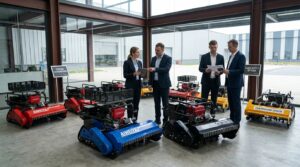
AWY Remote Control Lawn Mower Product Range
7. Government Contractor Procurement Checklist
Before purchasing equipment for a government-related project, contractors should prepare a procurement checklist.
7.1 Technical Documentation
Request:
- Product specification sheet
- Machine dimensions and operating weight
- Engine information
- Cutting system details
- Remote control specifications
- Maintenance instructions
- Operating manual
- Available product certificates and test documents
Only submit documents that are applicable to the actual product and jurisdiction.
7.2 Commercial Quotation
A complete quotation should clearly state:
- Model and configuration
- Unit price
- Included accessories
- Optional equipment
- Spare parts package
- Warranty terms
- Production lead time
- Shipping method
- Payment terms
- Quotation validity
7.3 Supplier Evaluation
Government contractors may need to evaluate multiple suppliers.
Consider:
- Manufacturing experience
- Product consistency
- Quality control procedures
- Export experience
- Technical communication
- Spare parts availability
- After-sales support
- Delivery reliability
7.4 Compliance Verification
Government contracts may specify particular safety, environmental, noise, emissions, or procurement requirements.
Do not assume that a product meets a particular standard based only on its general description.
Ask the supplier to identify the documents available for the exact model and configuration. Have the contracting authority or qualified compliance professional verify whether those documents satisfy the tender requirements.
8. How to Estimate the Total Cost of Ownership
The purchase price is only one part of the equipment investment.
For long-term government maintenance contracts, total ownership cost is an important comparison factor.
8.1 Initial Purchase Price
Compare the complete machine configuration rather than comparing headline prices alone.
A quotation should clearly identify what is included and which components are optional.
8.2 Fuel and Routine Operating Expenses
Estimate fuel consumption based on actual workload, engine configuration, mowing conditions, and operating hours.
Avoid using an assumed fuel consumption figure unless it has been confirmed by the manufacturer or measured under representative conditions.
8.3 Maintenance and Spare Parts
Ask about:
- Engine servicing
- Track replacement
- Cutting component replacement
- Belt inspection
- Electrical system maintenance
- Remote controller maintenance
- Availability of common spare parts
8.4 Transportation
If the contractor works across several districts or locations, include loading, unloading, trailer, and transportation expenses.
8.5 Annual Utilization
Estimate the number of working days and hours per year.
Equipment used across several contracts may offer a different investment profile from equipment dedicated to a single project.
A useful calculation is:
Total Annual Operating Cost = Fuel + Maintenance + Spare Parts + Transport + Labor + Other Operating Expenses
Compare the result with the existing vegetation management arrangement to evaluate potential financial benefits.
9. Operational Safety for Public Maintenance Projects
Government contractors often work in environments where pedestrians, vehicles, public facilities, and other workers may be nearby.
A safe operating procedure is essential.
9.1 Inspect the Work Area
Before mowing, identify:
- Pedestrian access
- Vehicle movement
- Underground utilities
- Electrical infrastructure
- Rocks and debris
- Drainage openings
- Unstable slopes
- Hidden obstacles
9.2 Establish a Controlled Work Zone
Use barriers, warning signs, traffic management measures, and exclusion zones where required.
Keep unauthorized people away from the machine and cutting area.
9.3 Train Operators
Operators should receive training on:
- Remote control functions
- Starting and stopping procedures
- Emergency-stop operation
- Terrain limitations
- Pre-operation inspections
- Maintenance requirements
9.4 Follow Manufacturer Instructions
Do not operate the mower beyond its approved conditions.
Pay particular attention to slopes, wet ground, unstable surfaces, and areas close to water or public infrastructure.
9.5 Maintain Equipment Records
For contractors managing public projects, equipment inspection and service records can help organize maintenance responsibilities.
Record operating hours, service dates, component replacements, inspection results, and any operational issues.
10. Remote Control Mower vs Traditional Mowing Equipment for Public Projects
Both equipment categories can be useful in government maintenance programs.
The right choice depends on the project rather than the equipment category alone.
| Evaluation Factor | Traditional Mowing Equipment | Remote Control Mower |
|---|---|---|
| Large flat grass areas | Often suitable | Suitable when justified by workflow |
| Selected steep slopes | Depends on equipment design | Some models are designed for selected slope applications |
| Operator position | Usually rides or walks with machine | Operator controls machine remotely |
| Restricted access | Depends on machine dimensions | Compact configurations may be useful |
| Uneven ground | Depends on tires and chassis | Tracked models may offer advantages in suitable conditions |
| Routine servicing | Varies by model | Includes engine, tracks, drive, and remote control system |
| Procurement planning | Established equipment category | Additional specialized equipment option |
A remote control mower should be considered part of a broader maintenance fleet. It does not need to replace every conventional mower.
11. Questions Government Contractors Should Ask Their Equipment Supplier
Before placing an order, contractors should ask clear technical and commercial questions.
- What cutting widths are available?
- Which engine configurations can be supplied?
- What terrain is the machine designed to handle?
- What is the machine’s operating weight?
- What remote control functions are included?
- What is the emergency-stop arrangement?
- Which spare parts are recommended for regular maintenance?
- What technical documentation is available?
- What warranty terms apply?
- What is the estimated production and delivery schedule?
- Can the supplier provide configuration recommendations for a specific project?
- Are dealer or bulk purchasing arrangements available?
Remote Control Lawn Mower Buying Guide
12. Frequently Asked Questions
Q1: Can government contractors use remote control lawn mowers for municipal maintenance?
Yes. Depending on the project requirements, they may be used for selected public green spaces, roadside vegetation, drainage areas, embankments, and infrastructure boundaries.
Q2: Are remote control lawn mowers suitable for large public maintenance contracts?
They may be suitable for specific parts of large contracts. Contractors should assess the working area, machine capacity, transport requirements, and expected utilization before purchasing.
Q3: Can a tracked remote control mower operate on slopes?
Some models are designed for selected sloped applications. Actual operating limits depend on the machine, terrain, surface condition, and manufacturer instructions.
Q4: What documents should I request from the manufacturer?
Request the technical datasheet, operating manual, maintenance information, warranty terms, and applicable product certificates or test documents.
Q5: Can I purchase several machines for a government maintenance fleet?
Bulk purchasing depends on supplier capacity, model availability, commercial terms, and delivery arrangements. Contact the manufacturer for a project-specific quotation.
Q6: How do I select the correct cutting width?
Consider the size of the working area, access width, vegetation density, required mowing frequency, and transportation limitations.
Q7: Does remote operation eliminate the need for safety procedures?
No. Operators still need training, safe positioning, exclusion zones, pre-operation inspections, and compliance with manufacturer instructions.
Q8: Can AWY provide recommendations for a specific government project?
You can send AWY the project application, terrain information, approximate mowing area, preferred configuration, and purchase quantity to request a suitable model recommendation.
13. Request an AWY Remote Control Lawn Mower Quotation
Government maintenance contractors need equipment that matches their project specifications, operational requirements, and procurement plans.
AWY offers different tracked remote control lawn mower configurations for commercial vegetation management applications.
Whether your company maintains municipal green spaces, roadside areas, drainage facilities, or public infrastructure boundaries, our team can help you evaluate available machine options.
Contact AWY with the following information:
- Company name
- Country or region
- Project type
- Intended mowing application
- Terrain conditions
- Approximate maintenance area
- Required cutting width
- Preferred engine configuration
- Estimated purchase quantity
- Technical or documentation requirements
Visit AWY: https://awymachine.com/