1. Introduction: The Challenges of Professional Riverbank and Embankment Maintenance
Riverbanks, drainage channels, flood-control embankments and water management facilities require regular vegetation maintenance. Grass, weeds, brush and other unwanted vegetation can grow rapidly, especially during warm and rainy seasons.
For municipal maintenance departments and professional contractors, keeping these areas under control is not simply a landscaping task. It is an ongoing operational responsibility involving labor planning, equipment selection, site accessibility and worker safety.
Traditional walk-behind mowers and ride-on machines can be difficult to use on steep, uneven or narrow embankments. In some locations, operators may need to work close to water, loose soil, drainage structures or other site hazards.
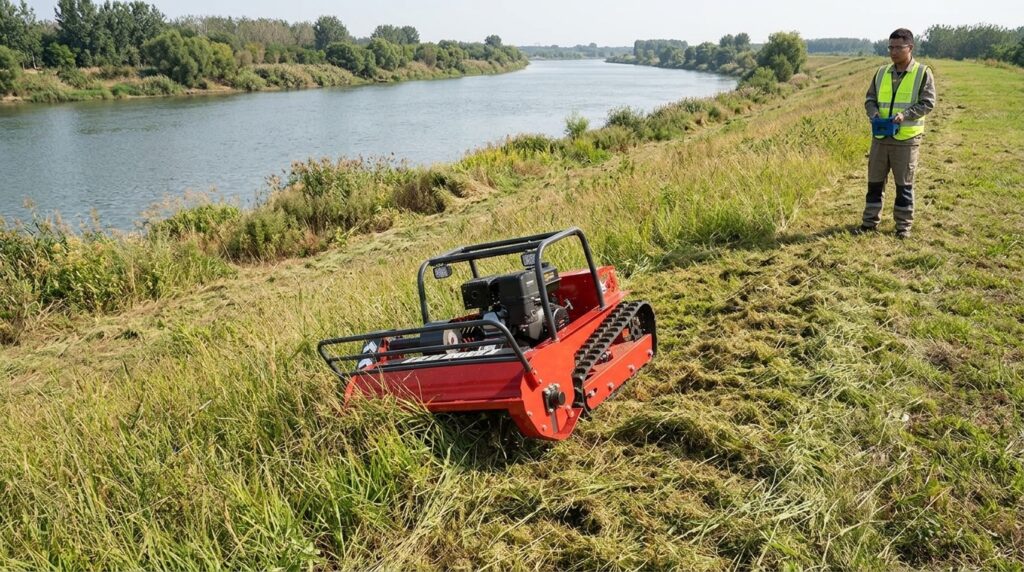
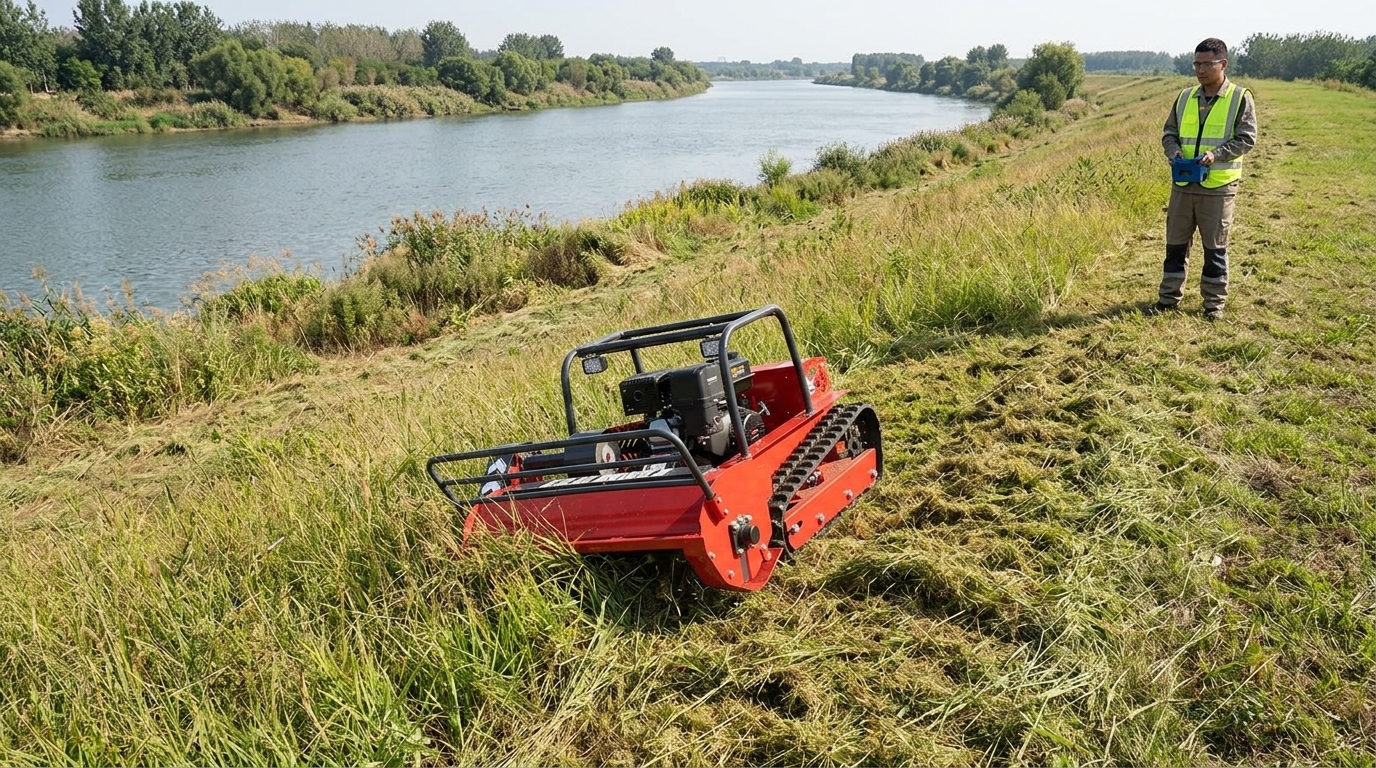
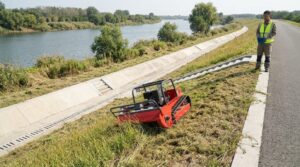
A remote control lawn mower for riverbanks provides an alternative approach. By allowing an operator to control the machine remotely from a more suitable position, this type of equipment can help maintenance teams manage challenging vegetation areas without requiring the operator to ride directly on the slope.
For B2B buyers, the important question is not simply whether a mower can cut grass on a slope. It is whether the equipment matches the site’s terrain, vegetation, working conditions, maintenance schedule and project requirements.
This guide explains how to evaluate remote control mowing equipment for riverbank and embankment maintenance projects.
Remote Control Lawn Mowers for Steep Slopes
2. Why Riverbank Maintenance Requires Specialized Mowing Equipment
Riverbank maintenance environments are different from ordinary lawns, parks and commercial landscapes. The terrain and surrounding conditions can create several operational challenges.
2.1 Steep and Uneven Embankment Surfaces
Many riverbanks are constructed with sloped soil, reinforced concrete, stone protection or mixed surfaces. Their gradients may vary considerably within the same project.
Conventional mowing equipment may have difficulty maintaining traction and stability on these surfaces. A machine designed for relatively flat ground may not be suitable for a steep embankment.
For contractors, evaluating slope conditions before selecting equipment is essential.
2.2 Wet Grass and Changing Ground Conditions
Riverbanks are frequently exposed to moisture, rainwater and irrigation runoff. Grass may become slippery, while the soil underneath can soften after rainfall.
These conditions can affect traction, steering and braking performance.
Maintenance teams should consider:
- Soil type and ground firmness
- Surface moisture and drainage
- Grass density and cutting resistance
- Potential erosion or loose material
- Seasonal changes in site conditions
A mower’s published climbing capability should never be treated as a guarantee that it can safely operate on every wet or unstable slope.
2.3 Restricted Access Along Waterways
Some riverbanks have narrow access paths, limited vehicle entry points or obstacles such as fences, drainage pipes and inspection structures.
Large conventional equipment may be difficult to transport or position in these areas.
Compact remote control mowing equipment can be useful where access is limited, provided that the machine’s dimensions, transport method and working clearance are appropriate.
2.4 Dense Grass and Uncontrolled Vegetation
Riverbank vegetation may include tall grass, weeds and tougher plant growth. Different sites require different cutting approaches.
Before purchasing equipment, contractors should identify whether the project mainly involves:
- Routine grass trimming
- Tall grass reduction
- Dense weed cutting
- Seasonal vegetation control
- Repeated maintenance of established grass areas
The cutting deck and blade configuration should match the vegetation type and the required finish.
3. How Remote Control Lawn Mowers Support Riverbank Contractors
Remote control mowing equipment is designed to let operators control machine movement and mowing functions from a remote position.
For professional riverbank maintenance, this operating method offers several potential advantages.
3.1 Remote Operation from a Suitable Working Position
Instead of riding on the machine, the operator controls it using a remote transmitter.
This can help maintenance teams position the operator away from certain difficult working areas. However, remote operation does not eliminate every hazard. Operators must still maintain visibility, follow the manufacturer’s operating instructions and keep an appropriate exclusion zone.
3.2 Tracked Mobility for Uneven Terrain
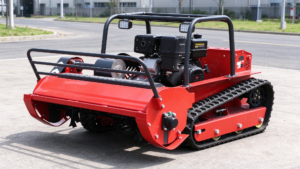
Many remote control slope mowers use crawler tracks instead of conventional wheels.
Tracks provide a larger contact area with the ground and can help distribute machine weight. Depending on the design and site conditions, this may improve traction on uneven terrain.
For riverbank applications, contractors should evaluate:
- Track width and contact length
- Ground clearance
- Track material and durability
- Machine weight
- Turning performance
- Traction on the actual working surface
Tracked equipment is not automatically suitable for every embankment. Soft soil, deep mud, loose stones and steep cross-slopes still require careful assessment.
3.3 Consistent Vegetation Management
A suitable mower can help contractors establish a more consistent mowing process across repeated maintenance cycles.
For projects involving multiple river sections, standardized equipment can simplify operator training, spare-parts management and maintenance scheduling.
3.4 Reduced Dependence on Manual Cutting
Manual brush cutters and handheld tools may still be necessary around structures, narrow corners and obstacles.
However, remote control mowing equipment can handle suitable open sections more efficiently, helping maintenance teams allocate workers to other tasks.
4. Important Applications in Riverbank and Water Management Projects
Remote control lawn mowers can support several types of vegetation management work.
4.1 Natural Riverbanks
Natural riverbanks often contain long grass, weeds and irregular ground surfaces.
A tracked remote control mower may be suitable for maintaining accessible sections where the vegetation and ground conditions match the machine’s operating capabilities.
4.2 Flood-Control Embankments
Flood-control embankments require regular inspection and maintenance.
Uncontrolled vegetation may make it more difficult for maintenance personnel to inspect the surface, access structures and identify visible changes in the embankment.
Mowing programs can help keep designated inspection areas accessible. Contractors should follow the site owner’s vegetation-management requirements and avoid damaging protective surfaces.
4.3 Drainage Channels and Ditches
Drainage channels can accumulate grass and weeds along their banks.
A compact remote control mower may be considered for suitable open sections, especially where traditional mowing equipment has limited access.
The machine must be selected according to ditch width, slope angle, ground firmness and available operating space.
4.4 Reservoir Banks and Water Infrastructure
Reservoir surroundings, water treatment facilities and irrigation infrastructure may include large grass-covered slopes.
For facility managers, the main priorities are often predictable maintenance schedules, manageable equipment requirements and reliable access to service support.
4.5 Irrigation Canals and Agricultural Waterways
Agricultural irrigation channels may require repeated vegetation control throughout the growing season.
Contractors working across multiple sites should consider equipment transportability, fuel or energy requirements, cutting performance and maintenance intervals.
5. How to Select the Right Remote Control Mower for Riverbank Projects
Selecting equipment for a riverbank maintenance contract requires more than comparing engine power or maximum slope ratings.
B2B buyers should evaluate the entire working environment.
5.1 Evaluate the Actual Slope Conditions
Begin by measuring the working slope and identifying the most difficult sections.
Consider:
- Maximum gradient
- Average gradient
- Cross-slope sections
- Surface condition
- Ground firmness
- Wet-weather exposure
- Obstacles and access restrictions
Manufacturers may publish maximum climbing angles under specified test conditions. These figures should be treated as reference specifications, not universal operating limits.
For a procurement decision, request the manufacturer’s operating guidance and verify suitability under representative site conditions.
5.2 Choose a Suitable Cutting Width
Cutting width influences how much vegetation can be covered in each pass.
A wider deck may reduce the number of passes across open areas, but it can also increase machine dimensions and make access more difficult.
| Project Requirement | Equipment Consideration |
|---|---|
| Narrow riverbank paths | Compact machine dimensions |
| Large open embankments | Wider cutting deck |
| Mixed terrain | Balance between width and maneuverability |
| Dense vegetation | Suitable cutting system and power |
| Multiple small sites | Transportability and setup time |
The most suitable cutting width depends on the available working space, vegetation density and required mowing frequency.
5.3 Check the Cutting System
Different vegetation types require different cutting configurations.
A rotary cutting system may be suitable for many routine grass-maintenance tasks. A flail-style cutting system may be considered for certain tougher vegetation applications, depending on the machine design and cutting requirements.
Before ordering, confirm:
- Cutting deck type
- Blade configuration
- Cutting height adjustment
- Suitable vegetation thickness
- Blade replacement procedure
- Availability of replacement components
Do not assume that every mower can safely process thick brush, woody stems or debris.
Remote Control Flail Mower vs Rotary Mower
5.4 Consider Machine Weight and Ground Pressure
Machine weight influences transport, traction and ground interaction.
A heavier machine may provide useful stability in some conditions, but it can also create additional pressure on soft or sensitive surfaces.
Contractors should compare machine weight, track dimensions and the site’s ground-bearing capacity.
5.5 Evaluate Remote Control Range and Visibility
The advertised remote-control range is only one part of the operating system.
Actual control performance can be affected by terrain, obstacles, interference and environmental conditions.
For riverbank projects, buyers should confirm:
- Remote-control range under realistic conditions
- Emergency stop functionality
- Signal-loss response
- Operator visibility
- Control layout and ease of use
- Availability of replacement transmitters
The operator should remain in a position where the machine and surrounding working area can be monitored appropriately.
5.6 Check Engine and Drive Configuration
Engine selection affects operating costs, maintenance planning and the machine’s suitability for different working schedules.
Depending on the model, commercial buyers may compare engine displacement, fuel consumption, cooling design, drive motors and service accessibility.
It is also important to understand whether the machine uses independent drive motors and how the control system manages turning and movement.
6. Example AWY Models for Professional Embankment Maintenance
AWY offers different remote control lawn mower configurations that may be considered for commercial vegetation management projects.
The following models can serve as starting points for equipment evaluation. Final selection should be based on the latest confirmed specifications and actual site conditions.
6.1 AWY-550H: Compact Equipment for Smaller Maintenance Areas
The AWY-550H is a compact option for buyers evaluating remote control mowing equipment for smaller or more restricted working areas.
Listed reference specifications include:
- Cutting width: 550 mm
- Engine: 224 cc gasoline engine
- Walking drive: Dual 750 W brushless motors
- Stated remote-control range: Up to 500 m
- Cutting height: 20–150 mm
- Listed maximum gradeability: Up to 45°
Potential applications include smaller embankment sections, drainage areas and sites where compact machine dimensions are important.
The stated gradeability should not be interpreted as a safe operating guarantee for wet, unstable or cross-sloped riverbanks.
AWY-550H remote control lawn mower
6.2 AWY-800S: A Wider Cutting Configuration for Larger Areas
The AWY-800S provides a wider cutting configuration for contractors who need to maintain larger vegetation areas.
Listed reference specifications include:
- Cutting width: 800 mm
- Machine weight: Approximately 360 kg
- Listed maximum gradeability: Up to 55°
- Stated mowing capacity: Approximately 1,500 m²/h
- Engine options: 459 cc gasoline or diesel configurations
- Walking drive: 850 W brushless motor
- Stated remote-control range: Up to 500 m
This model may be considered for larger embankment sections where the working area allows a wider machine.
Actual output depends on vegetation density, slope conditions, operator experience, turning time and site layout.
AWY-800S tracked remote control mower
6.3 AWY-900: A Higher-Capacity Option for Professional Contractors
The AWY-900 is a larger configuration for buyers evaluating higher-capacity mowing equipment.
Listed reference specifications include:
- Cutting width: 900 mm
- Listed maximum gradeability: Up to 55°
- Stated mowing capacity: Approximately 2,000 m²/h
- Engine options: LONCIN 452 cc, 608 cc or 764 cc configurations
- Walking drive: Two 1,500 W brushless motors
- Remote-adjustable cutting height: 2–20 cm
- Travel speed: 0–6 km/h
- Fuel tank capacity: 6 L
For professional contractors, the wider cutting deck and drive configuration may be relevant when comparing machines for repeated vegetation maintenance.
The final choice should account for transport access, machine weight, terrain, vegetation and maintenance requirements.
AWY-900 commercial remote control lawn mower
Important specification note: All model data above should be checked against the latest AWY product documentation before publication or quotation. Maximum gradeability and stated mowing capacity are manufacturer-listed reference figures, not guaranteed field performance.
7. Procurement Checklist for Municipal Departments and Contractors
For municipal buyers and professional maintenance companies, equipment procurement should consider long-term operating requirements rather than the purchase price alone.
7.1 Define the Maintenance Scope
Before requesting quotations, document the project requirements.
Include:
- Total area to be maintained
- Number of riverbank or drainage sections
- Average and maximum slope
- Vegetation type and average height
- Mowing frequency
- Seasonal working schedule
- Site access and transport conditions
This information helps suppliers recommend a more appropriate machine configuration.
7.2 Request Technical Documentation
Ask suppliers to provide:
- Product specifications
- Machine dimensions and operating weight
- Cutting deck details
- Engine and drive-system information
- Remote-control system specifications
- Safety instructions
- Maintenance schedule
- Spare-parts list
For public-sector projects, the documentation may also need to support internal technical review and tender requirements.
7.3 Evaluate After-Sales Support
A mower used in commercial maintenance may operate regularly throughout the growing season.
Buyers should check whether the supplier can provide:
- Technical assistance
- Replacement cutting components
- Track and drive-system parts
- Remote-control accessories
- Maintenance guidance
- Troubleshooting support
- Warranty information
A reliable parts supply can help reduce unnecessary equipment downtime.
7.4 Consider Total Cost of Ownership
The purchase price is only one part of equipment cost.
A more complete evaluation should include:
| Cost Category | What to Evaluate |
|---|---|
| Initial purchase | Machine price and configuration |
| Transportation | Shipping and delivery costs |
| Operation | Fuel or energy consumption |
| Maintenance | Routine servicing and wear parts |
| Labor | Operator and maintenance staffing |
| Downtime | Availability of parts and technical support |
| Equipment life | Durability and long-term serviceability |
For contractors bidding on recurring maintenance projects, understanding these costs can improve project pricing and equipment utilization.
7.5 Arrange a Practical Demonstration When Possible
A machine demonstration can help buyers evaluate actual performance.
Where practical, test the equipment on representative terrain under controlled conditions.
Observe:
- Starting and stopping
- Remote-control responsiveness
- Turning behavior
- Cutting performance
- Track traction
- Operator visibility
- Access to routine maintenance points
Do not use a demonstration to test beyond the manufacturer’s approved operating limits.
8. Safety Considerations for Riverbank Mowing Operations
Riverbank maintenance can involve water, slopes, unstable ground and hidden obstacles. Equipment selection must be accompanied by an appropriate operating procedure.
8.1 Inspect the Working Area Before Mowing
Before operation, check for:
- Soft or eroded soil
- Hidden holes
- Exposed roots
- Loose stones
- Waterlogged sections
- Debris and discarded materials
- Pipes, cables and drainage structures
Mark restricted areas and remove obstacles where appropriate.
8.2 Avoid Unverified Slope Conditions
Do not rely solely on the maximum slope figure shown in a product brochure.
A slope’s suitability depends on several factors, including surface material, moisture, machine orientation, cross-slope exposure and operating conditions.
Follow the manufacturer’s instructions and conduct a site-specific risk assessment.
8.3 Maintain a Safe Distance from Water
Keep the mower and operator away from unstable edges and hazardous water-side areas.
The site plan should identify safe operating boundaries, access routes and restricted zones.
Where the ground is unstable or the machine could slide toward water, do not operate until the risk has been assessed and suitable controls are in place.
8.4 Keep the Operator in a Suitable Position
The operator should maintain adequate visibility of the mower and its working environment.
Avoid operating from unstable ground or positions where the operator may be exposed to falling, slipping or other site hazards.
8.5 Follow Safe Maintenance Procedures
Before inspecting or servicing the cutting deck:
- Stop the machine.
- Shut down the engine or power system.
- Isolate the starting system as specified by the manufacturer.
- Wait for all moving parts to stop.
- Follow the approved maintenance procedure.
- Use appropriate protective equipment.
Never inspect or handle cutting components while the machine is running.
9. How Contractors Can Improve Riverbank Mowing Efficiency
Equipment performance is only one factor in project productivity. Work planning and maintenance organization also matter.
9.1 Divide Large Projects into Manageable Sections
For long riverbank projects, divide the work area into clearly defined sections.
This helps supervisors assign equipment, monitor progress and schedule repeat maintenance.
9.2 Match Equipment to Each Site
A single machine configuration may not be ideal for every riverbank.
A compact model may be better suited to restricted access, while a wider machine may be more appropriate for open sections.
Contractors managing multiple projects should compare the benefits of using different machine configurations.
9.3 Plan Around Seasonal Vegetation Growth
Grass and weeds often grow faster during warm and wet periods.
A planned mowing schedule can help prevent vegetation from becoming excessively dense and difficult to manage.
Maintenance frequency should be based on local climate, vegetation type, project requirements and environmental restrictions.
9.4 Establish Routine Equipment Inspections
A practical inspection schedule can help identify wear before it leads to unexpected downtime.
Important inspection areas include:
- Track condition and tension
- Cutting blades and deck
- Engine oil and filters
- Cooling system
- Remote-control transmitter
- Electrical connections
- Fasteners and protective components
9.5 Train Operators Consistently
For companies using multiple machines or operating across several sites, consistent operator training is important.
Training should cover machine controls, emergency procedures, terrain assessment, daily inspection and safe operating boundaries.
Remote Control Lawn Mower for Rental Businesses
10. Why B2B Buyers Should Work with an Experienced Manufacturer
For contractors, distributors and equipment rental companies, choosing a manufacturer involves more than selecting a model.
A suitable manufacturing partner should understand the requirements of professional equipment buyers.
10.1 Product Configuration Support
Different projects may require different cutting widths, engine configurations, drive systems and optional equipment.
A manufacturer that can explain configuration differences helps buyers make more informed purchasing decisions.
10.2 Technical Information for Commercial Projects
Dealers and contractors may need product specifications, operating instructions, photographs and technical documentation to support quotations and customer communication.
Clear documentation can simplify the purchasing process.
10.3 Spare Parts and Maintenance Support
Remote control mowing equipment contains mechanical, electrical and cutting components that require periodic inspection and replacement.
Before placing a bulk order, buyers should discuss spare-parts availability and after-sales procedures.
10.4 Supply Planning for Dealers and Distributors
Distributors may need to plan inventory according to seasonal demand and local market requirements.
Discussing production lead times, packaging, shipping arrangements and product configuration in advance can support more predictable supply planning.
11. Frequently Asked Questions
Q1: Can a remote control lawn mower be used for riverbank maintenance?
Yes, suitable remote control lawn mowers can be used for certain riverbank and embankment vegetation maintenance tasks. The machine must match the slope, surface condition, vegetation type and access requirements.
Q2: Are tracked remote control mowers suitable for embankments?
Tracked mowers may offer useful traction characteristics on suitable uneven surfaces. However, their suitability depends on the machine design and actual site conditions. Wet, loose or unstable slopes require additional assessment.
Q3: What cutting width is suitable for riverbank mowing?
There is no universal cutting width. Compact machines may be more practical for narrow access areas, while wider decks may improve coverage on large open embankments.
Q4: Can remote control mowers cut tall grass and weeds?
Many commercial models are designed for grass and certain types of dense vegetation. Buyers should confirm the cutting system’s capabilities and the manufacturer’s recommended vegetation limits before purchasing.
Q5: Is the maximum climbing angle the same as the safe operating angle?
No. A published maximum climbing angle is a manufacturer-listed performance figure under specified conditions. It does not guarantee safe operation on every surface, especially wet, loose or cross-sloped terrain.
Q6: What should contractors check before buying an embankment mower?
Important factors include slope conditions, machine weight, cutting width, track design, cutting system, remote-control functions, maintenance requirements, spare-parts availability and after-sales support.
Q7: Can one mower handle both riverbanks and drainage ditches?
Some machines may be suitable for both applications, but the available width, access conditions, terrain and vegetation must be checked for each site.
Q8: What information should I provide when requesting a quotation?
Provide the approximate working area, slope conditions, vegetation type, required cutting width, expected working frequency, destination country and any special project requirements. Photos or videos of the site can also help suppliers understand the application.
12. Conclusion: Choosing the Right Equipment for Long-Term Riverbank Maintenance
Riverbank and embankment vegetation management requires equipment that matches the terrain, vegetation and operational demands of each project.
For municipal departments, drainage companies and professional maintenance contractors, remote control lawn mowers can provide another option for managing suitable sloped and uneven grass areas.
The most effective purchasing decision considers more than maximum climbing angle or cutting width. Buyers should evaluate actual site conditions, remote-control performance, cutting-system suitability, transport requirements, maintenance support and total operating cost.
AWY provides different remote control lawn mower configurations for commercial vegetation management applications.
Looking for a suitable remote control lawn mower for riverbanks, drainage channels or embankment maintenance?
Contact AWY with your project requirements. Our team can help you compare machine configurations and identify equipment options for your commercial application.
Request a Quote from AWY
Website: https://awymachine.com/