
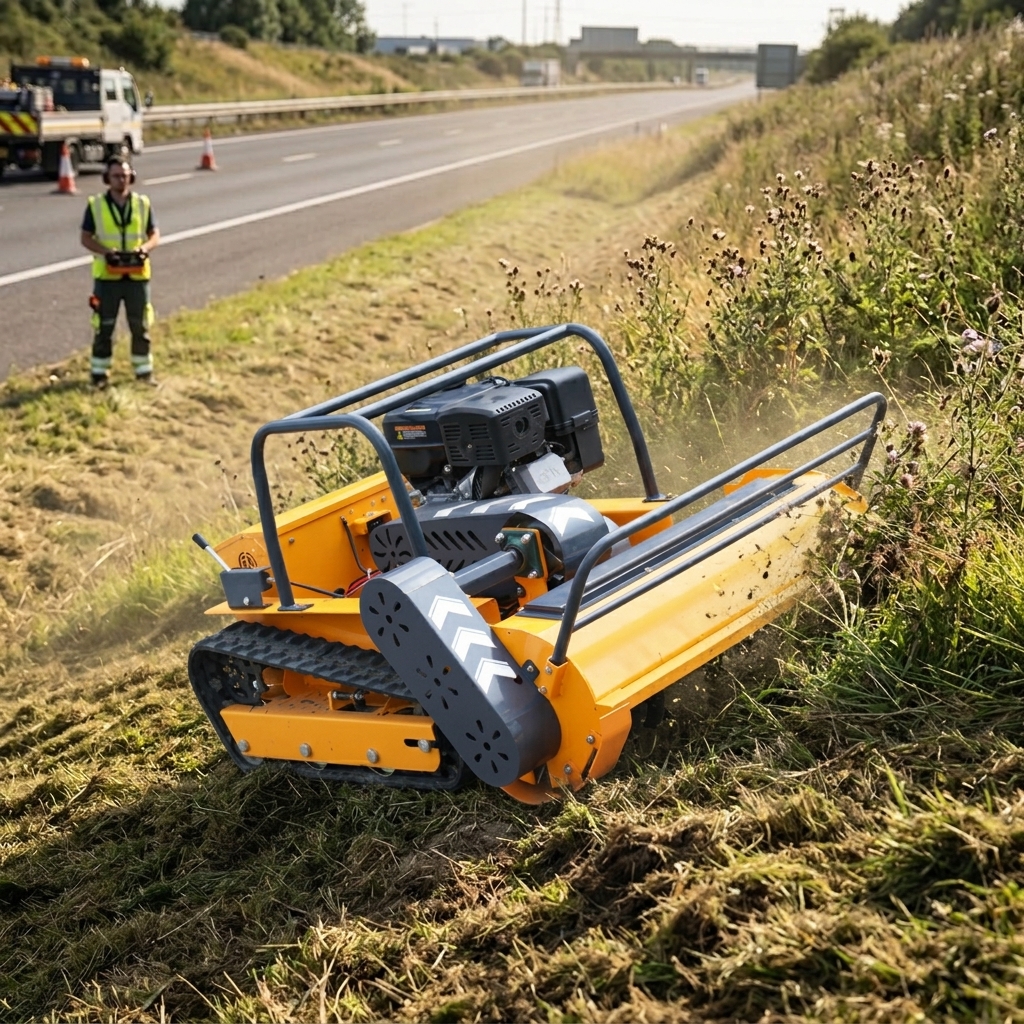
Mowing steep slopes is one of the most challenging vegetation management tasks.
Traditional lawn mowers may be difficult to maneuver on uneven terrain, while riding equipment can create additional operating challenges on steep hillsides, embankments, and rough ground.
This is where a remote control lawn mower for steep slopes can provide an alternative solution.
A remote controlled lawn mower allows the operator to control the machine from a distance instead of riding directly on the mower. Professional crawler models are designed with features such as tracked drive systems, low machine profiles, powerful engines, and specialized cutting systems to handle demanding outdoor environments.
But not every remote control mower is suitable for steep slopes.
The right machine depends on several factors, including:
- Slope angle
- Ground conditions
- Traction
- Machine weight
- Center of gravity
- Cutting system
- Engine power
- Track or wheel configuration
- Remote control system
- Vegetation type
This guide explains what you should consider when choosing a remote control lawn mower for steep slopes.
What Is a Remote Control Slope Mower?
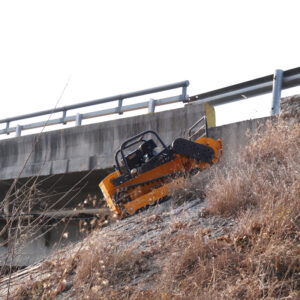
A remote control slope mower is a mowing machine designed to operate on challenging terrain while being controlled remotely by an operator.
Unlike a conventional walk-behind mower, the operator does not need to remain directly behind the cutting deck.
Depending on the model, the remote controller may allow the operator to control:
- Forward movement
- Reverse movement
- Steering
- Cutting operation
- Cutting height
- Machine speed
- Deck lifting
- Emergency stop functions
The exact functions vary by manufacturer and model.
The main purpose is to provide greater flexibility when mowing terrain that is difficult to access with conventional equipment.
For professional applications, remote control mowers can be used on:
- Hillsides
- Embankments
- Riverbanks
- Orchards
- Rough grassland
- Roadsides
- Large properties
- Solar farms
- Municipal vegetation areas
AWY’s product range currently separates mower types according to terrain and vegetation conditions, with crawler models positioned for slopes, rough terrain and embankments.
Why Are Slopes Difficult to Mow?
Before choosing a slope mower, it is important to understand why steep terrain creates additional challenges.
1. Reduced Traction
As the slope becomes steeper, traction becomes increasingly important.
Loose soil, wet grass, mud, gravel, and uneven surfaces can reduce grip.
A mower that performs well on flat grass may not perform the same way on a steep slope.
2. Uneven Ground
Slopes are rarely perfectly smooth.
You may encounter:
- Holes
- Rocks
- Tree roots
- Tall vegetation
- Loose soil
- Ditches
- Ruts
The mower therefore needs to maintain stable ground contact.
3. Machine Stability
Machine design becomes particularly important on slopes.
A low center of gravity and stable drive system can help the machine maintain contact with the ground.
However, buyers should always follow the manufacturer’s operating limits.
4. Operator Position
Operating a mower directly on a steep slope can be physically demanding.
With a remote control mower, the operator can stand at an appropriate location and control the machine from a distance.
This is one of the major reasons professional contractors consider remote-controlled slope mowers.
Crawler vs Wheel Mower for Steep Slopes
One of the first decisions is whether you need a crawler or wheel configuration.
Crawler Remote Control Mower
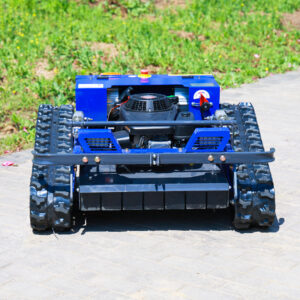
Crawler systems use continuous tracks instead of conventional wheels.
They are commonly selected for:
- Slopes
- Rough terrain
- Embankments
- Uneven ground
- Orchards
- Heavy vegetation
Tracks provide a large contact area with the ground and can be useful when traction and terrain stability are priorities.
AWY currently positions its crawler remote control mower category specifically for slopes, rough terrain, embankments and outdoor vegetation management.
Wheel Remote Control Mower
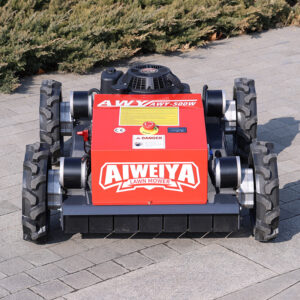
Wheel-based machines can be useful when:
- Terrain is relatively flat
- Ground is firm
- High maneuverability is important
- The application is primarily lawn or field maintenance
For steep or rough terrain, however, a crawler configuration may be more appropriate depending on the specific machine and manufacturer specifications.
Crawler vs Wheel Remote Control Mower
What Is Gradeability?
One of the most important specifications for a slope mower is gradeability.
Gradeability describes the maximum slope that a machine is designed or rated to climb or operate on under specified conditions.
It is often expressed in degrees.
For example, some AWY crawler mower models list a maximum gradeability of 55°. The AWY-800S, AWY-1000S and AWY-1200S product pages currently list 55° gradeability.
However, buyers should not interpret a maximum gradeability number as meaning that every real-world slope at that angle is automatically safe or suitable.
Actual performance can depend on:
- Soil
- Moisture
- Grass condition
- Surface texture
- Direction of travel
- Machine configuration
- Operator control
- Weight distribution
Therefore:
Always follow the manufacturer’s operating instructions and terrain limitations.
Degrees vs Percentage Slope
Slope is sometimes expressed in degrees and sometimes as a percentage.
These measurements are not the same.
For example:
- 10° ≈ 17.6% grade
- 20° ≈ 36.4% grade
- 30° ≈ 57.7% grade
- 45° = 100% grade
This distinction is important when comparing machines from different manufacturers.
If a supplier says a mower can operate on a certain slope, confirm whether the specification is expressed in:
degrees
or
percentage grade.
What Makes a Good Remote Control Mower for Steep Slopes?
Several design features matter when choosing a slope mower.
1. Crawler Track System
Tracks can provide useful traction characteristics on uneven terrain.
For slope applications, look for:
- Durable tracks
- Strong drive motors
- Good ground contact
- Stable chassis
- Appropriate track width
2. Low Center of Gravity
A machine with a suitable center of gravity can provide greater stability on uneven ground.
The overall design matters more than any single component.
Consider:
- Machine height
- Machine width
- Weight distribution
- Engine position
- Cutting deck position
3. Powerful Drive System
The mower needs enough drive capability to move across the intended terrain.
AWY’s current S-Series models use crawler drive systems and brushless travel motors, with different engine configurations depending on the model. For example, the AWY-800S lists an 850W brushless walking motor and gasoline or diesel engine options.
4. Remote Control Range
Remote operation is particularly useful when the operator needs to remain away from the mower.
AWY’s AWY-800S and AWY-800S PRO pages currently list remote control ranges of up to 500 meters.
Actual operating range can vary depending on terrain, obstacles, interference and operating conditions.

Choosing the Right Cutting System for Slopes
Drive performance is only one part of the equation.
You also need to consider the vegetation.
Rotary Cutting System
Rotary cutting systems can be suitable for:
- Regular grass
- Lawn maintenance
- Field grass
- General vegetation
They are commonly used when the main objective is grass cutting.
Flail Cutting System
Flail cutting systems are often considered when vegetation becomes heavier.
Applications can include:
- Tall grass
- Dense weeds
- Rough vegetation
- Shrubs
- Overgrown land
AWY’s current remote control flail mower range is positioned for dense grass, weeds, brush and rough vegetation.
If your slope is covered with thick vegetation, selecting the correct cutting system can be just as important as choosing the drive system.
Engine Power for Slope Mowing
Engine power is another important consideration.
However, higher horsepower does not automatically mean a mower is better.
You should consider the entire machine configuration.
Important factors include:
- Engine output
- Drive motor power
- Cutting width
- Cutting system
- Machine weight
- Terrain
- Vegetation density
For example, AWY’s AWY-800S is offered with either a LONCIN 459CC gasoline engine or KOOP 195 diesel engine, combined with an 850W brushless walking motor.
The best engine configuration depends on your application and market requirements.
Cutting Width vs Slope Maneuverability
A wider cutting deck can increase coverage.
But wider is not always better.
On steep slopes or narrow areas, a smaller mower may be easier to maneuver.
Consider the relationship between:
Cutting Width
Machine Width
Terrain
Working Area
For example, AWY’s current S-Series includes different cutting widths:
- AWY-800S — 80 cm
- AWY-1000S — 100 cm
- AWY-1200S — 120 cm
The AWY-1200S is positioned as a heavy-duty model for larger grass areas, farms, orchards, slopes and professional landscaping.

How to Choose a Remote Control Mower for Different Slopes
Not every slope is the same.
Gentle Slopes
For relatively gentle slopes with good ground conditions, a compact crawler mower may be sufficient.
Important priorities:
- Maneuverability
- Cutting width
- Operating efficiency
- Machine size
Moderate Slopes
For moderate slopes, traction and stability become more important.
Consider:
- Crawler drive
- Ground clearance
- Machine weight
- Engine power
- Track design
Steep Slopes
For steep slopes, you should pay closer attention to:
- Manufacturer-rated gradeability
- Traction
- Center of gravity
- Track system
- Remote control
- Machine stability
- Surface conditions
Do not select a machine based on one specification alone.
Wet Grass and Slopes
Wet conditions can significantly change mowing performance.
Wet grass can reduce traction and make slopes more difficult to navigate.
Before operating on wet slopes, consider:
- Soil condition
- Track traction
- Surface drainage
- Weather
- Visibility
- Vegetation density
If the ground becomes unstable, stop operation and reassess the conditions.
A mower’s maximum gradeability specification should not be treated as permission to operate under every weather condition.
Remote Control Mower Safety on Slopes
Safety should be one of the first considerations when purchasing a slope mower.
Before operation:
Inspect the Terrain
Check for:
- Rocks
- Holes
- Ditches
- Loose soil
- Obstacles
- Unexpected drop-offs
Inspect the Machine
Check:
- Tracks
- Cutting system
- Engine
- Remote controller
- Emergency stop
- Fasteners
- Fluid levels
Maintain a Clear Operating Area
Keep people, animals and unnecessary equipment away from the working area.
Maintain Visual Awareness
The operator should be able to monitor the machine and terrain throughout operation.
Follow Manufacturer Instructions
Always follow the operating limits and safety instructions supplied with the machine.

Remote Control Mower for Hillside Vegetation
Hillsides can have very different vegetation conditions.
A slope may contain:
- Short grass
- Tall grass
- Weeds
- Brush
- Shrubs
- Mixed vegetation
Therefore, choosing the right cutting head is important.
For regular grass, a rotary cutting system may be sufficient.
For dense vegetation, a flail mower may provide a more suitable configuration.
The correct choice depends on the vegetation, terrain and desired mowing result.
Remote Control Mower for Roadside Slopes
Roadside slopes are another important application.
Maintenance teams may need to control vegetation along:
- Highways
- Rural roads
- Municipal roads
- Drainage channels
- Embankments
- Public infrastructure
A remote control mower can allow the operator to control the machine without riding directly on the mowing equipment.
However, roadside applications require additional attention to:
- Traffic
- Pedestrians
- Obstacles
- Visibility
- Working boundaries
- Local regulations
Always establish an appropriate work zone before operating machinery near public roads.
Remote Control Mower for Orchard Slopes
Orchards often combine several challenges:
- Slopes
- Narrow rows
- Tree trunks
- Uneven ground
- Tall grass
- Obstacles
A compact crawler mower can be useful when maneuverability and traction are important.
The machine width should be compared with the orchard row spacing before purchasing.
For example, AWY currently positions the AWY-800S for agricultural orchards as well as slopes and municipal landscaping.
Remote Control Lawn Mower for Orchards
Remote Control Mower for Solar Farm Slopes
Solar farms can also require vegetation control across uneven terrain.
When selecting equipment, consider:
- Panel row spacing
- Ground clearance
- Slope
- Cutting width
- Turning space
- Vegetation type
A mower that is too wide may be difficult to maneuver between equipment.
A mower that is too small may require more passes.
The correct balance depends on the site layout.
What Size Remote Control Mower Should You Choose?
There is no universal best size.
Instead, consider the working area and terrain.
Compact Mower
Best for:
- Narrow areas
- Orchards
- Smaller properties
- Complex terrain
Medium Mower
Best for:
- General commercial mowing
- Farms
- Landscaping
- Moderate working areas
Heavy-Duty Mower
Best for:
- Large fields
- Dense vegetation
- Commercial contractors
- Large properties
- High-volume mowing
AWY’s current range includes models from approximately 550 mm cutting width through 1200 mm cutting width, giving buyers different options depending on application requirements.
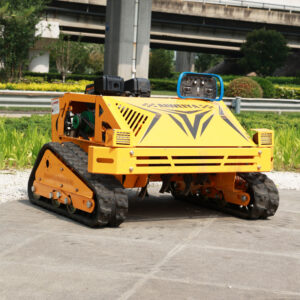
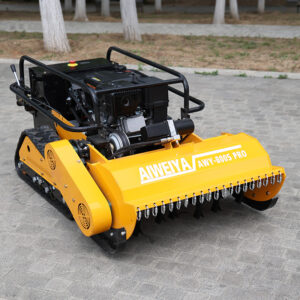
Example: AWY Remote Control Mowers for Slopes
AWY’s current range provides several examples of different configurations.
AWY-550H
The AWY-550H is a compact tracked remote control mower with a 550 mm cutting width, 224cc gasoline engine, up to 500m remote control and up to 45° gradeability. It is positioned for lawns, orchards, wild grassland and challenging slopes.
AWY-800S
The AWY-800S uses an 80 cm cutting width and crawler configuration, with a listed 55° gradeability and 1500 m²/h mowing efficiency. It is positioned for orchards, hillsides, golf courses and embankments.
AWY-1000S
The AWY-1000S combines a 100 cm cutting width with crawler drive and is positioned for lawns, orchards, slopes and larger grassland areas.
AWY-1200S
The AWY-1200S provides a 120 cm cutting width and is positioned as a heavy-duty option for large grass areas, farms, orchards, slopes and professional landscaping projects.
This illustrates an important point:
The best slope mower is not necessarily the biggest mower.
It should be the model that matches your terrain, vegetation and required working capacity.


Key Specifications to Compare
When comparing remote control lawn mowers for steep slopes, create a simple specification checklist.
| Specification | Why It Matters |
|---|---|
| Gradeability | Indicates the manufacturer’s rated slope capability |
| Drive System | Determines traction and terrain suitability |
| Cutting Width | Affects coverage and maneuverability |
| Engine Power | Supports cutting and machine operation |
| Machine Weight | Influences transport and terrain behavior |
| Ground Clearance | Important on uneven terrain |
| Remote Range | Determines operating flexibility |
| Cutting Height | Helps match different vegetation conditions |
| Cutting System | Determines suitable vegetation |
| Spare Parts | Important for long-term operation |
| Warranty | Supports after-sales confidence |
Do not compare machines based on engine horsepower alone.
A complete machine specification provides a much better basis for decision-making.
How Much Does a Remote Control Slope Mower Cost?
The cost depends on the configuration.
Important price factors include:
- Engine
- Cutting width
- Track system
- Cutting system
- Remote control system
- Hydraulic functions
- Machine size
- Optional equipment
- OEM requirements
- Shipping destination
A compact mower and a heavy-duty 120 cm crawler mower should not be expected to have the same price.
For B2B buyers, it is usually better to request a quotation based on the actual application rather than comparing generic online prices.
Remote Control Lawn Mower Buying Guide
Maintenance for Slope Mowers
Operating on slopes can place additional demands on equipment.
Regularly inspect:
Tracks
Check track tension, wear and damage.
Cutting System
Inspect blades, flails, rotor components and protective structures.
Engine
Follow the manufacturer’s maintenance schedule.
Drive System
Check motors, transmission components and related systems.
Remote Controller
Inspect controls, battery condition and communication performance.
Fasteners
Vibration can loosen mechanical components over time.
Regular preventive maintenance can help identify problems before they affect a commercial mowing project.
How to Choose the Best Remote Control Lawn Mower for Steep Slopes
Use this checklist before purchasing:
Step 1: Measure Your Slope
Determine the approximate slope angle.
Step 2: Examine the Ground
Is it:
- Firm?
- Wet?
- Rocky?
- Muddy?
- Uneven?
Step 3: Identify Vegetation
Is it:
- Lawn grass?
- Tall grass?
- Weeds?
- Brush?
- Mixed vegetation?
Step 4: Select the Drive System
For challenging terrain, compare crawler options carefully.
Step 5: Select the Cutting System
Choose rotary or flail based on vegetation.
Step 6: Choose Cutting Width
Balance productivity with maneuverability.
Step 7: Check Gradeability
Compare the manufacturer’s rated specification with your terrain.
Step 8: Evaluate Remote Control
Consider operating range and available functions.
Step 9: Check Service Support
Ask about:
- Spare parts
- Warranty
- Technical support
- Manuals
- Replacement components
Step 10: Request a Configuration Recommendation
Give the manufacturer your:
- Slope
- Vegetation
- Working area
- Terrain
- Quantity
- Destination country
A professional supplier should be able to recommend a suitable configuration.
Frequently Asked Questions
What is the best remote control lawn mower for steep slopes?
The best model depends on slope angle, ground conditions, vegetation, working area and required productivity. Crawler remote control mowers are often considered for challenging slopes because of their tracked drive configuration.
Can a remote control mower mow a 45-degree slope?
Some models are rated for slopes around this range or higher, but the manufacturer’s exact specification must be checked. Actual operating conditions can affect performance significantly.
Are crawler mowers better for slopes?
Crawler mowers can provide useful traction and stability characteristics for uneven terrain, but suitability depends on the complete machine design and terrain conditions.
What cutting system is best for steep slopes?
It depends on the vegetation. Rotary systems may suit regular grass, while flail systems can be considered for tall grass, weeds and denser vegetation.
Are remote control mowers safe on slopes?
Remote operation can allow the operator to control the mower from a distance, but safe operation still depends on machine design, terrain conditions, operator training and compliance with manufacturer instructions.
How wide should a slope mower be?
The ideal cutting width depends on the working area. Wider machines can increase coverage, while narrower machines may provide better maneuverability in confined or complex terrain.
Can remote control mowers work on wet slopes?
Wet conditions can reduce traction and increase operating difficulty. Always evaluate actual ground conditions and follow the manufacturer’s operating limits.
Can remote control mowers be used in orchards?
Yes. Suitable compact crawler models can be used in orchard grass management, provided the machine dimensions, terrain capability and cutting system match the orchard layout.
Final Thoughts
Choosing a remote control lawn mower for steep slopes requires more than looking at engine power or maximum gradeability.
You need to evaluate the entire mowing environment.
Start with the terrain.
Then consider:
Slope → Ground → Vegetation → Drive System → Cutting System → Machine Size → Remote Control → Maintenance
For challenging terrain, crawler machines can provide a practical solution when their specifications match the application.
For dense vegetation, a flail cutting system may be more appropriate.
For narrower areas, a compact machine may provide better maneuverability.
For larger properties, a wider cutting deck can improve coverage.
AWY’s current range includes compact, medium and heavy-duty crawler configurations, including the AWY-550H, AWY-800S, AWY-1000S and AWY-1200S.
If you are unsure which model is appropriate for your slope mowing project, provide the following information:
- Slope angle
- Grass or vegetation type
- Working area
- Terrain condition
- Required cutting width
- Destination country
- Quantity
AWY can then recommend a suitable remote control mower configuration for your application.
Request a Remote Control Mower Recommendation
Related Articles
What Is a Remote Control Lawn Mower?
How Does a Remote Control Lawn Mower Work?
How to Choose a Remote Control Lawn Mower