
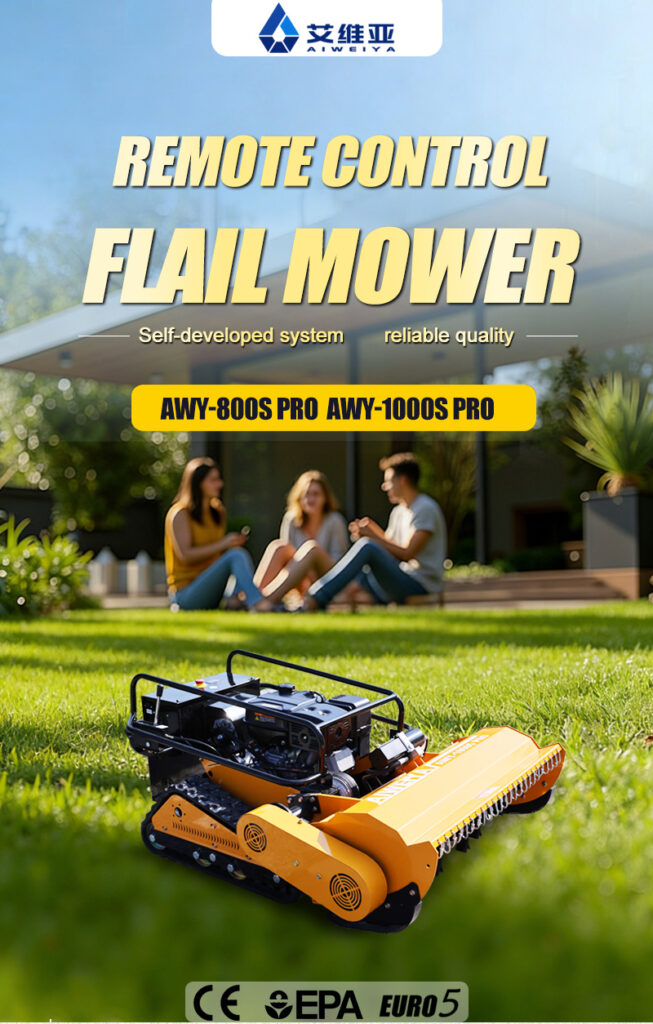
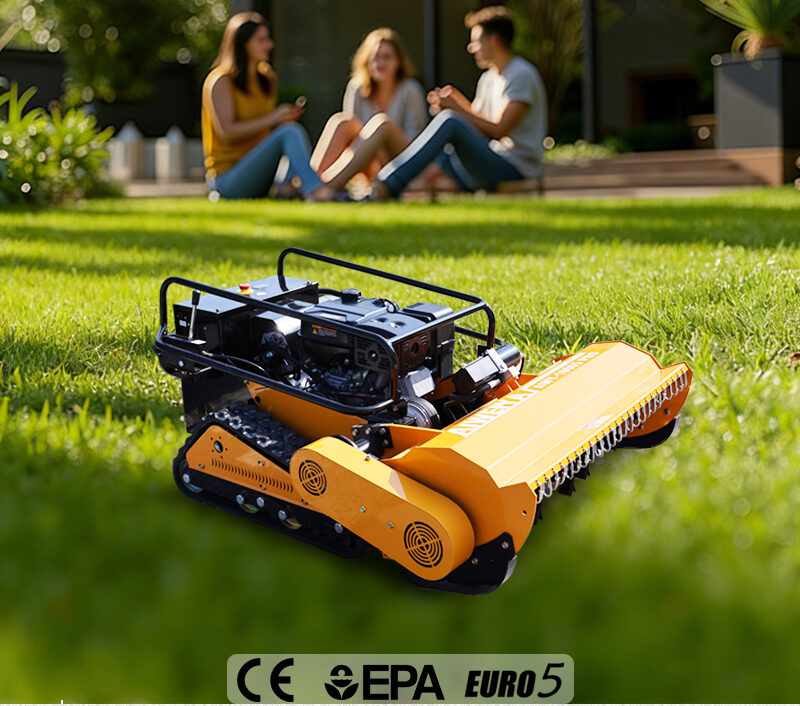
A remote control lawn mower is a powered mowing machine that allows an operator to control the mower from a distance using a wireless remote controller. Unlike conventional lawn mowers that require the operator to walk behind, ride on, or sit directly on the machine, a remote controlled lawn mower allows the operator to remain away from the cutting equipment while controlling its movement and mowing functions.
Remote control mowers are particularly useful for challenging mowing environments such as steep slopes, orchards, farms, roadside vegetation, rough terrain, and areas with tall or dense grass.
Depending on the model, an RC lawn mower may use wheels or crawler tracks and can be equipped with different cutting systems, including rotary and flail mowing systems.
For professional landscaping companies, farms, contractors, municipalities, and land maintenance businesses, a remote control mower can provide a practical way to manage difficult mowing jobs while improving operator control and working efficiency.
How Does a Remote Control Lawn Mower Work?
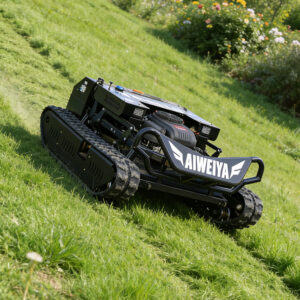
A remote control mower typically combines several systems that work together:
- Wireless remote control system
- Engine or electric motor
- Drive system
- Cutting system
- Chassis
- Safety system
The operator uses a handheld remote controller to send commands to the mower.
Depending on the machine, the operator may be able to control:
- Forward movement
- Reverse movement
- Left and right steering
- Cutting system
- Cutting height
- Engine or motor functions
- Emergency stop
The remote communicates with a receiver installed on the mower. The receiver processes the operator’s commands and sends them to the corresponding drive and control systems.
This allows the operator to control the mower without sitting directly on the machine.
What Makes a Remote Controlled Lawn Mower Different?
The biggest difference between a remote controlled lawn mower and a traditional mower is the way the machine is operated.
A traditional mower usually requires the operator to be physically close to the machine. A riding mower requires the operator to sit on the machine, while a walk-behind mower requires the operator to follow behind it.
A remote control mower separates the operator from the machine.
This design can be especially useful when mowing areas with:
- Steep slopes
- Uneven ground
- Dense vegetation
- Tall grass
- Obstacles
- Ditches
- Rough terrain
For professional users, this can make remote controlled mowing equipment an attractive option for difficult mowing applications.
Key Components of a Remote Control Mower
1. Remote Controller
The remote controller is the primary interface between the operator and the mower.
Depending on the model, the controller may provide controls for driving, steering, mowing, speed, and emergency stop functions.
A well-designed controller should be easy to operate and provide the operator with clear control over the machine.
2. Drive System
The drive system determines how the mower moves across the ground.
Remote control mowers commonly use either:
- Wheels
- Crawler tracks
Wheel-based machines can be suitable for many conventional mowing applications.
Crawler mowers use tracks instead of traditional wheels and can provide additional traction on certain types of rough or sloped terrain.
When selecting a remote control mower, the terrain where the machine will be used should be one of the first considerations.
3. Cutting System
The cutting system determines what type of vegetation the machine is designed to handle.
Common cutting systems include rotary mowing decks and flail mowing systems.
A rotary mower is commonly used for grass and general vegetation maintenance.
A flail mower uses multiple flails or cutting tools mounted on a rotating rotor. This type of cutting system can be suitable for heavier vegetation, grass, weeds, and certain types of brush, depending on the machine’s design and specifications.
For example, a remote control flail mower can be particularly useful for professional vegetation management on difficult terrain.
4. Engine or Motor
The power system provides the energy needed for driving and cutting.
Depending on the model, a remote control mower may use an internal combustion engine or an electric power system.
When comparing machines, users should consider:
- Power output
- Fuel or battery requirements
- Operating time
- Maintenance
- Terrain
- Cutting conditions
The right power system depends on the application and the expected workload.
5. Safety System
Safety is an important consideration when operating any powered mowing machine.
Remote control mowers may include safety functions such as emergency stop systems, communication monitoring, protective structures, and other machine-specific safety features.
Operators should always follow the manufacturer’s operating instructions and use the machine only within its specified operating conditions.
What Are the Benefits of a Remote Control Lawn Mower?
1. Remote Operation
One of the most obvious advantages is remote operation.
The operator does not need to sit directly on the mower or walk immediately behind the cutting equipment.
This can be especially useful for difficult mowing environments where maintaining a safe operating position is important.
2. Suitable for Slopes and Difficult Terrain
Steep and uneven terrain can be challenging for conventional mowing equipment.
A remote control mower can be designed specifically for these conditions.
Crawler-based remote mowers, for example, can provide strong ground contact and traction depending on their track design, weight distribution, and operating conditions.
Some professional remote control mowers are designed for substantial slope capability. However, the maximum gradeability varies by machine, and users should always follow the manufacturer’s specifications and operating instructions.
3. Access to Difficult-to-Reach Areas
Some properties contain areas that are difficult to maintain with conventional equipment.
Examples include:
- Hillsides
- Ditches
- Orchards
- Farm fields
- Roadsides
- Embankments
- Solar farm vegetation areas
A remote control mower can give operators greater flexibility when maintaining these areas.
4. Useful for Heavy Vegetation
Some remote controlled mowers are equipped with heavy-duty cutting systems designed for demanding vegetation management.
Flail mowing systems can be particularly useful for applications involving dense grass, weeds, and certain types of brush.
However, users should always match the mower and cutting system to the vegetation type and machine specifications.
5. Improved Operator Positioning
Instead of being positioned directly on or immediately behind the mower, the operator can control the machine from a suitable location.
This can be particularly valuable when the mowing environment contains slopes, uneven terrain, or other challenging conditions.
Where Can a Remote Control Lawn Mower Be Used?
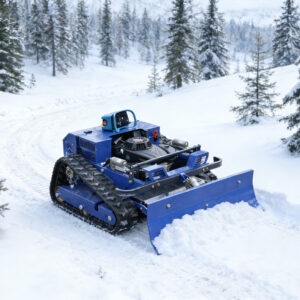
A remote control mower can be used in many professional and commercial applications.
Steep Slopes
Steep slopes are one of the most common applications for remote control mowing equipment.
A suitable machine can be used for maintaining grass and vegetation on slopes where conventional equipment may be difficult to operate.
Orchards
Orchards often contain uneven ground, grass between trees, narrow working areas, and vegetation that needs regular maintenance.
Compact remote control mowers can be useful for maintaining grass between rows of fruit trees, depending on machine dimensions and operating requirements.
Farms
Farm properties can include large fields, access roads, slopes, and areas with tall grass or weeds.
A remote control mower can be used for routine vegetation management across different parts of a farm.
Roadsides and Embankments
Roadside vegetation and embankments can be difficult to maintain because of uneven terrain and limited access.
Remote control mowing equipment can provide an alternative solution for professional vegetation maintenance.
Solar Farms
Solar farms require regular vegetation management to keep grass and weeds under control.
A suitable remote control mower can be used for vegetation maintenance around solar installations, provided that the machine’s dimensions, cutting system, and operating method are appropriate for the site.
Commercial Landscaping
Landscaping contractors and property maintenance companies may use remote control mowers for large properties and difficult areas.
The ability to remotely control the machine can provide greater flexibility when managing challenging mowing jobs.
Remote Control Mower vs. Traditional Lawn Mower
The right mower depends on the application.
A traditional walk-behind mower may be sufficient for a small, flat residential lawn.
A riding mower can be useful for larger areas with relatively accessible terrain.
A remote control mower becomes more attractive when the application involves difficult terrain, steep slopes, heavy vegetation, or other challenging working conditions.
| Feature | Traditional Mower | Remote Control Mower |
|---|---|---|
| Remote operation | No | Yes |
| Steep terrain applications | Limited depending on model | Many models are designed for slopes |
| Operator rides machine | Some models | No |
| Difficult terrain | Model dependent | Designed for selected applications |
| Heavy vegetation | Model dependent | Flail options available |
| Commercial applications | Yes | Yes |
| Orchard applications | Possible | Suitable models available |
| Roadside vegetation | Limited depending on terrain | Suitable models available |
The important point is that a remote control mower is not necessarily designed to replace every traditional lawn mower.
Instead, it provides another solution for mowing applications where conventional equipment may not be the most practical choice.
How to Choose the Right Remote Control Lawn Mower
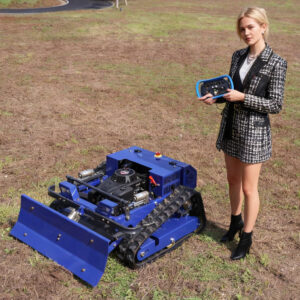
Before purchasing an RC lawn mower, consider the following factors.
Terrain
Start by identifying the terrain.
Is the property:
- Flat?
- Hilly?
- Steep?
- Rocky?
- Uneven?
- Narrow?
- Difficult to access?
Terrain should influence your choice between wheel and crawler machines.
Slope Capability
If you plan to mow slopes, check the manufacturer’s specified maximum gradeability.
Do not select a machine based only on a marketing claim. Consider the actual terrain, surface conditions, vegetation, machine configuration, and operating instructions.
Cutting Width
A wider cutting width can increase productivity in suitable open areas.
A narrower machine may be easier to maneuver in orchards or confined spaces.
Choose the cutting width based on the working environment rather than simply choosing the largest available mower.
Cutting System
Consider what type of vegetation you need to cut.
For ordinary grass maintenance, a rotary cutting system may be suitable.
For heavier vegetation, weeds, and certain brush applications, a flail mower may be a better option.
Power
Engine or motor power should match the workload.
Heavy vegetation, slopes, wider cutting decks, and demanding working conditions may require more power.
Remote Control Range
For larger properties, remote control range can be an important consideration.
The required range depends on the site layout, terrain, visibility, and operating environment.
Why Choose a Professional Remote Control Mower?
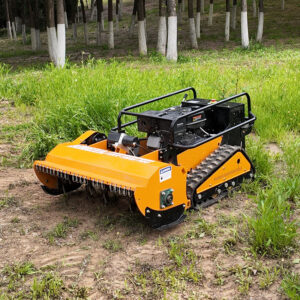
For commercial users, the machine should be viewed as more than simply a lawn mower.
It is a piece of vegetation management equipment.
Professional buyers should consider:
- Machine durability
- Parts availability
- Technical support
- Product configuration
- Maintenance requirements
- OEM/ODM capability
- Dealer support
- Long-term operating costs
For importers and distributors, supplier capabilities can be just as important as machine specifications.
A reliable manufacturer should be able to provide technical documentation, spare parts, product support, and suitable configurations for different markets.
Why Choose AWY Remote Control Mowers?
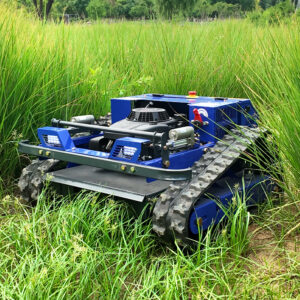
AWY Machine focuses on remote control mowing equipment for professional and commercial applications.
The product range includes crawler, wheel, and flail mower configurations designed for different terrain and vegetation management requirements.
AWY remote control mower solutions can be considered for applications such as:
- Steep slopes
- Orchards
- Farms
- Roadsides
- Rough terrain
- Dense grass
- Weed management
- Solar farm vegetation management
Different models offer different combinations of cutting width, power, drive systems, and operating capabilities.
For example, AWY’s crawler-based models are designed for applications where traction and terrain adaptability are important considerations, while flail mower configurations are intended for heavier vegetation management.
For distributors, contractors, landscaping companies, farms, and other professional users, choosing the correct model should begin with the actual terrain, vegetation type, required working width, and expected workload.
Frequently Asked Questions
Are remote control lawn mowers safe?
Remote control mowers can help position the operator away from the machine, but they still require proper training and safe operating procedures. Users should always follow the manufacturer’s instructions and operate the machine within its specified conditions.
Can a remote control mower cut tall grass?
Yes, suitable models can be designed for tall and dense grass. The appropriate machine depends on grass height, density, moisture, terrain, and cutting system.
Can remote control mowers work on slopes?
Some remote control mowers are specifically designed for slope applications. However, maximum slope capability varies by model and actual operating conditions.
Are crawler mowers better than wheel mowers?
Not necessarily in every application. Crawler mowers can offer advantages in traction and certain difficult terrains, while wheel mowers may be better suited to other applications. The best choice depends on the working environment.
Can a remote control mower be used in an orchard?
Yes. Compact remote control mowers can be useful for grass and vegetation management in orchards. Machine dimensions and maneuverability should be considered when selecting a model.
What is the difference between a remote control mower and a robotic mower?
A remote control mower is actively controlled by an operator using a remote controller. A robotic mower generally operates autonomously according to a programmed system or navigation technology.
Conclusion
A remote control lawn mower is a specialized mowing machine that allows an operator to control mowing and driving functions remotely.
Compared with conventional lawn mowers, remote controlled mowers can offer a practical solution for challenging applications such as steep slopes, orchards, farms, roadsides, rough terrain, and heavy vegetation.
However, the right machine depends on the actual application.
Before choosing a remote control mower, consider the terrain, slope, vegetation type, cutting width, power, drive system, remote control requirements, and maintenance needs.
If you are looking for a professional remote control mower for commercial landscaping, farming, orchards, slopes, or other difficult terrain, explore AWY Machine’s range of remote control mowing solutions or contact the factory to discuss the most suitable configuration for your application.
Looking for a remote control mower for your terrain? Contact AWY Machine to discuss your requirements and find the right model for your application.