
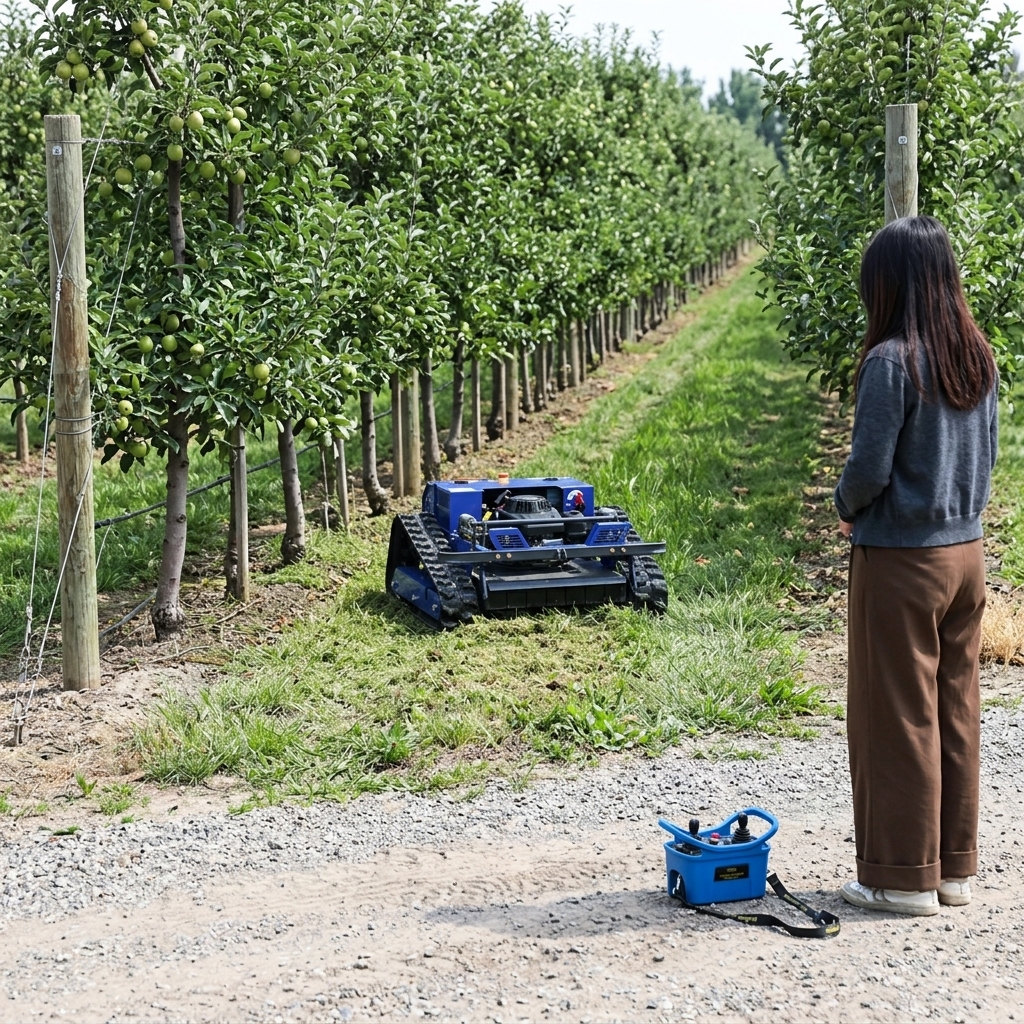
Vineyards and orchards require regular vegetation management throughout the growing season. Grass and weeds can develop between tree rows, beneath vines, along field boundaries and around access paths.
For commercial growers, maintaining these areas is part of an ongoing agricultural operation. The workload can become more demanding when the property includes narrow planting rows, uneven ground, sloping fields or dense vegetation.
Traditional tractors and agricultural mowers remain useful for many farms. However, some terrain and access conditions may call for more specialized equipment.
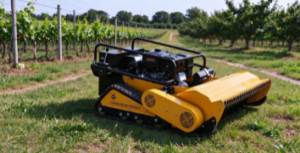
A remote control lawn mower for vineyards and orchards can be considered for selected mowing tasks where a compact machine, remote operation or tracked mobility may be beneficial.
The right equipment depends on the crop layout, row spacing, terrain, vegetation type, required cutting height and the farm’s maintenance schedule.
This guide explains how growers, agricultural contractors and farm equipment distributors can evaluate remote control mowers for vineyard and orchard applications.
Why Vineyards and Orchards Need Specialized Mowing Equipment
Agricultural properties can contain several distinct mowing zones.
A vineyard may include narrow lanes between grapevine rows, sloping sections, headlands for turning, access roads and perimeter vegetation.
An orchard may include mature trees, low branches, irrigation lines, uneven soil and grass growing around the tree rows.
Each area presents different requirements.
Common maintenance zones include:
- Grass between vineyard rows
- Orchard alleys between tree rows
- Field boundaries
- Farm access roads
- Embankments and slopes
- Grass around storage and working areas
- Rough vegetation on unused land
A single machine may not be suitable for every zone. Farm operators should identify the areas that require mowing most frequently before selecting equipment.
1. Mowing Between Vineyard Rows
Vineyards often feature long, organized rows with grass or other vegetation growing between them.
A mower used in these areas must fit the available space while avoiding contact with grapevines, posts, wires and other vineyard infrastructure.
Before choosing a machine, measure:
- Distance between vine rows
- Narrowest access point
- Machine body width
- Total cutting-deck width
- Turning space at row ends
- Ground clearance
- Height of low branches or wires
Remember that the cutting deck may extend beyond the machine’s tracks or wheels. Buyers should check the complete working width rather than relying on the machine-body width alone.
For vineyards with narrow spacing, a compact mower may be more practical than a wide, heavy-duty unit.
2. Grass Management in Orchards
Orchard grass management varies according to crop type, planting density, climate and farm practices.
Apple, pear, citrus, olive and other fruit orchards can have different row spacing and canopy structures.
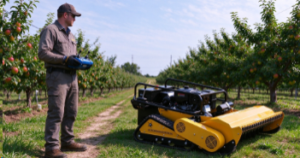
A remote mower may be worth evaluating for selected areas between trees, especially where the terrain or vegetation makes routine mowing more difficult.
Before deployment, consider:
- Tree spacing
- Low branches
- Root zones
- Irrigation pipes
- Exposed cables
- Rocks and fallen branches
- Soil softness after rain
- Access for maintenance vehicles
The machine must be suitable for the crop layout and should not be operated in a way that risks damaging trees or irrigation infrastructure.
3. Mowing on Sloping Vineyards and Orchards
Some vineyards and orchards are established on hillsides or rolling agricultural land.
Slopes can complicate mowing because ground conditions may change across the property. Soil moisture, loose material, grass height and the direction of travel can all affect machine performance.
Tracked remote control mowers may be worth considering for suitable sloped applications because their crawler tracks provide continuous contact with the ground.
However, track design alone does not determine whether a machine is safe for a particular slope.
Buyers should evaluate:
- Manufacturer-rated gradeability
- Machine weight and center of gravity
- Track design
- Ground surface and soil stability
- Moisture and weather
- Vegetation density
- Operating direction
- Manufacturer instructions
Do not assume that a published maximum slope rating guarantees safe operation under all field conditions. Steep vineyard and orchard terrain should be assessed before equipment is selected.
Remote Control Lawn Mower for Steep Slopes
4. Managing Tall Grass and Weeds
Grass and weeds can grow quickly during warm, wet periods.
If mowing is delayed, some areas may develop dense or overgrown vegetation that requires a different cutting approach from a regularly maintained grass lane.
When evaluating equipment for these conditions, consider:
- Maximum recommended vegetation height
- Grass density
- Weed type
- Cutting mechanism
- Cutting-height adjustment
- Engine power
- Deck design
- Cleaning and maintenance access
A flail-style mower may be suitable for some rough-grass and vegetation-management applications. The actual cutting capability depends on its blade design and the manufacturer’s specifications.
For vineyards and orchards that require a neat grass finish, a different cutting configuration may be more appropriate.
Remote Control Lawn Mower for Overgrown Grass
5. Maintaining Field Boundaries and Access Routes
Agricultural properties often include field edges, drainage areas, boundary strips and farm access routes.
These areas may receive less frequent maintenance than the main crop rows.
A remote mower can be considered for selected boundary and rough-grass applications where its dimensions and cutting system suit the terrain.
Before mowing, identify irrigation equipment, drainage structures, exposed cables and other obstacles that may not be immediately visible in tall vegetation.
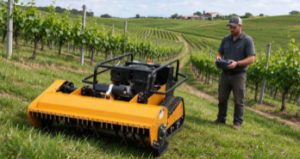
How to Choose the Right Remote Control Mower for Vineyards and Orchards
The most suitable mower is not necessarily the largest or most powerful model. It is the machine that fits the crop layout, terrain and recurring maintenance tasks.
Machine Width and Row Spacing
Measure the narrowest passage the mower must enter.
Compare it with:
- Overall machine width
- Cutting-deck width
- Track or wheel width
- Required clearance around trees or vines
- Turning space
A wider cutting deck can cover more ground per pass in open areas, but it may be difficult to maneuver in narrow crop rows.
For agricultural applications, access should be confirmed before productivity is considered.
Cutting Width
Cutting width affects how much ground the mower can cover in one pass.
A wider mower may be useful for broad orchard alleys or open vineyard sections. A narrower model may be easier to use in restricted spaces.
Actual output also depends on vegetation density, ground conditions, turning time, operating speed and the number of obstacles.
Cutting Height
Different farms may have different grass-management objectives.
Some growers prefer relatively short grass between rows, while others maintain taller vegetation according to their agricultural practices.
Review the available cutting-height range and adjustment method before purchasing.
If the machine needs to handle several vegetation zones, confirm that its cutting system can accommodate the expected conditions.
Remote-Control Range
Large agricultural properties may require the operator to control the mower across extended rows or separated work areas.
When comparing remote-control systems, ask about:
- Stated maximum range
- Signal stability
- Terrain and obstruction effects
- Emergency-stop functions
- Controller battery life
- Visibility requirements
- Manufacturer operating instructions
The maximum advertised range should not be treated as a guaranteed working distance in every vineyard or orchard.
Crawler vs. Wheel Mowers for Agricultural Use
Both tracked and wheeled remote mowers may be appropriate for agricultural applications.
Tracked Remote Control Mowers
Tracked configurations may be worth evaluating for:
- Suitable slopes
- Uneven fields
- Rough grass
- Some soft-ground conditions
- Agricultural land with challenging terrain
Their suitability depends on the machine’s design, weight, track system and actual field conditions.
Wheeled Remote Control Mowers
Wheeled configurations may be appropriate for:
- Relatively flat fields
- Firm ground
- Open grass lanes
- Accessible farm areas
For farms with mixed terrain, equipment selection should reflect the dominant mowing conditions and the areas where conventional equipment has limitations.
Crawler vs Wheel Remote Control Lawn Mower
Rotary vs. Flail Cutting Systems
The cutting system should match the farm’s vegetation-management needs.
Rotary cutting configurations may be suitable for regular grass-cutting applications, depending on the blade design and machine specifications.
Flail cutting configurations may be worth considering for selected rough-grass, weed and dense-vegetation applications.
Before purchasing, clarify whether the primary objective is a maintained grass finish, rough vegetation control or a combination of both.
Some agricultural operations may benefit from using different machines for different areas rather than expecting one mower to meet every requirement.
Remote Control Flail Mower vs Rotary Mower
Protecting Trees, Vines and Irrigation Systems
Crop protection is an important consideration when using mechanical mowing equipment.
Vineyards and orchards may contain infrastructure that is difficult to see from the operator’s position, particularly when grass is tall.
Potential hazards include:
- Irrigation pipes
- Drip lines
- Tree trunks
- Vine posts
- Support wires
- Exposed electrical cables
- Stakes
- Fallen branches
- Rocks
Before mowing, inspect the intended route and identify vulnerable infrastructure.
Maintain suitable clearance from trunks, posts and irrigation equipment. Avoid operating where the mower’s dimensions, cutting mechanism or visibility make it difficult to control the machine around obstacles.
Remote control does not eliminate the risk of accidental contact.
Soil Conditions and Weather
Field conditions can change considerably during the growing season.
Wet soil may reduce traction and increase the risk of rutting or soil disturbance. Dry, hard ground may create different challenges around rocks and uneven surfaces.
Before operating, consider:
- Recent rainfall
- Soil softness
- Drainage
- Ground slope
- Loose stones
- Grass moisture
- Weather forecasts
- Manufacturer restrictions
Where the ground is unsuitable, delaying mowing may be preferable to risking damage to the field or equipment.
Mowing Frequency for Vineyards and Orchards
There is no universal mowing schedule for every vineyard or orchard.
The appropriate frequency depends on:
- Climate
- Rainfall
- Growing season
- Grass species
- Soil fertility
- Crop-management practices
- Desired vegetation height
- Local agricultural requirements
Some farms may need frequent mowing during active growth, while others may use a less intensive schedule.
Farm managers should develop a vegetation-management plan around actual field conditions and crop-management objectives.
Maintenance Requirements for Agricultural Mowers
For commercial growers, equipment reliability is important during busy periods of the agricultural season.
Before purchasing, ask the manufacturer about routine service requirements and the availability of replacement parts.
Important areas include:
- Engine servicing
- Cutting blades or flails
- Tracks or wheels
- Drive motors
- Belts and bearings
- Controller maintenance
- Air filters
- Fuel system
- Fasteners and protective components
The operator should follow the manufacturer’s maintenance schedule and inspect the machine before use.
For farms operating several machines, keeping commonly required spare parts on hand may help simplify maintenance planning.
Transport Between Fields
A vineyard or orchard business may manage several plots or properties.
The mower may need to travel between fields or be loaded onto a trailer for transport.
Consider:
- Machine weight
- Overall dimensions
- Loading method
- Trailer capacity
- Access-road conditions
- Storage
- Security
- Transportation distance
A machine that fits the farm’s transport arrangements can be easier to integrate into a regular maintenance routine.
Buying for a Commercial Farm or Agricultural Contractor
The purchasing process differs depending on whether the buyer is an individual grower, a large agricultural business or a service contractor.
For Vineyard and Orchard Owners
Prioritize:
- Compatibility with row spacing
- Ease of operation
- Cutting-height adjustment
- Maintenance requirements
- Spare-parts access
- Total cost of ownership
For Agricultural Contractors
Also evaluate:
- Equipment utilization across clients
- Transport between jobs
- Durability under repeated use
- Availability of technical support
- Machine versatility
- Fleet standardization
For Agricultural Equipment Distributors
Additional considerations include:
- Dealer pricing
- Minimum order quantity
- Export packaging
- Product documentation
- Warranty arrangements
- OEM or private-label options
- Spare-parts supply
Recommended AWY Models for Vineyard and Orchard Applications
AWY offers several tracked remote control mower configurations that buyers can evaluate according to their crop layout and field conditions.
AWY-550H — Compact Agricultural Applications
Listed specifications include:
- 550 mm cutting width
- 224 cc gasoline engine
- Dual 750 W brushless walking motors
- Up to 500 m stated remote-control range
- 20–150 mm cutting-height range
- Up to 45° stated gradeability
This model may be worth evaluating for selected vineyard or orchard areas where compact dimensions and tracked mobility are important.
Before purchasing, confirm that the complete machine width fits between the crop rows.
AWY-800S — Larger Grass and Rough-Vegetation Areas
Listed specifications include:
- 800 mm cutting width
- 360 kg machine weight
- 459 cc gasoline or diesel configurations
- 850 W brushless walking motor
- Around 1,500 m²/h stated mowing capacity
- Up to 500 m stated remote-control range
- Up to 55° stated gradeability
This configuration may be considered for larger open grass areas, field boundaries and selected rough-vegetation applications where its dimensions and cutting system are suitable.
AWY-900 — Wider Cutting Configuration
Listed specifications include:
- 900 mm cutting width
- 2000 m²/h stated mowing capacity
- LONCIN gasoline engine options
- Dual 1500 W brushless walking motors
- 2–20 cm remote-adjustable cutting height
- 0–6 km/h operating speed
- 6 L fuel tank
This model may be worth evaluating for wider orchard alleys, larger open grass areas and suitable terrain.
Important: Published mowing-capacity and gradeability figures are manufacturer-stated specifications. Actual results depend on vegetation, soil, terrain, operating method and site conditions. Verify the latest specifications with AWY before ordering.
How to Evaluate the Cost of Ownership
The lowest purchase price does not necessarily represent the lowest long-term operating cost.
Agricultural buyers should compare the total expected cost of using a mower over its working life.
Include:
- Initial purchase price
- Transport and delivery
- Fuel consumption
- Routine maintenance
- Cutting-component replacement
- Track or wheel replacement
- Spare parts
- Operator training
- Seasonal utilization
- Downtime
- Storage
Then compare these costs with the current approach to mowing, including hired services and existing machinery.
For agricultural contractors, the number of jobs completed across the season can significantly affect the economics of owning specialized equipment.
Avoid relying on generic productivity or payback claims. Use your own mowing area, frequency, labor cost and local service prices to build a realistic comparison.
Questions to Ask the Manufacturer
Before placing a B2B order, request clear answers to the following.
Machine specifications
- What is the complete machine width?
- What is the cutting-deck width?
- Which cutting systems are available?
- What is the recommended vegetation height?
- What is the cutting-height range?
- What terrain conditions are supported?
- What are the operating limits?
Agricultural compatibility
- Can the machine fit the intended row spacing?
- What clearance should be maintained around irrigation equipment?
- Is a particular configuration recommended for the site’s terrain?
- Are replacement cutting components available?
Commercial supply
- What is the minimum order quantity?
- Are bulk prices available?
- What is the production lead time?
- What warranty applies?
- Are spare parts available for export?
- Can OEM branding or customization be discussed?
Providing photos, row-spacing measurements and terrain details can help the manufacturer assess the application more accurately.
OEM and Private-Label Opportunities for Agricultural Dealers
Agricultural equipment distributors may want to add remote control mowers to their product range.
Depending on the manufacturer’s capabilities, OEM cooperation may include:
- Brand logo
- Machine color
- Selected configurations
- Packaging
- Product documentation
- Market-specific requirements
Dealers should confirm the available options, minimum order quantities, lead times and warranty arrangements before committing to a private-label program.
Frequently Asked Questions
Is a remote control lawn mower suitable for vineyards?
It may be suitable for selected grass-maintenance areas between vine rows, along field boundaries or on appropriate slopes. Machine dimensions and row spacing must be checked before purchase.
Can a remote mower operate between orchard trees?
Yes, if the complete machine and cutting deck fit the available space and the operator can maintain appropriate clearance from trees, irrigation systems and other infrastructure.
Are tracked remote mowers suitable for hilly orchards?
Some tracked models are designed for slope applications. Buyers must verify the manufacturer’s limits and assess actual soil, moisture, slope and vegetation conditions.
Which cutting system is best for orchard grass?
The answer depends on grass height, density and the required finish. A regular grass-cutting system may suit maintained lanes, while some flail configurations may be suitable for rough vegetation.
What cutting width is best for a vineyard?
There is no universal best width. Measure the narrowest row spacing and compare it with the complete machine width and cutting-deck width.
Can a remote mower damage irrigation pipes?
It can if the route is not assessed or the equipment is unsuitable. Identify irrigation lines, exposed cables and other obstacles before mowing, and follow the manufacturer’s operating instructions.
Can agricultural contractors buy multiple AWY mowers?
B2B buyers can discuss quantities, configurations, spare parts, delivery schedules and applicable commercial terms directly with AWY.
Can AWY provide customized machines for agricultural distributors?
OEM or customization options may be available depending on the required configuration and order. Confirm the details directly with the manufacturer.
Conclusion
Vineyards and orchards require mowing equipment that matches the crop layout, terrain and vegetation-management strategy.
A remote control lawn mower can be considered for selected applications involving:
- Grass between crop rows
- Orchard alleys
- Vineyard field boundaries
- Suitable hillside terrain
- Rough grass
- Difficult-access agricultural areas
Before purchasing, evaluate the machine’s width, cutting system, ground conditions, remote-control functions, maintenance requirements and transport arrangements.
For commercial growers, agricultural contractors and equipment distributors, choosing the right configuration begins with a clear understanding of the field—not simply the machine’s headline specifications.
Request an Agricultural Mowing Solution from AWY
When contacting AWY, provide:
- Crop type
- Row spacing
- Field size
- Terrain and slope
- Grass or weed conditions
- Required cutting width
- Estimated quantity
- Destination country
- OEM requirements, if applicable
These details can help AWY assess which remote control mower configurations may fit your agricultural application.
Related Articles
Remote Control Lawn Mower for Farms
Remote Control Lawn Mower for Steep Slopes
Remote Control Lawn Mower for Overgrown Grass
Crawler vs Wheel Remote Control Lawn Mower