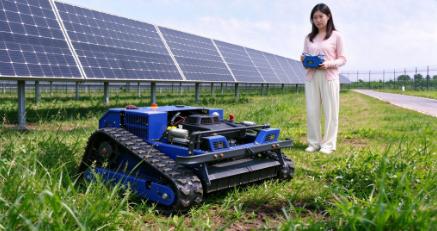
Solar farms require more than solar panels, electrical equipment and monitoring systems.
Vegetation management is also an important part of maintaining many utility-scale and commercial solar sites.
Grass and weeds can grow beneath and around solar panels, along access roads, near fencing and throughout the unused areas of a solar installation.
If vegetation becomes too tall or dense, it can make site access more difficult and increase maintenance requirements.
For solar farm operators and maintenance contractors, choosing the right mowing equipment is therefore an important part of site management.
A remote control lawn mower for solar farms can be considered for selected vegetation-management applications where conventional equipment is difficult to use.
Remote-controlled tracked mowers can potentially help maintenance teams work in areas with uneven terrain, slopes, tall grass and restricted access.
However, solar farms are specialized environments. Equipment must be selected according to the panel layout, row spacing, terrain, vegetation, access routes and site safety requirements.
This guide explains what solar farm operators, EPC companies, O&M contractors and vegetation-management companies should consider when evaluating remote control mowing equipment.
Why Vegetation Management Matters at Solar Farms
A solar farm may occupy a large area of land.
Depending on the project, the site can contain:
- Hundreds or thousands of solar panels
- Access roads
- Panel rows
- Drainage areas
- Perimeter fencing
- Maintenance paths
- Electrical equipment
- Vegetated buffer zones
- Slopes and embankments
Grass growth can vary significantly across the site.
Some areas may require regular mowing, while other sections may need occasional vegetation control.
A structured vegetation-management program helps maintenance teams keep access routes usable and prevent vegetation from becoming excessively overgrown.
The specific requirements vary by site design and local conditions.
What Makes Solar Farm Mowing Different?
Mowing a solar farm is not exactly the same as mowing a conventional field.
The equipment must operate around valuable infrastructure.
Solar panels may be positioned relatively close together, while electrical equipment and cable systems can be distributed throughout the site.
This means maintenance teams need to consider:
- Panel clearance
- Row spacing
- Equipment access
- Ground conditions
- Turning space
- Vegetation height
- Slopes
- Drainage
- Electrical infrastructure
A mower that works well in an open field may not necessarily be suitable for a solar installation.
1. Mowing Between Solar Panel Rows
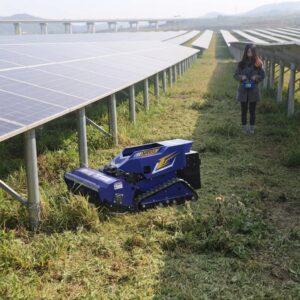
One of the most obvious applications is vegetation management between panel rows.
However, the available space varies from project to project.
Before purchasing a mower, measure:
- Row spacing
- Minimum clearance
- Access width
- Turning areas
- Panel height
- Ground slope
The machine must be narrow enough to access the intended work area without contacting panels, support structures or other equipment.
Machine width should therefore be evaluated together with the solar farm’s actual layout.
2. Vegetation Around the Solar Farm Perimeter
Solar farms often have extensive perimeter fencing.
Grass can grow along:
- Security fences
- Access roads
- Maintenance paths
- Property boundaries
These areas can be difficult to maintain efficiently with large ride-on equipment.
A remote mower may be considered for selected perimeter vegetation-management applications.
3. Sloped Solar Farm Terrain
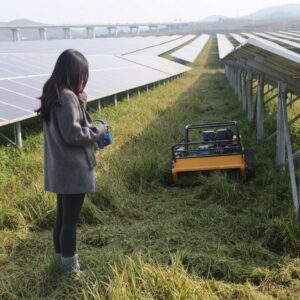
Not all solar farms are built on completely flat ground.
Some installations may include:
- Hills
- Sloping fields
- Embankments
- Uneven access roads
For these environments, tracked remote control mowers may be worth evaluating.
Crawler tracks can provide continuous contact with the ground and may offer useful traction on suitable terrain.
However, the actual suitability depends on:
- Slope angle
- Soil conditions
- Surface moisture
- Machine configuration
- Vegetation
- Operating direction
- Manufacturer limits
Never select a mower based only on its maximum advertised gradeability.
The machine must be appropriate for the actual site.
Remote Control Lawn Mower for Steep Slopes
4. Tall Grass and Overgrown Vegetation
Solar farms can experience rapid vegetation growth depending on climate and rainfall.
If mowing is delayed, grass can become:
- Tall
- Dense
- Wet
- Difficult to cut
In these conditions, a heavy-duty cutting system may be preferable to equipment designed only for short, maintained lawns.
For rough vegetation, buyers may evaluate flail-style mower configurations.
A flail cutting system can be particularly useful for certain tall-grass and vegetation-management applications.
However, the exact cutting capability depends on the machine design.
Remote Control Mower for Overgrown Grass
5. Drainage and Difficult-Access Areas
Solar sites often include drainage infrastructure to manage rainwater.
Vegetation can grow around:
- Drainage channels
- Ditches
- Embankments
- Culverts
- Low areas
These areas may not be suitable for large conventional mowing equipment.
A compact remote mower can potentially provide another option for selected difficult-access areas.
Before operation, maintenance teams should identify underground infrastructure and drainage features.
Choosing a Remote Control Mower for Solar Farms
Several factors should be evaluated before purchasing.
Machine Width
The first question is:
Can the mower physically access the intended mowing areas?
Measure the narrowest passage.
Then compare it with:
- Machine width
- Track width
- Cutting-deck width
Do not assume that a smaller cutting deck automatically means a smaller machine.
Always compare the complete machine dimensions.
Cutting Width
Once access has been confirmed, evaluate cutting capacity.
A wider deck can potentially improve productivity in open areas.
However, narrower configurations may be more practical between closely spaced solar arrays.
This creates an important balance between:
Accessibility vs. Productivity
For solar farm applications, accessibility often needs to be considered first.
Cutting Height
Vegetation-management requirements vary.
Some operators may want relatively short grass around access routes, while other areas may be maintained at a different height.
Review:
- Minimum cutting height
- Maximum cutting height
- Adjustment method
- Cutting consistency
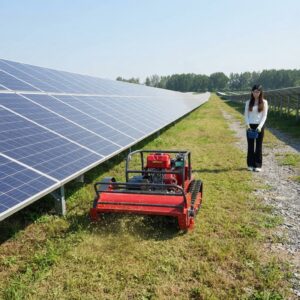
Tracked vs. Wheeled Remote Mowers for Solar Sites
Both tracked and wheeled machines can have applications in vegetation management.
Tracked Remote Mower
Tracked configurations may be considered for:
- Slopes
- Uneven terrain
- Rough grass
- Soft ground
- Difficult-access areas
Their continuous track contact can be useful for certain terrain conditions.
Wheeled Remote Mower
Wheeled machines may be suitable for:
- Flat areas
- Firm ground
- Open fields
- Accessible maintenance routes
Solar farm operators should select based on the actual site rather than assuming that one configuration is universally better.
Crawler vs Wheel Remote Control Lawn Mower
Rotary vs. Flail Cutting Systems
The cutting system should match the vegetation.
Rotary Mower
Potential applications:
- Regular grass
- Maintained vegetation
- Open areas
- Routine mowing
Flail Mower
Potential applications:
- Tall grass
- Weeds
- Rough vegetation
- Heavy vegetation management
For solar farms, some operators may use different equipment for different zones.
For example:
Panel Rows → Regular Grass Mowing
Perimeter → Rough Vegetation Management
Embankments → Specialized Slope Mowing
This zone-based approach can make equipment selection more efficient.
Remote Control Flail Mower vs Rotary Mower
Protecting Solar Infrastructure During Mowing
Solar panels and related infrastructure represent a significant investment.
Mowing operations should therefore be carefully planned.
Operators should avoid:
- Contact with panels
- Contact with support structures
- Cutting cables or exposed infrastructure
- Throwing debris toward panels
- Operating outside designated zones
Before mowing, inspect the work area for:
- Rocks
- Metal objects
- Fallen branches
- Exposed cables
- Construction debris
The mower’s cutting system should be appropriate for the vegetation and site conditions.
Operator Visibility and Remote Control
Remote control provides flexibility in operator positioning.
However, the operator should maintain appropriate visibility and control of the machine.
This is particularly important in solar farms because:
- Panel rows can obstruct sight lines
- Terrain can hide the machine
- Large sites create long distances
- Infrastructure can create blind spots
The operator should select a position that provides suitable awareness of the machine and surroundings.
Solar Farm Mowing Frequency
There is no single mowing schedule suitable for every solar project.
Frequency depends on:
- Climate
- Rainfall
- Grass species
- Soil
- Season
- Site requirements
- Vegetation-management policy
Some locations may require frequent mowing during the growing season.
Other sites may require less frequent maintenance.
A good vegetation-management program should be based on actual site conditions rather than a fixed schedule alone.
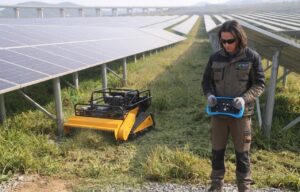
Maintenance Requirements
Commercial solar farm operators should consider machine maintenance before purchasing.
Important questions include:
- How often does the engine require servicing?
- How frequently should cutting components be inspected?
- How long do tracks typically last?
- Are spare parts available?
- Is technical support available?
- What warranty is provided?
For large O&M companies, spare-parts availability can be especially important.
A mower that cannot be serviced quickly may create unnecessary downtime.
Transporting the Mower Around Solar Sites
Large solar farms may cover extensive areas.
The mower may need to be transported between:
- Different field sections
- Separate solar arrays
- Maintenance areas
- Storage facilities
Consider:
- Machine weight
- Machine dimensions
- Trailer compatibility
- Loading method
- On-site access roads
If multiple sites are managed by one contractor, transportation becomes even more important.
Using Remote Mowers in Solar Farm O&M Contracts
Solar farm operators frequently rely on specialized operations and maintenance providers.
Landscaping contractors and vegetation-management companies can potentially add remote mowing to their service portfolio.
Potential services include:
- Routine grass cutting
- Perimeter vegetation control
- Slope mowing
- Rough-grass management
- Seasonal vegetation maintenance
This can allow contractors to provide a broader range of services to renewable-energy clients.
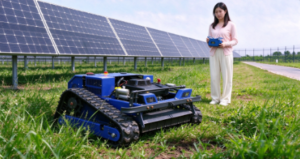
Recommended AWY Remote Control Mowers for Solar Farm Applications
AWY offers several remote control mower configurations that may be evaluated for different solar-site applications.
AWY-550H
The compact tracked configuration offers:
- 550 mm cutting width
- 224 cc gasoline engine
- Dual 750 W brushless walking motors
- Up to 500 m stated remote-control range
- 20–150 mm cutting height
- Up to 45° stated gradeability
It may be considered for selected areas where compact dimensions and tracked mobility are important.
AWY-800S
The AWY-800S offers:
- 800 mm cutting width
- 360 kg machine weight
- 459 cc gasoline or diesel options
- Up to 55° stated gradeability
- Around 1,500 m²/h stated mowing capacity
- 850 W brushless walking motor
- Up to 500 m stated remote-control range
It can be evaluated for larger vegetation-management applications.
AWY-900
The AWY-900 provides:
- 900 mm cutting width
- Around 2,000 m²/h stated mowing capacity
- Up to 55° stated gradeability
- 1,500 W × 2 walking motors
- 0–6 km/h operating speed
- 2–20 cm remote-adjustable cutting height
- 6 L fuel tank
This configuration may be suitable for larger open areas where machine dimensions are compatible with the solar site’s layout.
B2B Solar Farm Equipment Purchasing Checklist
Before purchasing remote mowing equipment, solar operators and contractors should evaluate:
Site
-
Panel row spacing
-
Access roads
-
Slopes
-
Drainage
-
Vegetation type
-
Perimeter requirements
Machine
-
Machine width
-
Cutting width
-
Machine weight
-
Track configuration
-
Cutting system
-
Cutting-height range
-
Remote-control range
Operations
-
Operator training
-
Work-zone procedures
-
Infrastructure protection
-
Maintenance schedule
-
Spare parts
Purchasing
-
MOQ
-
Bulk pricing
-
Lead time
-
Warranty
-
OEM availability
-
Technical support
How to Calculate Whether a Remote Mower Is Worth Buying
A commercial buyer should compare the cost of ownership with the site’s actual mowing workload.
Consider:
Annual mowing area
Mowing frequency
Labor requirements
Transportation
Equipment maintenance
Seasonal utilization
The result can then be compared with the cost of outsourcing vegetation management.
For companies managing multiple solar farms, equipment utilization may be significantly higher than for a single small property.
This makes fleet planning especially important.
FAQ
Can a remote control lawn mower be used on solar farms?
Yes, remote mowers can be evaluated for selected solar farm vegetation-management applications, provided the machine is suitable for the site’s layout, terrain and safety requirements.
Can a remote mower operate between solar panels?
Potentially, if the mower’s complete dimensions and cutting system are compatible with the available spacing. The operator should confirm clearance before deployment.
Are tracked mowers suitable for solar farms?
Tracked configurations may be useful for uneven ground and suitable slopes. However, the correct machine depends on the specific solar site.
Can remote mowers cut tall grass around solar panels?
Some commercial remote mowers are designed for tall grass and rough vegetation. The exact capability depends on the cutting system and machine configuration.
Will a remote mower damage solar panels?
Properly selected and operated equipment should be used according to manufacturer instructions and site procedures. Operators should prevent contact with panels and structures and assess debris risks before mowing.
Can one remote mower maintain a large solar farm?
It depends on the site area, mowing frequency, machine productivity, terrain and transport requirements.
Are remote mowers suitable for solar O&M contractors?
Yes. Vegetation management is a recurring requirement at many renewable-energy sites, making remote mowing equipment potentially useful for professional O&M and landscaping contractors.
Can AWY provide multiple machines for solar farm contractors?
For B2B projects, buyers can discuss quantities, configurations, OEM requirements, spare parts and delivery schedules directly with the manufacturer.
Conclusion
Vegetation management is an important part of maintaining many solar farms and renewable-energy facilities.
A remote control lawn mower can be considered for:
- Grass maintenance
- Solar farm perimeters
- Suitable areas between panel rows
- Slopes
- Embankments
- Rough vegetation
- Difficult-access locations
The most important step is to match the mower to the actual site.
Before purchasing, evaluate:
Panel Layout → Access Width → Terrain → Vegetation → Cutting System → Machine Size → Transport → Maintenance
For solar farm owners, O&M contractors and commercial landscaping companies, the right remote mower can become a valuable part of a professional vegetation-management fleet.
Request a B2B Solar Farm Mowing Solution
When contacting AWY, provide:
- Solar farm size
- Panel-row spacing
- Terrain conditions
- Vegetation type
- Approximate mowing area
- Required cutting width
- Quantity
- Destination country
- OEM requirements
This information allows the manufacturer to recommend a more suitable remote control mower configuration for the application.
Related Articles
Remote Control Lawn Mower for Industrial Sites
Remote Control Lawn Mower for Large Facilities
Remote Control Lawn Mower for Property Management Companies
Remote Control Lawn Mower for Hotels and Resorts
Remote Control Lawn Mower for Steep Slopes
Remote Control Lawn Mower for Overgrown Grass