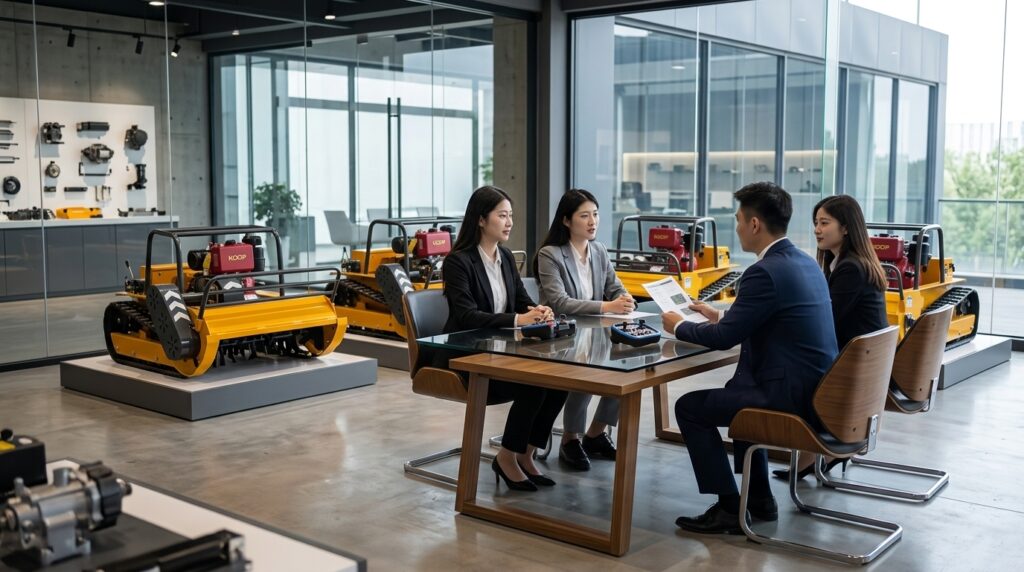

Property management companies are responsible for keeping outdoor areas attractive, functional and well maintained.
Depending on the properties they manage, their maintenance teams may need to handle:
- Large lawns
- Residential communities
- Commercial buildings
- Business parks
- Hotels and resorts
- Private estates
- Slopes
- Green belts
- Parking areas
- Property boundaries
- Overgrown grass
- Difficult outdoor areas
For smaller properties, conventional lawn equipment may be sufficient.
However, larger properties and challenging terrain can create additional equipment requirements.
A remote control lawn mower gives property management companies another option for professional vegetation maintenance. Instead of requiring an operator to sit directly on the machine, a remote-controlled mower can be operated from a distance using a dedicated controller.
This operating concept can be particularly relevant when a property includes slopes, rough terrain, tall grass or areas that are difficult to access with conventional mowing equipment.
For property managers, the most important question is not simply:
“Which remote mower has the most power?”
A better question is:
“Which mower configuration matches the properties we manage and the maintenance work we perform?”
This guide explains how property management companies can evaluate remote control lawn mowers for commercial property maintenance.
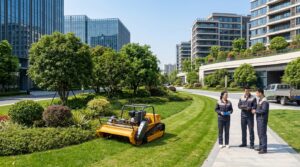
Why Property Managers Need the Right Mowing Equipment
Property management is different from maintaining a single private lawn.
A property management company may be responsible for multiple locations, each with different requirements.
One property might contain a flat lawn surrounding an office building.
Another may include:
- Slopes
- Drainage channels
- Large grass areas
- Trees
- Embankments
- Rough vegetation
- Long property boundaries
The maintenance team therefore needs equipment that matches different operating conditions.
A remote mower can be considered as part of a broader property-maintenance equipment fleet.
It does not necessarily replace every conventional mower.
Instead, it can be used for applications where remote operation, crawler mobility or heavy-duty vegetation cutting provides practical advantages.
Common Property Types for Remote Control Mowers
Different property-management businesses can have very different mowing requirements.
1. Residential Communities
Large residential communities often include:
- Shared lawns
- Green belts
- Sloped landscaping
- Open grass areas
- Walking paths
- Drainage zones
- Community parks
A compact remote control mower can be considered where the property contains areas that are difficult for conventional equipment to access.
For community properties, machine width and maneuverability are particularly important.
The machine needs to fit the available access routes while still providing sufficient cutting capacity.
2. Commercial Office Parks
Business parks and office campuses often contain large landscaped areas.
Maintenance teams may need to manage:
- Grass
- Slopes
- Property boundaries
- Green areas between buildings
- Drainage zones
- Peripheral vegetation
A remote mower can be useful as part of a commercial grounds-maintenance fleet, especially where the property contains rough or sloped sections.
3. Hotels and Resorts
Hotels and resorts often place strong emphasis on outdoor appearance.
Outdoor maintenance may involve:
- Large lawns
- Garden areas
- Slopes
- Golf-adjacent areas
- Guest-accessible green spaces
- Large private estates
In these environments, the maintenance strategy may require different machines for different areas.
A remote mower can be assigned to rough grass or challenging terrain while conventional equipment handles areas requiring fine turf finishing.
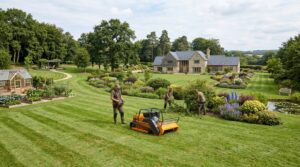
4. Private Estates
Large private estates can contain significant amounts of grass and vegetation.
Property managers may need to maintain:
- Large lawns
- Orchard areas
- Slopes
- Field boundaries
- Woodland edges
- Access roads
A remote control mower can provide another option for managing less accessible parts of an estate.
5. Residential Property Management
Property management companies may also oversee multiple apartment complexes or residential developments.
For these properties, mowing equipment needs to balance:
- Cutting performance
- Machine dimensions
- Noise considerations
- Storage
- Transport
- Operator training
- Maintenance requirements
A compact crawler mower may be suitable for selected areas, while conventional equipment may continue to be used for regular lawn finishing.
The right fleet strategy depends on the actual property portfolio.
6. Industrial and Commercial Sites
Some property managers are responsible for industrial or warehouse properties.
These locations may have large outdoor areas where vegetation can grow around:
- Buildings
- Fences
- Loading zones
- Access roads
- Drainage areas
- Empty land
- Property boundaries
In these applications, the focus may shift from aesthetic lawn finishing to general vegetation management.
A heavier-duty remote mower may therefore be more appropriate.
Remote Control Lawn Mower for Industrial Sites
When Should Property Managers Consider a Remote Mower?
A remote control mower may be worth evaluating when one or more of the following conditions exist:
Challenging terrain
The property contains slopes, uneven ground or rough terrain.
Dense vegetation
The maintenance team regularly encounters tall grass, weeds or brush.
Large outdoor areas
There are significant areas that require regular mowing.
Multiple property types
The company manages different sites with different mowing requirements.
Difficult access
Some vegetation areas are difficult to reach with conventional ride-on equipment.
Fleet standardization
The company wants to establish a repeatable equipment strategy across multiple properties.
Remote Control Mower vs Conventional Mower
Property managers should not automatically replace conventional mowing equipment.
Different machines serve different purposes.
Conventional Mower
Often suitable for:
- Flat lawns
- Fine turf
- Regular grass maintenance
- Small areas
- Areas requiring precise finishing
Remote Control Mower
Can be considered for:
- Slopes
- Rough grass
- Tall vegetation
- Uneven terrain
- Difficult-access areas
- Large vegetation-management projects
A mixed fleet can sometimes be more practical than relying on one machine type for every property.
Crawler Remote Mower vs Wheel Remote Mower
The choice between crawler and wheel configurations should be based on property conditions.
Crawler Configuration
Tracked remote mowers can be considered for:
- Slopes
- Uneven terrain
- Rough ground
- Orchards
- Embankments
- Dense vegetation areas
Crawler tracks provide continuous contact with the ground and can be advantageous for certain challenging terrain applications.
Wheel Configuration
Wheel-based remote mowers can be suitable for:
- Flat lawns
- Open fields
- Parks
- Large accessible properties
- Regular grass maintenance
Property managers should evaluate their actual portfolio rather than selecting a machine based solely on specifications.
Crawler vs Wheel Remote Control Lawn Mower
Cutting System Is Important
Not all property maintenance involves the same type of vegetation.
For maintained lawns, a conventional grass-cutting configuration may be sufficient.
For rough vegetation, contractors may prefer a flail-style cutting system.
Rotary Cutting
Suitable applications may include:
- Regular grass
- Open lawns
- Large maintained areas
Flail Cutting
Potential applications include:
- Tall grass
- Weeds
- Brush
- Rough vegetation
- Overgrown property areas
Property managers should identify the vegetation conditions at their sites before selecting the mower.
Remote Control Flail Mower vs Rotary Mower
Machine Size and Property Access
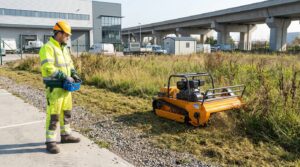
One of the most overlooked considerations for property managers is machine size.
A machine with a wider cutting deck may cover more area per pass.
However, it may also require more space for:
- Storage
- Transport
- Gate access
- Narrow pathways
- Loading
- Maintenance
Before purchasing, property managers should measure the smallest access point at the sites where the mower will operate.
Important dimensions include:
- Machine width
- Machine length
- Machine height
- Track width
- Cutting deck width
A slightly smaller machine may be more practical if it can access more properties within the company’s portfolio.
Remote-Control Range
Remote-control range is another specification to evaluate.
Professional machines may offer remote-control ranges of several hundred meters under suitable conditions.
However, the stated range should not be treated as the guaranteed operating distance in every environment.
Actual performance can depend on:
- Buildings
- Trees
- Terrain
- Signal obstruction
- Interference
- Operator position
For property maintenance, reliable control and clear machine visibility are important.
The operator should maintain appropriate awareness of the machine and its surroundings throughout operation.
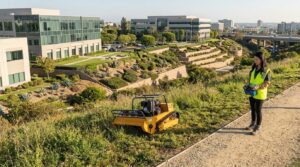
Slope Maintenance
Sloped areas can be one of the strongest reasons for property managers to consider tracked remote mowers.
Large properties can contain:
- Drainage slopes
- Embankments
- Landscaped hills
- Roadside slopes
- Retention areas
- Uneven terrain
Before using a mower on a slope, property managers should evaluate:
- Slope angle
- Ground condition
- Moisture
- Vegetation
- Machine configuration
- Operator training
- Manufacturer operating limits
A manufacturer’s maximum gradeability figure should always be interpreted according to the specified operating conditions.
Productivity Considerations for Property Managers
Property managers should evaluate mower productivity in relation to the actual site.
Important variables include:
- Cutting width
- Ground speed
- Vegetation density
- Terrain
- Turning frequency
- Obstacles
- Operator experience
- Cutting height
- Weather
A wider cutting width does not automatically mean the machine will always complete a property faster.
For example, a large machine may be highly productive in an open field but less convenient in a landscaped area containing many trees and obstacles.
Therefore, property managers should evaluate usable productivity, not only the manufacturer’s theoretical mowing capacity.
Maintenance and Equipment Availability
Property maintenance often operates on a schedule.
If a mower becomes unavailable during a busy maintenance period, the company may need to reorganize labor or equipment.
Before purchasing a remote mower, ask the supplier about:
- Routine service intervals
- Engine maintenance
- Track replacement
- Cutting blade replacement
- Drive motor maintenance
- Remote controller maintenance
- Battery replacement
- Spare parts availability
- Technical support
For companies managing multiple properties, keeping commonly required spare parts in inventory may also be worth considering.
Operator Training
Remote-controlled equipment still requires trained operators.
A property management company should establish standard procedures for:
Before operation
- Inspect the mower
- Check fuel or battery
- Check cutting system
- Inspect tracks
- Test remote controller
- Check emergency-stop function
- Inspect the work area
During operation
- Maintain clear visibility
- Keep people away from the operating area
- Monitor terrain
- Avoid unsafe obstacles
- Follow manufacturer limits
- Stop the machine if conditions become unsuitable
After operation
- Clean the machine
- Inspect cutting components
- Check for damage
- Store the controller correctly
- Perform required maintenance
Remote control changes where the operator stands; it does not remove the need for professional operating procedures.
Managing Multiple Properties With One Mower
For property management companies with several nearby properties, one remote mower may potentially support multiple locations.
Before adopting this strategy, calculate:
Property area + mowing frequency + travel time + transport requirements + available operators
For example, a company managing several commercial properties may schedule the remote mower according to seasonal maintenance demand.
However, companies with many geographically separated sites may need multiple machines.
Fleet decisions should be based on actual utilization rather than simply the number of properties.
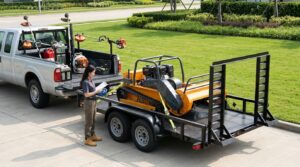
Transport Between Properties
If the mower is used across multiple locations, transportation becomes part of the operating cost.
Property managers should consider:
- Trailer availability
- Loading ramps
- Machine weight
- Vehicle payload
- Loading time
- Storage
- Security
A mower that can be transported efficiently between sites may be easier to integrate into a multi-property maintenance operation.
Choosing an AWY Remote Control Mower
AWY offers different remote-controlled mower configurations that can be considered for property maintenance applications.
AWY-550H
The AWY-550H is a compact tracked configuration.
Key specifications include:
- 550 mm cutting width
- 224 cc gasoline engine
- Dual 750 W brushless walking motors
- Up to 500 m stated remote-control range
- 20–150 mm cutting height
- Up to 45° stated gradeability
It can be considered for smaller managed properties, orchards, slopes and areas where compact dimensions are useful.
AWY-800S
The AWY-800S provides a wider cutting configuration for professional vegetation management.
Key specifications include:
- 800 mm cutting width
- 360 kg machine weight
- Up to 55° stated gradeability
- Around 1,500 m²/h stated mowing capacity
- 459 cc gasoline or diesel options
- 850 W brushless walking motor
- Up to 500 m stated remote-control range
It may be suitable for larger commercial properties, rough grass, slopes, embankments and other demanding maintenance environments.
AWY-900
The AWY-900 provides a 900 mm cutting width and is designed for all-terrain remote mowing applications.
Key specifications include:
- 900 mm cutting width
- Up to 55° stated gradeability
- Around 2,000 m²/h stated mowing capacity
- 1,500 W × 2 brushless walking motors
- 2–20 cm remote-adjustable cutting height
- 0–6 km/h operating speed
- 6 L fuel tank
For property managers handling larger sites, the wider cutting configuration can be considered where access conditions allow.
AWY-1000S and AWY-1200S
For larger grass areas, AWY-1000S and AWY-1200S provide wider cutting configurations.
They can be considered for:
- Large estates
- Commercial properties
- Farms
- Orchards
- Slopes
- Large grass areas
- Professional landscaping operations
The appropriate model depends on access, vegetation, transport and workload.
B2B Purchasing: What Property Management Companies Should Ask
Before purchasing a remote control mower, request detailed information from the manufacturer.
Product
- What is the cutting width?
- What vegetation can it handle?
- What is the maximum recommended slope?
- What is the operating speed?
- What is the machine weight?
- What is the remote-control range?
Maintenance
- What parts require regular replacement?
- How often is maintenance required?
- Are spare parts available?
- Is technical support provided?
Supply
- What is the MOQ?
- What is the production lead time?
- Is OEM available?
- Can the machine be customized?
- What export certifications are available?
- How is the machine packaged for international shipment?
Commercial Support
- Are dealer prices available?
- Can multiple machines be ordered?
- Is training available?
- Is after-sales support available?
- Can the supplier support long-term fleet purchases?

Remote Mower Fleet Strategy for Property Managers
Larger property management companies may benefit from creating equipment categories.
Compact Mower
For:
- Residential communities
- Narrow access
- Smaller properties
- Detailed vegetation work
Medium Mower
For:
- Commercial properties
- Office parks
- Estates
- Mixed terrain
Heavy-Duty Mower
For:
- Industrial properties
- Large estates
- Slopes
- Rough vegetation
- Large grass areas
This approach can make it easier to assign the correct machine to each property.
Should Property Managers Buy or Outsource Mowing?
Not every property management company needs to own mowing equipment.
There are two common approaches.
Option 1: Outsource Mowing
The property manager hires a landscaping contractor.
This can reduce direct equipment ownership responsibilities.
Option 2: Maintain Equipment In-House
The company purchases equipment and manages mowing internally.
This can provide more direct control over scheduling and equipment availability, but requires:
- Operators
- Maintenance
- Storage
- Transport
- Equipment management
A third option is a hybrid model, where routine mowing is outsourced while specialized equipment is maintained for selected properties.
The best approach depends on property portfolio size, staffing and maintenance strategy.
FAQ
Is a remote control lawn mower suitable for property management companies?
Yes. Remote control mowers can be considered for commercial properties, residential communities, estates, office parks, industrial sites, slopes and other managed outdoor areas.
Can one remote mower maintain multiple properties?
Potentially, depending on property size, mowing frequency, transportation distance and equipment availability. Companies should calculate utilization before deciding how many machines are required.
Are tracked remote mowers suitable for slopes?
Tracked machines can be considered for slope applications, but property managers should follow the manufacturer’s operating limits and evaluate actual ground conditions before operation.
Can remote mowers cut tall grass?
Many professional remote mowers are designed for grass and vegetation management. The exact vegetation capacity depends on the mower’s cutting system and configuration.
Is a flail mower better for property maintenance?
A flail mower can be useful for tall grass, weeds and rough vegetation. For regularly maintained lawns, another cutting system may be more appropriate.
How should property managers choose the mower size?
Consider the property area, access width, vegetation, terrain, transportation requirements and desired mowing frequency. The largest machine is not always the most practical option.
Can property management companies purchase remote mowers in bulk?
Yes, B2B manufacturers and dealers may offer multiple-unit purchasing options. Buyers should confirm MOQ, production capacity, lead time, spare parts and after-sales support.
Can the mower be customized with a company brand?
Depending on the manufacturer, OEM and private-label options may include machine color, branding, product configuration and packaging.
Conclusion
For property management companies, outdoor maintenance is an operational responsibility rather than simply a landscaping task.
The right equipment needs to work across the company’s actual property portfolio.
A remote control lawn mower can be considered for applications involving:
- Commercial properties
- Residential communities
- Office parks
- Hotels and resorts
- Private estates
- Industrial sites
- Slopes
- Rough grass
- Tall vegetation
- Difficult-access areas
The best solution depends on the company’s terrain, vegetation, property size, maintenance schedule and fleet strategy.
Before purchasing, property managers should evaluate:
Application → Terrain → Cutting system → Machine size → Transport → Maintenance → Operator training → Supplier support
For companies managing multiple properties, a well-planned remote mower fleet can become one part of a broader professional grounds-maintenance strategy.
Request a B2B Remote Mower Solution
If your company manages commercial properties, residential communities, estates, industrial sites or other large outdoor areas, provide the following information when contacting a manufacturer:
- Property type
- Terrain
- Grass or vegetation type
- Approximate mowing area
- Required cutting width
- Expected quantity
- Destination country
- OEM/private-label requirements
A manufacturer can then recommend a configuration based on the actual operating environment.
Related Articles
Remote Control Lawn Mower for Municipal Parks
Remote Control Lawn Mower for Industrial Sites
Remote Control Lawn Mower for Landscaping Contractor
Remote Control Lawn Mower for Rental Business
Remote Control Lawn Mower for Steep Slope