
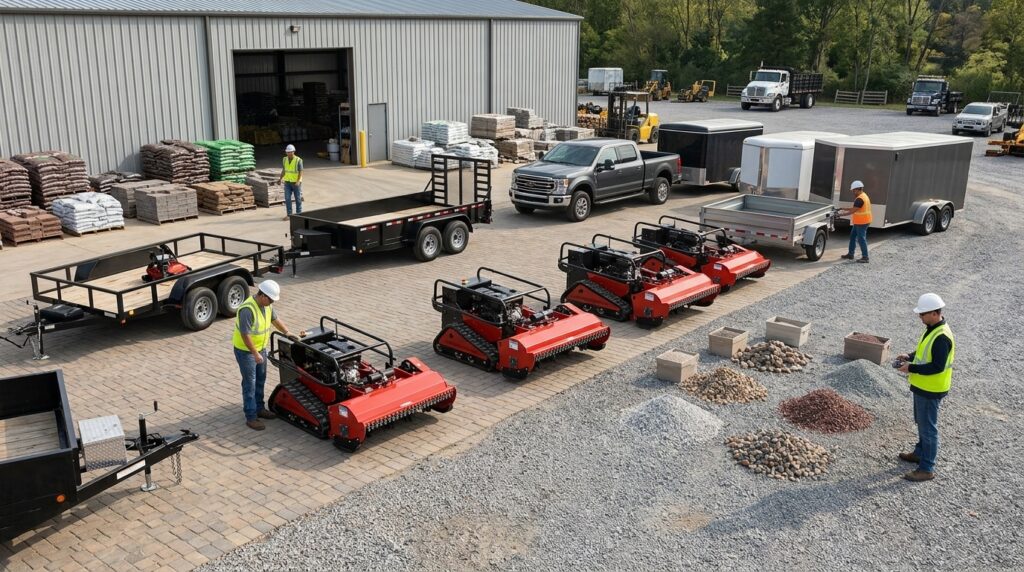
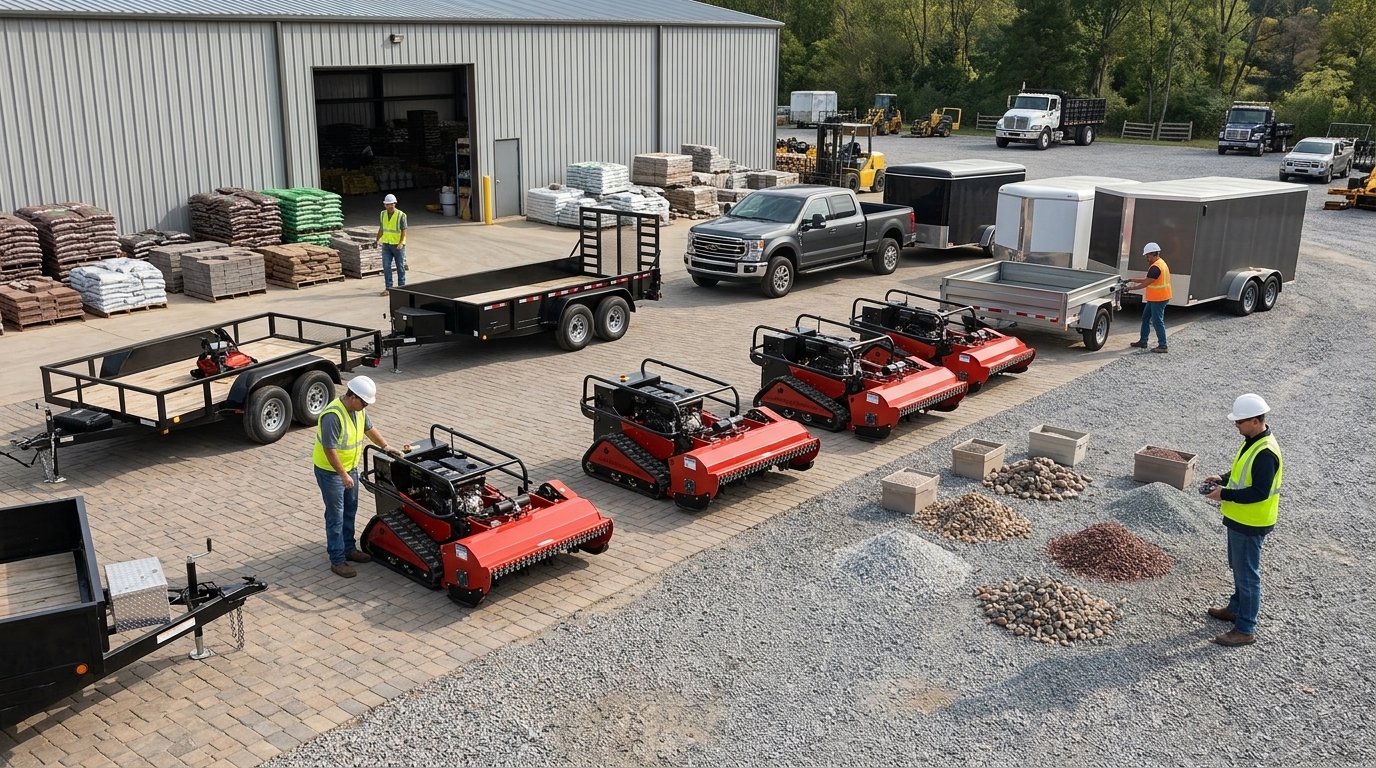
Landscaping contractors manage a wide variety of mowing projects. A typical commercial landscaping company may work on residential estates, commercial properties, parks, roadside areas, orchards, industrial facilities, sports grounds, slopes, and other outdoor spaces.
Not every job can be handled efficiently with a conventional walk-behind mower or ride-on mower.
Steep slopes, rough terrain, tall grass, dense weeds, narrow access areas, and large vegetation-management projects can create additional challenges for landscaping crews. In these situations, a remote control lawn mower can provide contractors with another equipment option for professional mowing operations.
A remote controlled lawn mower allows an operator to control the machine from a distance instead of sitting directly on the mower. Depending on the machine configuration, contractors can use remote mowers for slope mowing, grass cutting, brush management, orchard maintenance, roadside vegetation control, and other commercial landscaping applications.
For landscaping companies, the purchasing decision is not simply about finding the largest mower or the machine with the highest horsepower.
The right equipment should match the company’s:
- Typical customer sites
- Terrain conditions
- Grass and vegetation types
- Cutting requirements
- Transport capabilities
- Operator experience
- Maintenance resources
- Fleet strategy
- Project size
- Business model
This guide explains what landscaping contractors should consider when selecting a remote control lawn mower for commercial work.
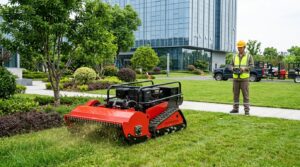
Why Landscaping Contractors Are Considering Remote Control Mowers
Commercial landscaping contractors often need equipment that can work across different types of properties.
A company may mow flat commercial lawns on Monday, maintain an orchard on Wednesday, and handle a difficult roadside slope later in the week.
This creates a need for versatile equipment.
A remote control mower can be particularly relevant when the job involves terrain where operating a conventional ride-on machine may be inconvenient or unsuitable.
Common contractor challenges include:
- Steep slopes
- Uneven terrain
- Tall grass
- Dense weeds
- Brush and vegetation
- Difficult-to-access areas
- Large commercial properties
- Roadside vegetation
- Orchard and agricultural sites
- Embankments
- Industrial property boundaries
- Solar farm vegetation
- Municipal green spaces
Instead of purchasing different specialized machines for every application, contractors may consider multifunctional remote-controlled mowing equipment that can cover several project types.
However, versatility should always be evaluated against actual job requirements.
Where Landscaping Contractors Can Use Remote Control Lawn Mowers
The best machine for a landscaping contractor depends heavily on the types of contracts the company accepts.
Below are several common applications.
1. Commercial Properties
Commercial properties may include:
- Office parks
- Business campuses
- Shopping centers
- Hotels
- Resorts
- Large private estates
- Property management sites
Large properties can require regular vegetation maintenance.
A remote mower can be used in selected areas where maneuverability, operator visibility, or terrain conditions make remote operation useful.
2. Sloped Landscapes
Slopes are one of the most important applications for tracked remote control lawn mowers.
A conventional mower may be difficult to operate on steep or uneven terrain.
A crawler-style remote mower can provide a different operating approach by allowing the operator to remain away from the machine while controlling it remotely.
For contractors working on slopes, important specifications include:
- Maximum gradeability
- Track design
- Machine weight
- Center of gravity
- Cutting width
- Remote-control range
- Traction
- Ground contact
- Cutting height adjustment
Important: gradeability specifications should be evaluated under the manufacturer’s stated test conditions. Actual operating conditions can vary depending on soil, moisture, vegetation, slope geometry, and machine configuration.
Read more about remote control lawn mowers for steep slopes
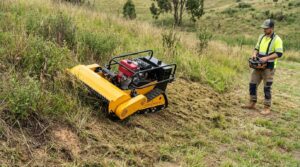
3. Overgrown Grass and Dense Vegetation
Landscaping contractors may also receive vegetation-management jobs rather than routine lawn mowing.
These projects can involve:
- Tall grass
- Weeds
- Brush
- Wild vegetation
- Unmaintained property
- Field edges
- Vacant land
- Property boundaries
For these conditions, contractors should pay close attention to the cutting system.
A machine designed primarily for fine lawn finishing may not be the same as a mower configured for dense vegetation.
For tougher vegetation, a remote control flail mower can be an option worth evaluating.
Flail mowing systems use multiple cutting tools mounted on a rotating rotor and are commonly considered for grass, weeds and vegetation-management applications.
Remote Control Lawn Mower for Overgrown Grass
4. Roadside and Property-Edge Vegetation
Commercial landscaping companies sometimes work near:
- Roads
- Parking areas
- Drainage channels
- Property boundaries
- Green belts
- Embankments
- Access roads
These locations can combine vegetation with uneven terrain or restricted working areas.
A remote-controlled mower can allow the operator to control the machine from a distance while maintaining a clear view of the equipment and surrounding work area.
Contractors should still establish appropriate work-zone controls, traffic management, exclusion zones and operating procedures for each site.
Remote Control Lawn Mower for Roadside Vegetation Management
5. Parks and Large Green Spaces
Landscaping contractors responsible for maintaining parks or large public spaces may need equipment capable of covering different vegetation zones.
Typical areas include:
- Open grass
- Slopes
- Tree-lined areas
- Drainage zones
- Field edges
- Large lawns
- Rough grass areas
The most appropriate machine may differ from one section of the property to another.
A wider cutting deck can be useful for open areas, while a more compact machine may be easier to maneuver around obstacles.
Remote Control Lawn Mower for Municipal Parks
What Should Landscaping Contractors Look for?
Choosing a commercial remote control mower requires more than comparing engine horsepower.
A practical evaluation should consider the entire operating system.
1. Cutting Width
Cutting width directly affects how much vegetation the machine can cover during each pass.
For example, a compact mower may be appropriate for:
- Narrow areas
- Orchards
- Complex landscaping
- Smaller properties
A wider mower may be more suitable for:
- Large grass areas
- Commercial properties
- Large estates
- Open fields
However, a wider cutting deck also increases machine dimensions.
Contractors should compare:
Cutting width + transport dimensions + site access + expected workload
rather than choosing the widest mower automatically.
2. Gradeability
For contractors working on hillsides, gradeability is an important specification.
Manufacturers may publish maximum slope or gradeability figures such as 45° or 55°.
These figures should not be interpreted as a universal guarantee for every site.
Actual performance can depend on:
- Ground surface
- Soil moisture
- Tire or track condition
- Vegetation
- Slope direction
- Machine configuration
- Operator technique
- Weather conditions
Contractors should request detailed operating recommendations from the manufacturer before purchasing equipment for steep terrain.
3. Remote Control Range
Remote-control distance can influence how contractors operate the mower.
A longer stated control range may provide more flexibility on large properties.
However, range should not be considered independently.
Contractors should also evaluate:
- Signal stability
- Visibility
- Terrain obstruction
- Battery life
- Emergency stop functions
- Controller ergonomics
For professional work, consistent machine response can be more important than simply selecting the largest advertised range.
4. Engine and Power System
Commercial contractors should examine the complete powertrain.
Depending on the machine, configurations may include:
- Gasoline engines
- Diesel engines
- Electric drive motors
- Brushless travel motors
- Hybrid systems
The right configuration depends on expected workload and operating environment.
For example, a contractor operating heavy-duty equipment for long vegetation-management projects may have different requirements from a landscaping company focused mainly on smaller commercial lawns.
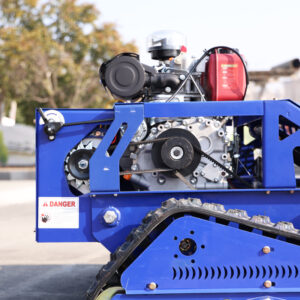
Crawler vs. Wheel Remote Control Mowers for Contractors
Landscaping contractors should decide whether a crawler or wheel configuration better matches their projects.
Crawler Remote Control Mower
Crawler machines are generally suited to applications where traction and terrain adaptability are important considerations.
Potential applications include:
- Slopes
- Rough terrain
- Orchards
- Embankments
- Uneven grassland
- Dense vegetation
For contractors handling difficult terrain regularly, a tracked configuration may be worth considering.
Wheel Remote Control Mower
Wheel-based machines can be suitable for:
- Flat lawns
- Parks
- Open grass areas
- Farms
- Large accessible properties
They may provide a practical solution where extreme terrain capability is not the primary requirement.
There is no single configuration that fits every landscaping business.
The decision should be based on the company’s actual project mix.
Crawler vs Wheel Remote Control Lawn Mower
Flail Mower or Rotary Mower?
The cutting system is another important decision.
Rotary Mower
Rotary systems can be suitable for many conventional grass-cutting applications.
They may be considered when contractors primarily maintain:
- Regular lawns
- Open grass
- Parks
- Large maintained areas
Flail Mower
Flail systems may be more appropriate when vegetation-management requirements include:
- Tall grass
- Weeds
- Brush
- Rough vegetation
- Overgrown areas
Contractors should match the cutting system to the vegetation they actually encounter.
Remote Control Flail Mower vs Rotary Mower
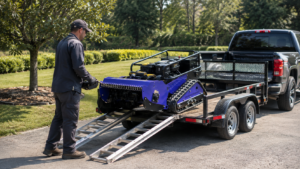
Transport Matters for Landscaping Contractors
A mower may perform well on the job site but still create operational problems if it is difficult to transport.
Contractors should evaluate:
- Machine weight
- Overall width
- Overall length
- Loading method
- Trailer requirements
- Vehicle payload
- Storage requirements
- Loading and unloading time
For companies managing multiple projects in different locations, transport efficiency can influence overall fleet productivity.
A compact machine may be easier to move between sites, while a larger machine may provide a wider cutting path.
The correct choice depends on project scale.
Maintenance and Spare Parts
For professional contractors, equipment downtime can affect project scheduling.
Before purchasing a remote control mower, ask the manufacturer about:
- Engine service
- Hydraulic components
- Drive motors
- Controller maintenance
- Cutting blades
- Belts
- Filters
- Batteries
- Electrical components
- Replacement tracks
- Spare parts availability
A B2B supplier should ideally provide clear information about maintenance intervals and replacement components.
Contractors should also understand which maintenance tasks can be handled locally and which require specialized technical support.
Operator Training Is Still Important
Remote operation does not eliminate the need for trained operators.
A professional landscaping company should establish procedures covering:
- Pre-operation inspection
- Remote controller operation
- Emergency stop procedures
- Terrain assessment
- Safe working distance
- Obstacle identification
- People and vehicle exclusion zones
- Machine recovery
- Shutdown procedures
- Routine maintenance
Operators should understand both the machine and the limitations of remote control.
A remote mower should never be treated as an autonomous machine unless it is specifically designed and certified for autonomous operation.
Using Remote Mowers for Contract Landscaping Work
The commercial value of remote mowing equipment can also be considered from a contract-management perspective.
A landscaping contractor may bid on projects involving:
- Slope mowing
- Commercial property maintenance
- Vegetation clearing
- Large estate maintenance
- Orchard mowing
- Roadside vegetation management
- Industrial property maintenance
- Solar farm vegetation control
- Municipal landscaping
The mower becomes part of the company’s overall service capability.
This can allow contractors to evaluate jobs based on:
Site conditions → Required equipment → Labor requirements → Transport → Maintenance → Project schedule
Instead of simply asking:
“How much does the mower cost?”
A contractor should ask:
“Which types of projects can this machine support, and does it fit our existing operation?”
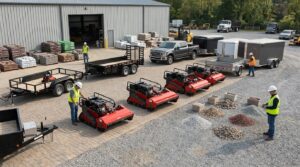
Building a Remote Mower Fleet
For larger landscaping companies, one machine may eventually become part of a broader fleet.
A fleet strategy could include different machine sizes.
Compact Remote Mower
Suitable for:
- Smaller properties
- Orchards
- Narrow access areas
- Detailed vegetation work
Medium-Duty Remote Mower
Suitable for:
- Commercial landscaping
- Parks
- Estates
- Mixed vegetation
Heavy-Duty Remote Mower
Suitable for:
- Large properties
- Slopes
- Dense vegetation
- Industrial sites
- Agricultural land
Standardizing machines where possible can also simplify:
- Operator training
- Spare parts
- Maintenance
- Transport
- Purchasing
- Dealer support
Choosing the Right AWY Remote Control Lawn Mower
For B2B landscaping applications, different AWY mower configurations can be considered according to terrain and workload.
AWY-550H
A compact crawler mower designed for applications where maneuverability and remote operation are important.
Key specifications include:
- 550 mm cutting width
- 224 cc gasoline engine
- Dual 750 W brushless drive motors
- Up to 500 m stated remote-control range
- 20–150 mm cutting height
- Up to 45° stated gradeability
This type of machine can be considered for landscaping contractors working on smaller commercial properties, orchards, slopes and rough grass areas.
AWY-800S
The AWY-800S provides a wider 800 mm cutting width and is designed for professional vegetation-management applications.
Key specifications include:
- 800 mm cutting width
- 360 kg machine weight
- Up to 55° stated gradeability
- Around 1,500 m²/h stated mowing capacity
- 459 cc gasoline or diesel configuration
- 850 W brushless walking motor
- Up to 500 m stated remote-control range
It can be considered for contractors handling orchards, hillsides, embankments, golf courses and larger landscaping projects.
AWY-900
For contractors looking for a larger all-terrain configuration, the AWY-900 offers:
- 900 mm cutting width
- Up to 55° stated gradeability
- Around 2,000 m²/h stated mowing capacity
- 1,500 W × 2 brushless walking motors
- 2–20 cm remote-adjustable cutting height
- 0–6 km/h operating speed
- 6 L fuel tank
The model can be considered for larger commercial landscaping and challenging terrain applications.
AWY-1000S and AWY-1200S
For contractors handling larger mowing areas, wider cutting configurations can help reduce the number of passes required under suitable operating conditions.
The AWY-1000S and AWY-1200S are positioned for larger grass areas, farms, orchards, slopes and professional landscaping applications.
Contractors should compare actual site access, transport requirements and cutting conditions before selecting a wider machine.
What Should B2B Buyers Ask the Manufacturer?
Before placing a commercial order, landscaping contractors should request detailed information.
Product Questions
- What is the actual cutting width?
- What vegetation is the mower designed to handle?
- What is the recommended maximum slope?
- What is the machine weight?
- What is the remote-control range?
- What engine options are available?
- What cutting-height adjustments are available?
Commercial Questions
- What is the minimum order quantity?
- Are dealer prices available?
- Are OEM or private-label options available?
- Can machine specifications be customized?
- What spare parts are available?
- What is the warranty policy?
- What after-sales support is provided?
- What export documentation is available?
- What packaging is used for international shipment?
- What is the estimated production lead time?
These questions can help contractors evaluate not only the mower itself but also the supplier relationship.
OEM and Private-Label Opportunities for Landscaping Equipment Dealers
Some landscaping businesses are also equipment distributors or regional dealers.
For these companies, OEM and private-label cooperation may be relevant.
Potential customization options can include:
- Machine color
- Brand logo
- Cutting width
- Engine configuration
- Control system
- Product labeling
- Packaging
- Market-specific configurations
A manufacturer with established production capabilities may be able to support dealers that want to develop their own remote mowing equipment range.
For B2B buyers, it is important to confirm customization requirements before placing an order.
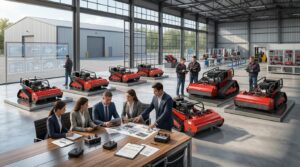
Remote Control Lawn Mower Buying Checklist for Contractors
Before purchasing, use the following checklist.
Application
☐ What types of properties will the mower maintain?
☐ Is the main application lawn mowing or vegetation management?
☐ Will the machine work on slopes?
☐ Will it cut tall grass or brush?
Machine
☐ Cutting width
☐ Engine type
☐ Drive system
☐ Cutting system
☐ Gradeability
☐ Cutting height
☐ Remote-control range
Logistics
☐ Machine dimensions
☐ Machine weight
☐ Trailer compatibility
☐ Loading method
☐ Storage requirements
After-Sales
☐ Spare parts
☐ Warranty
☐ Technical support
☐ Maintenance requirements
☐ Operator training
B2B Supply
☐ MOQ
☐ OEM availability
☐ Customization options
☐ Production capacity
☐ Export packaging
☐ Lead time
Frequently Asked Questions
Is a remote control lawn mower suitable for landscaping contractors?
Yes, remote control lawn mowers can be suitable for landscaping contractors working on applications such as commercial properties, slopes, orchards, parks, overgrown areas and other vegetation-management projects. The appropriate model depends on site conditions and cutting requirements.
Are remote control mowers good for commercial landscaping?
They can be useful for certain commercial landscaping applications, particularly where terrain, vegetation or access conditions create challenges for conventional mowing equipment.
What type of remote mower is best for slopes?
Tracked remote control mowers are commonly considered for slope applications because their crawler configuration can provide continuous ground contact. Contractors should evaluate the manufacturer’s gradeability specifications and actual site conditions before operation.
Should landscaping contractors choose a flail mower?
A flail mower may be worth considering when the contractor regularly handles tall grass, weeds, brush or rough vegetation. For regularly maintained lawns, another cutting configuration may be more appropriate.
How far can a remote control mower operate?
Remote-control range varies by model. Some professional machines specify ranges of several hundred meters under suitable conditions. Actual usable range can be affected by terrain, obstructions and signal conditions.
Can remote control mowers be customized for landscaping businesses?
Some manufacturers provide OEM and customization services. Depending on the supplier, customization may include color, branding, cutting width, engine configuration and other product specifications.
What should contractors consider before buying a remote mower?
Contractors should consider application, terrain, vegetation type, cutting width, gradeability, transport, maintenance, spare parts, operator training, supplier support and total fleet requirements.
Conclusion
For professional landscaping contractors, equipment selection should start with the work rather than the machine.
A remote control lawn mower can be a practical option for selected commercial applications involving slopes, rough terrain, tall grass, dense vegetation, orchards, parks, industrial properties and other challenging mowing environments.
The key is matching the machine to the contractor’s actual workload.
Before purchasing, evaluate:
- Terrain
- Vegetation
- Cutting width
- Cutting system
- Gradeability
- Remote-control range
- Transport
- Maintenance
- Spare parts
- Operator training
- Supplier support
- OEM requirements
For landscaping companies building or expanding a commercial equipment fleet, working directly with an experienced manufacturer can also provide opportunities for product customization, dealer cooperation and long-term B2B supply.
If you are looking for a remote control lawn mower for landscaping contracting work, provide your application, terrain, vegetation type, required cutting width, target market and expected quantity. A suitable machine configuration can then be evaluated according to your project requirements.
Request a B2B Remote Control Mower Solution
Tell us about your landscaping projects and equipment requirements.
We can help evaluate suitable remote control mower configurations for commercial landscaping, slope mowing, vegetation management and other professional applications.
Recommended information to include:
- Application
- Terrain
- Grass or vegetation type
- Cutting width
- Required quantity
- Destination country
- OEM/private-label requirements
Related Articles
Remote Control Lawn Mower for Steep Slopes
Remote Control Lawn Mower for Overgrown Grass
Crawler vs Wheel Remote Control Lawn Mower
Remote Control Flail Mower vs Rotary Mower
Remote Control Lawn Mower for Municipal Parks