
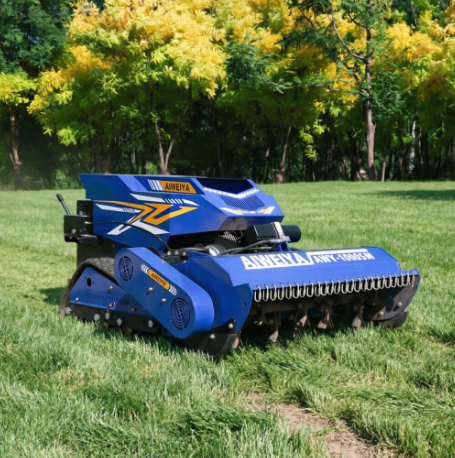
Farm properties often contain much more than regularly maintained grass.
Farmers and agricultural contractors may need to manage grass around fields, orchards, access roads, drainage areas, embankments, unused land and property boundaries.
These areas can quickly become covered with:
- Tall grass
- Weeds
- Brush
- Thick vegetation
- Fallen plants
- Rough vegetation
- Uneven ground
A conventional lawn mower may not always be the most practical solution for these conditions.
A remote control lawn mower for farms provides an alternative approach. The operator can control the mower remotely while the machine cuts vegetation across large or difficult outdoor areas.
For agricultural users, the right machine should be selected according to terrain, vegetation, cutting width, machine power, traction and expected workload.
This guide explains how to choose a remote control farm mower and what features matter most for agricultural vegetation management.
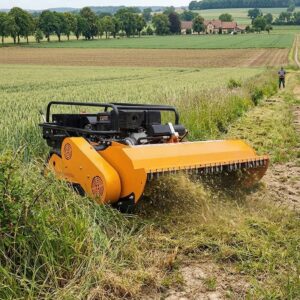
Why Do Farms Need Specialized Mowing Equipment?
Farm vegetation management is different from residential lawn maintenance.
A residential lawn is usually:
- Regularly maintained
- Relatively flat
- Free from large obstacles
- Consistent in grass height
Farm land can be very different.
You may encounter:
- Uneven terrain
- Long grass
- Dense weeds
- Slopes
- Soft soil
- Stones
- Tree roots
- Ditches
- Rough field edges
A professional farm mower therefore needs to handle more demanding conditions.
This is where remote-controlled agricultural mowing equipment can provide an advantage.
Where Can a Remote Control Mower Be Used on a Farm?
A remote control mower does not have to be limited to the main field.
It can potentially be used in multiple areas around an agricultural property.
1. Field Edges
Grass and weeds can grow rapidly along field boundaries.
Regular vegetation control can help keep these areas manageable.
2. Farm Roads
Access roads and tracks can develop vegetation along their edges.
A remote control grass cutter can help maintain these areas without requiring a large tractor-mounted implement.
3. Orchard Areas
Orchards often require vegetation management between and around tree rows.
A compact remote-controlled mower can be useful where maneuverability is important.
Remote Control Lawn Mower for Orchards
4. Sloped Farm Land
Some farms contain hillsides and sloping areas that are difficult to mow with conventional equipment.
A crawler remote control mower can be considered for these applications.
Remote Control Lawn Mower for Steep Slopes
5. Drainage Embankments
Drainage channels and embankments can contain dense grass and weeds.
The mower should be selected according to the actual slope and terrain conditions.
6. Unused Agricultural Land
Unused sections of a farm can become heavily overgrown.
A heavy-duty remote control flail mower can be particularly useful for these areas.
Remote Control Lawn Mower for Overgrown Grass
What Type of Farm Mower Should You Choose?
There is no single best farm mower for every agricultural property.
The right machine depends on your working conditions.
Flat and Open Farm Land
A wheel-based remote control mower can be an efficient option when the terrain is firm and relatively flat.
Uneven Farm Land
A crawler configuration may provide additional traction and stability.
Sloped Agricultural Areas
Crawler machines are often a strong starting point when slope capability is important.
Tall Grass and Dense Weeds
A flail cutting system can be more suitable for rough vegetation.
Large Areas
A wider cutting deck can reduce the number of passes required.
The most important point is to match the complete machine configuration to the application.
Crawler vs Wheel Farm Mower
The drive system is one of the first things agricultural buyers should evaluate.
| Requirement | Crawler Mower | Wheel Mower |
|---|---|---|
| Flat farmland | Excellent | Excellent |
| Open grassland | Excellent | Excellent |
| Uneven terrain | Strong | Model dependent |
| Slopes | Strong application fit | Model dependent |
| Soft ground | Strong | Model dependent |
| Orchard terrain | Strong | Suitable |
| Farm roads | Suitable | Suitable |
| Embankments | Strong application fit | More terrain dependent |
| Rough vegetation | Excellent with suitable cutting system | Good |
| Transportation | Model dependent | Often convenient |
For farms with mixed terrain, a crawler mower can provide greater versatility.
Why Are Crawler Tracks Useful on Farms?
Agricultural properties can contain terrain that changes from one section to another.
A machine may move from:
Flat field → uneven field edge → soft soil → slope → orchard
A crawler platform can provide strong ground contact across changing terrain.
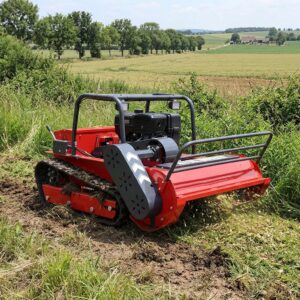
How Wide Should a Farm Mower Be?
Cutting width is directly related to mowing productivity.
A wider mower can cover more ground in each pass.
However, bigger is not always better.
A large machine may be difficult to maneuver around:
- Trees
- Buildings
- Narrow farm roads
- Fences
- Orchard rows
- Small fields
Consider your actual working environment.
Around 550 mm
Suitable for applications where compact size and maneuverability are important.
Around 800 mm
A good middle ground for many professional landscaping and agricultural applications.
Around 1000 mm
Suitable when wider coverage is more important.
Around 1200 mm
More suitable for large-area and heavy-duty vegetation management where site conditions allow.
Engine Power and Farm Mowing
Engine power should be considered together with the cutting system.
A mower working in short grass requires less cutting effort than one processing dense weeds and tall vegetation.
Before selecting a machine, consider:
- Grass height
- Vegetation density
- Cutting width
- Cutting height
- Travel speed
- Slope
- Soil conditions
A high-power engine does not automatically guarantee better mowing performance.
The cutting system, transmission and overall machine design must work together.
Flail Mower for Farm Vegetation
A remote control flail mower for farms can be useful when vegetation is more demanding than ordinary lawn grass.
Flail systems are commonly considered for:
- Tall grass
- Dense weeds
- Rough fields
- Orchard vegetation
- Field boundaries
- Embankments
- Mixed vegetation
Instead of relying on a small number of large horizontal blades, a flail system uses multiple cutting tools mounted around a rotating rotor.
This configuration can make it suitable for professional vegetation management.
Remote Control Flail Mower vs Rotary Mower
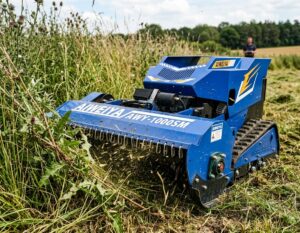
Remote Control Operation for Agricultural Mowing
One of the major differences between a remote control mower and conventional ride-on equipment is the operator position.
The operator can control the mower remotely rather than sitting directly on the machine.
Depending on the model, remote functions may include:
- Forward
- Reverse
- Steering
- Travel speed
- Cutting operation
- Cutting-height adjustment
- Engine functions
- Start and stop
This can make remote operation particularly practical for difficult or restricted mowing areas.
However, remote operation does not eliminate the need for proper safety procedures.
Operators should always:
- Maintain visual contact
- Keep people away from the working area
- Inspect the terrain
- Follow the manufacturer’s instructions
- Avoid unauthorized operation
- Check the machine before use
Farm Mowing Productivity
Productivity depends on several variables.
A simplified way to think about mowing capacity is:
Working Width × Travel Speed × Operating Efficiency = Practical Productivity
For example, increasing cutting width can reduce the number of passes required.
However, actual productivity may decrease when:
- Grass becomes extremely dense
- Terrain becomes steep
- Obstacles increase
- The operator must make frequent turns
- Cutting height needs to be adjusted
- Ground conditions become difficult
Therefore, published theoretical capacity should not be treated as guaranteed real-world output.
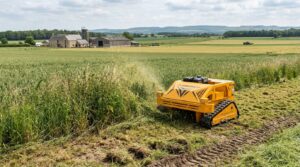
Remote Control Mower vs Tractor Mower
For some farms, the question is not only crawler vs wheel.
It may also be:
Should I use a remote control mower or tractor-mounted mowing equipment?
Both have their place.
| Feature | Remote Control Mower | Tractor-Mounted Mower |
|---|---|---|
| Small restricted areas | Excellent | Limited |
| Slopes | Strong application fit | Depends on tractor |
| Operator exposure | Remote operation | Operator sits on tractor |
| Narrow areas | Often suitable | Model dependent |
| Large open fields | Suitable | Excellent |
| Transportation | Relatively simple for compact models | Tractor required |
| Multi-purpose tractor use | No | Yes |
| Rough vegetation | Strong with suitable cutter | Strong with suitable implement |
A tractor remains an extremely valuable agricultural machine.
However, a remote control mower can complement existing farm equipment rather than necessarily replacing it.
When Should a Farm Consider a Remote Control Mower?
A remote mower can make particular sense when a farm frequently deals with difficult vegetation.
Consider one if you regularly maintain:
- Steep grass banks
- Field boundaries
- Orchard slopes
- Rough grassland
- Drainage areas
- Roadside vegetation
- Overgrown land
- Areas unsuitable for larger machinery
If most of your mowing occurs on flat, open fields, conventional tractor equipment may remain the more efficient primary solution.
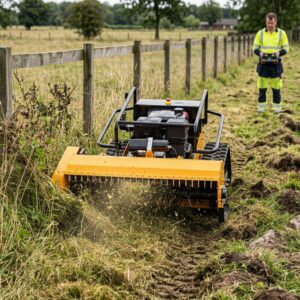
Choosing a Farm Mower Based on Terrain
Before buying, divide your property into different mowing zones.
Zone A — Flat Field
Prioritize:
- Cutting width
- Productivity
- Transport
- Operating cost
Zone B — Orchard
Prioritize:
- Machine width
- Maneuverability
- Cutting height
- Ground clearance
Zone C — Slopes
Prioritize:
- Gradeability
- Traction
- Stability
- Remote control
Zone D — Rough Vegetation
Prioritize:
- Engine power
- Flail cutting system
- Cutting durability
- Ground protection
This approach is more useful than trying to find one specification that solves every problem.
AWY Remote Control Mowers for Agricultural Applications
AWY offers multiple crawler remote control mower configurations that can be considered for agricultural vegetation management.
For compact agricultural applications, the AWY-550 provides a 550 mm cutting width and crawler design.
For larger professional mowing requirements, the AWY-800S series provides an 800 mm cutting width and is designed for applications including orchards, hillsides, embankments and rough vegetation.
For larger areas, AWY also provides 1000 mm and 1200 mm crawler mower configurations.
The best model depends on:
- Farm size
- Terrain
- Vegetation
- Required cutting width
- Daily mowing hours
- Slope
- Transportation
- Desired configuration
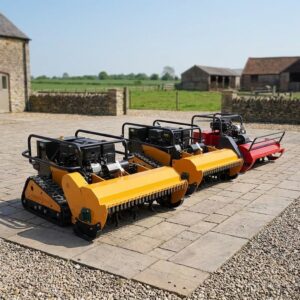
AWY Crawler Remote Control Mower Products
How to Calculate the Right Cutting Width
Use your farm layout as the starting point.
If most mowing areas are:
Wide and open
→ Consider a wider mower.
Narrow or obstructed
→ Consider a more compact model.
Between orchard rows
→ Measure row spacing before purchasing.
Mixed terrain
→ Prioritize the complete machine configuration rather than width alone.
For commercial users, the ideal mower often represents a balance between productivity and accessibility.
Farm Mower Maintenance
Agricultural mowing equipment operates in demanding environments.
Regular maintenance can help reduce unexpected downtime.
Important inspection areas include:
Engine
Check:
- Oil
- Filters
- Fuel system
- Cooling system
Cutting System
Check:
- Blades or flails
- Rotor
- Fasteners
- Cutting deck
Drive System
For crawler models, inspect:
- Tracks
- Rollers
- Sprockets
- Track tension
- Drive components
Remote Control System
Check:
- Battery
- Controller
- Signal
- Control response
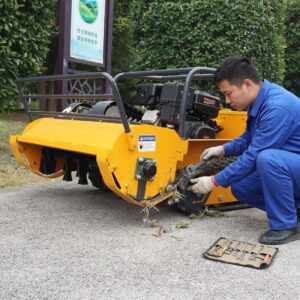
Farm Remote Control Mower Buying Checklist
Before requesting a quotation, prepare the following information.
Farm Information
- Total mowing area
- Main mowing locations
- Number of mowing days per year
Terrain
- Flat
- Rolling
- Uneven
- Sloped
- Steep
Vegetation
- Short grass
- Tall grass
- Weeds
- Brush
- Mixed vegetation
Machine Requirements
- Cutting width
- Engine type
- Remote range
- Cutting-height adjustment
- Crawler or wheel
Business Requirements
- Quantity
- Destination country
- Spare parts
- Warranty
- OEM branding
- Custom color
- Certification requirements
Providing these details allows the manufacturer to recommend a more appropriate configuration.
Frequently Asked Questions
What is the best remote control mower for a farm?
There is no single best model for every farm. Choose according to terrain, vegetation, cutting width, working area and required productivity.
Can a remote control mower replace a tractor?
Usually, it should be viewed as complementary equipment rather than a universal tractor replacement. Remote mowers are particularly useful for areas where compact size, remote operation or terrain capability is important.
Can a remote control mower cut tall farm grass?
Yes, suitable heavy-duty models can be configured for tall grass and dense vegetation. Cutting performance depends on the mower configuration and actual vegetation conditions.
Are crawler mowers good for farmland?
Crawler mowers can be useful on uneven, soft or sloped agricultural land. For flat and firm fields, wheel machines can also be effective.
What cutting width should I choose?
Choose based on the area being mowed. Wider machines can improve coverage, while compact machines can be easier to maneuver around trees, fences and restricted areas.
Can a remote control mower work in an orchard?
Yes. Compact remote-controlled mowers can be useful in orchards, particularly where row spacing, uneven terrain or slopes make conventional mowing more difficult.
Is a flail mower suitable for farm weeds?
A flail mower can be a strong option for tall grass, weeds and rough vegetation, provided the vegetation is within the manufacturer’s recommended operating range.
Final Thoughts
Choosing a remote control lawn mower for farms starts with understanding your land.
A farm may contain several different mowing environments, from flat fields and orchard rows to steep banks and rough vegetation.
For flat areas, a wheel mower may provide an efficient solution.
For difficult terrain, a crawler mower can offer stronger traction and versatility.
For tall grass and dense weeds, a heavy-duty flail cutting system can be particularly useful.
The most important factors are:
- Terrain
- Vegetation
- Cutting width
- Engine power
- Cutting system
- Traction
- Gradeability
- Remote-control functions
- Maintenance
- After-sales support
Instead of choosing a mower based only on horsepower or price, evaluate how the machine will perform across your actual farm.
Request a Farm Remote Control Mower Recommendation
If you are looking for a professional remote control farm mower, send the manufacturer:
Farm Area + Terrain + Vegetation + Slope + Required Cutting Width + Quantity
With this information, the manufacturer can recommend a suitable mower configuration for your agricultural application.
Looking for a crawler remote control mower for your farm? Contact AWY for a professional agricultural mowing solution.
Related Articles
- What Is a Remote Control Lawn Mower?
- How Does a Remote Control Lawn Mower Work?
- How to Choose a Remote Control Lawn Mower
- Remote Control Lawn Mower Buying Guide
- Remote Control Lawn Mower for Steep Slopes
- Remote Control Lawn Mower for Orchards
- Remote Control Lawn Mower for Overgrown Grass
- Crawler vs Wheel Remote Control Lawn Mower
- Remote Control Flail Mower vs Rotary Mower