
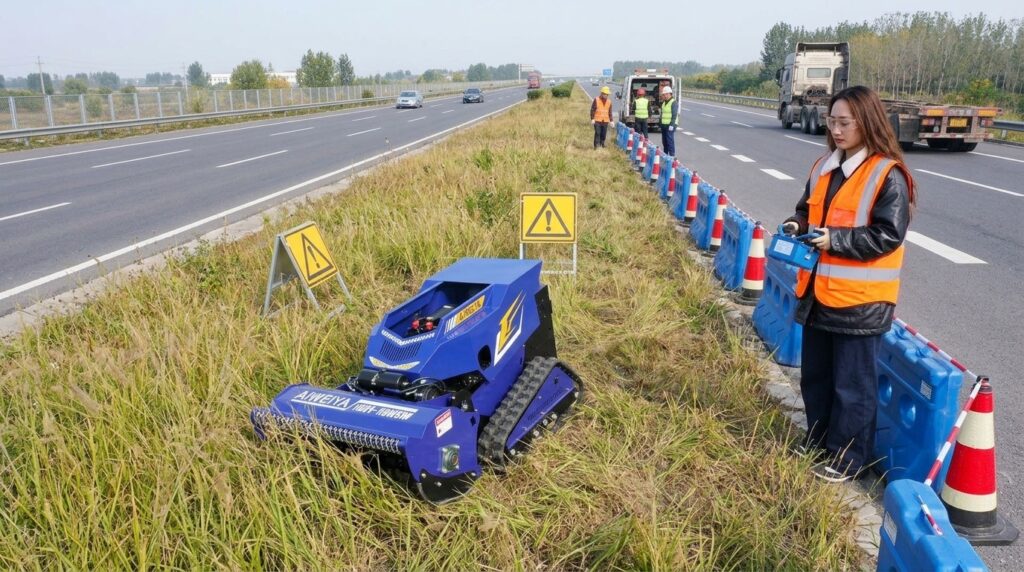
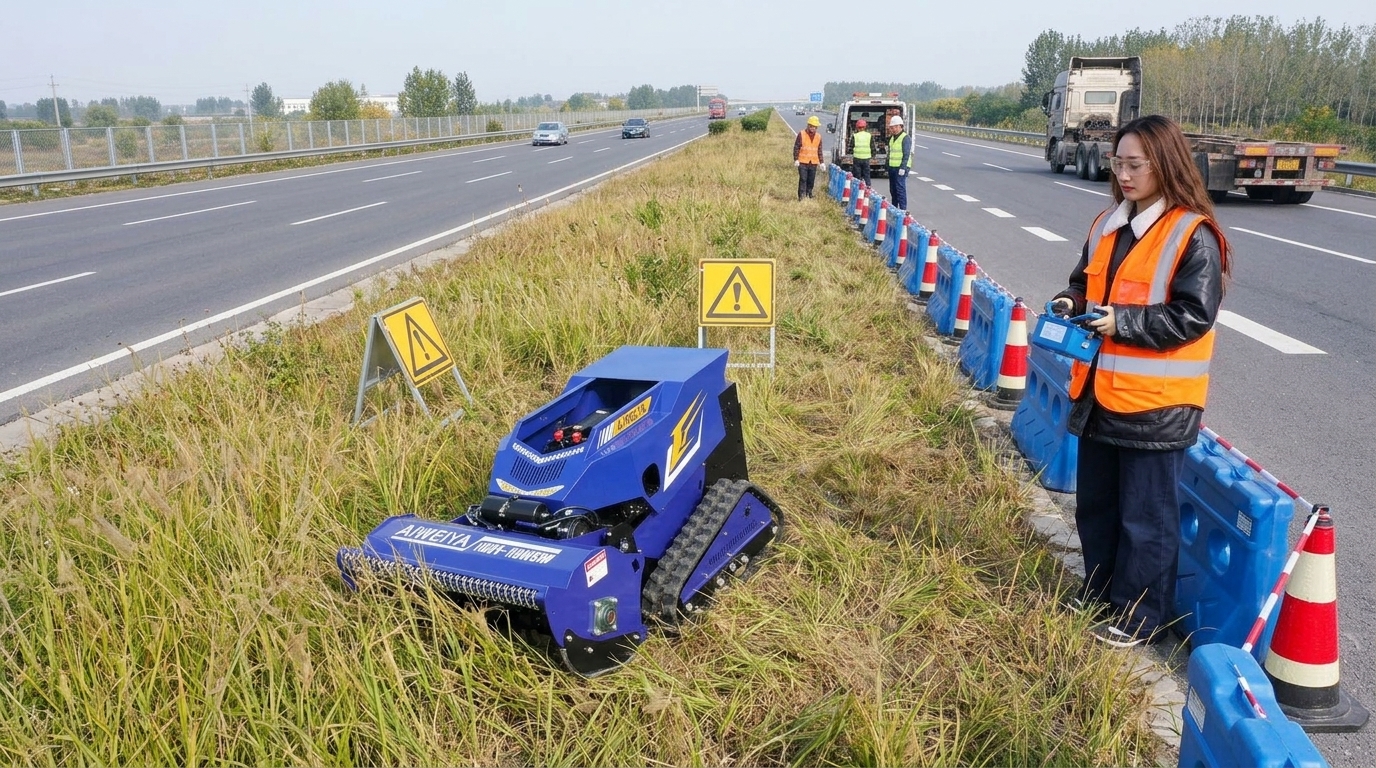
Introduction: Improving Roadside Vegetation Maintenance with the Right Equipment
Roadside vegetation maintenance is an ongoing responsibility for highway contractors, municipal service providers, road maintenance companies and infrastructure management teams.
Grass and weeds grow along road verges, drainage channels, embankments, access roads and the boundaries of transportation infrastructure. If these areas are not maintained according to the relevant maintenance plan, vegetation may obstruct sightlines, interfere with inspections or complicate routine roadside work.
However, roadside mowing is different from maintaining an ordinary lawn. Contractors may need to work on uneven ground, manage narrow strips of vegetation, coordinate with traffic-control teams and operate within strict work-zone boundaries.
A remote control lawn mower for roadside maintenance contractors may be suitable for selected vegetation-maintenance tasks where the machine’s cutting capability, terrain limits and operating requirements match the job.
Remote operation allows the operator to control the mower from a separate position rather than walking directly behind it. This can be useful when evaluating certain sloped or difficult-to-access areas, but it does not remove the need for traffic management, trained operators or site-specific risk assessments.
This guide explains how contractors can evaluate remote control lawn mowers for roadside work, compare machine configurations and plan equipment purchases for recurring maintenance contracts.
1. Why Roadside Maintenance Contractors Need Specialized Equipment
Roadside maintenance work includes more than cutting grass beside a road. Contractors may maintain highway verges, rural road boundaries, drainage margins, access-road slopes and large areas of vegetation around transportation infrastructure.
The equipment required depends on the terrain, vegetation and operating environment.
1.1 Maintaining Road Verges
A road verge is the strip of land alongside a road, often covered with grass or low vegetation.
Some verges are wide and relatively flat, while others are narrow, uneven or interrupted by signs, barriers, drainage structures and utility equipment.
A remote control mower may be considered for suitable verges where the machine can operate within the designated maintenance area without interfering with road users or roadside infrastructure.
Before selecting a machine, contractors should measure the available working width and identify access points, obstacles and areas that require a different maintenance method.
1.2 Managing Roadside Embankments
Road embankments may require regular vegetation control to support maintenance access and preserve the intended appearance of the roadside landscape.
A tracked remote control mower may be worth evaluating for suitable embankments, particularly where conventional mowing equipment is difficult to position.
However, slope suitability depends on more than the advertised maximum gradeability. Ground stability, moisture, slope direction, surface erosion, vegetation and the manufacturer’s operating limits must all be considered.
For additional guidance, read:
Remote control mowing on steep slopes
1.3 Maintaining Rural Roads and Access Routes
Rural roads and private access routes can have long grass strips, uneven shoulders and vegetation around drainage channels.
Contractors may need to maintain these areas regularly over a large service area.
A remote mower may be suitable for designated grass-cutting tasks when access, visibility, traffic separation and ground conditions permit. The machine should not be operated on an active road or shoulder exposed to traffic unless an approved work-zone plan and applicable regulations specifically allow the activity.
1.4 Managing Vegetation Around Drainage Infrastructure
Grass and weeds may grow around roadside ditches, drainage outlets and channels.
Before mowing these areas, contractors should identify the location of drains, culverts, exposed pipes, inspection chambers and unstable edges.
A mower should not be operated near an unprotected drop or on a soft drainage bank unless the machine and conditions have been specifically assessed as suitable.
1.5 Maintaining Large Transportation Property Boundaries
Road maintenance contractors may also be responsible for vegetation around service compounds, roadside facilities, maintenance depots and other transportation-related properties.
These locations may offer more predictable working conditions than exposed highway shoulders, depending on their layout.
A remote mower may be considered for suitable grass areas after the work zone has been inspected and separated from vehicles, pedestrians and other site activities.
For related commercial applications, see:
Remote control mowers for large facilities
2. What Roadside Vegetation Tasks Can a Remote Mower Handle?
The first step in equipment selection is to define the work. A remote control lawn mower is primarily a vegetation-cutting machine, not a complete roadside clearing system.
2.1 Routine Grass Cutting
Routine mowing is generally the most straightforward application to evaluate.
Contractors can consider remote mowers for suitable grass strips, designated roadside slopes and maintenance areas where the vegetation falls within the machine’s specified cutting capability.
The required cutting height and frequency should follow the contract specifications, local maintenance standards and site conditions.
2.2 Tall Grass and Selected Weeds
Some roadside areas receive less frequent maintenance and may develop taller grass or mixed weeds.
A heavy-duty mower or suitable flail-mower configuration may be worth evaluating for these tasks. Actual suitability depends on vegetation density, material size, cutting mechanism, machine power and operating conditions.
Contractors should not assume that every mower can handle woody brush, saplings or dense vegetation simply because it is marketed as heavy-duty equipment.
2.3 Vegetation Along Barriers and Fencing
Grass may grow around roadside fencing, property boundaries and other fixed infrastructure.
The main equipment considerations are cutting width, maneuverability, obstacle clearance and access.
Where fencing or barriers restrict movement, a compact machine may be more appropriate than a wider model. Contractors should also verify that the cutting system is suitable for the vegetation and will not damage nearby infrastructure.
2.4 Grass Around Drainage Channels
Some drainage margins require periodic mowing to maintain the intended vegetation height.
The contractor must confirm that the bank is stable, the channel edge is clearly identified and the machine can operate within its approved limits.
Where the ground is waterlogged, eroded or structurally uncertain, mowing should be postponed until the site has been assessed and made suitable for the task.
2.5 What Remote Lawn Mowers Cannot Replace
Remote mowers should not automatically be used for:
- Removing fallen trees or large branches.
- Cutting substantial woody brush beyond the machine’s rated capability.
- Removing road debris, metal waste or discarded construction materials.
- Operating through unidentified cables or buried-service hazards.
- Performing traffic-control duties or replacing road-closure equipment.
- Replacing excavators, forestry mulchers or dedicated brush-clearing machinery.
For heavy clearing or debris removal, contractors should use equipment designed for that task. The area can then be assessed for routine mowing once the hazards have been addressed.
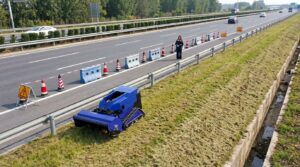
3. Roadside Work-Zone Safety and Site Assessment
Roadside work introduces hazards that are not always present in ordinary landscaping. Traffic, uneven ground, hidden utilities and limited visibility can affect the suitability of a mowing operation.
A remote mower must be used as part of an approved roadside maintenance procedure.
3.1 Establish Traffic Controls Before Mowing
Before starting work near a public road, contractors should coordinate with the responsible road authority or site manager.
Depending on the location and the work, the plan may require temporary traffic management, signs, barriers, lane restrictions or a designated exclusion zone.
The required controls depend on local regulations, road speed, traffic volume, sightlines and the exact work location.
Do not assume that remote operation alone makes mowing beside live traffic acceptable.
3.2 Inspect the Ground and Remove Hazards
Roadside areas can contain rocks, broken glass, metal fragments, litter, branches and other debris.
These objects can damage cutting components or become dangerous projectiles. Inspect the work area and remove hazards using approved procedures before mowing.
Do not use the mower to process unknown roadside waste.
3.3 Identify Utilities and Roadside Infrastructure
Road verges may contain communication cables, electrical equipment, irrigation lines, drainage infrastructure, utility markers and underground services.
Identify relevant services and follow the site requirements before operating near them.
Do not mow over exposed cables or enter areas where the location of a utility is uncertain. Consult the responsible authority or utility provider when necessary.
3.4 Assess Slope Stability and Surface Conditions
Road embankments can have loose soil, erosion, wet grass and uneven surfaces.
Check for:
- Soft or waterlogged ground.
- Unstable slope edges.
- Erosion channels and exposed roots.
- Unexpected holes or depressions.
- Steep cross-slopes.
- Loose gravel and surface material.
- Areas where the machine could slide or overturn.
A machine’s published maximum gradeability is not a universal safe operating limit. Follow the manufacturer’s instructions for slope direction, surface conditions and permitted operation.
3.5 Maintain Operator Visibility and Control
The operator should be positioned according to the machine’s instructions and the approved work-zone plan.
Buildings, road curves, barriers and changes in elevation can restrict visibility or interfere with the remote-control signal.
If the operator cannot maintain adequate control or observe the surrounding area as required, the operation should stop until conditions are corrected.
3.6 Protect Road Users and Other Workers
Keep mowing separate from pedestrians, maintenance crews and vehicle movements.
Where visibility is poor or dust affects the work area, additional controls may be needed. Work should stop if a person enters the controlled zone or traffic conditions change in a way that makes the task unsuitable.
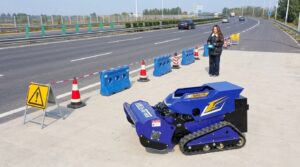
4. How to Choose the Right Remote Control Mower for Roadside Contracts
A suitable machine should match the most demanding tasks it is expected to perform, within the manufacturer’s operating limits.
4.1 Select Cutting Width Based on the Working Area
Cutting width affects how much grass the machine can cut in a single pass, but wider equipment may be less convenient around narrow verges, drainage structures and restricted access points.
Compare the cutting width with the actual available working space.
Also check overall machine dimensions, turning clearance, loading arrangements and the width of access gates or maintenance routes.
4.2 Choose Tracks or Wheels According to Terrain
Tracked and wheeled mowers have different operating characteristics.
Tracked models may be worth evaluating for selected rough or sloped areas, while wheeled machines may suit firmer, more predictable surfaces.
The final decision should account for machine weight, soil strength, moisture, gradient, slope direction and the manufacturer’s requirements.
For more information, read:
Crawler versus wheel remote control mowers
4.3 Match the Cutting System to Vegetation
Roadside maintenance contracts can involve different vegetation types.
| Vegetation type | Equipment consideration | Important limitation |
|---|---|---|
| Regular roadside grass | Standard grass-cutting configuration | Confirm the required finish and cutting height |
| Tall grass | Mower rated for the vegetation height | Actual performance depends on density and conditions |
| Mixed weeds and rough growth | Suitable flail-mower configuration may be considered | Confirm allowable material size and cutting capability |
| Woody brush | Dedicated brush-clearing equipment may be needed | Do not assume a grass mower can process woody material |
| Roadside debris | Separate inspection and removal equipment | A mower is not a debris-removal machine |
A flail mower may suit certain rough vegetation tasks, while other cutting systems may be more appropriate for maintained grass.
Read the comparison guide:
Remote control flail mower versus rotary mower
4.4 Evaluate Cutting Height and Adjustment
Different roadside maintenance contracts may specify different cutting heights.
Review the adjustment range, whether the height can be changed remotely and whether the system is appropriate for the intended vegetation.
Do not assume that a low cutting setting is best for rough roadside ground. Cutting too low may increase the chance of contact with stones or other hidden objects.
4.5 Check Remote-Control Functions
Remote-control range is relevant when the operator needs to position themselves away from the cutting area.
However, advertised range should not be treated as guaranteed performance in every location. Obstacles, interference, terrain and visibility can affect practical operation.
Ask the supplier about signal-loss behavior, emergency-stop functions, operating procedures and any restrictions on working distance.
4.6 Compare Machine Weight and Transport Requirements
Roadside contractors may move equipment between several work zones in a single day.
Check the machine’s operating weight, dimensions, loading method, trailer compatibility and transport requirements.
Also consider the ground surface. A machine that is suitable for a firm embankment may not be appropriate for soft shoulders or recently disturbed soil.
4.7 Review Maintenance and Parts Availability
Recurring road maintenance contracts require reliable equipment planning.
Compare routine servicing requirements, cutting-component replacement, track or wheel maintenance, engine servicing and the availability of technical support.
For contractors operating several machines, maintenance records and access to replacement parts can be important purchasing considerations.
5. Comparing Remote Control Mowers for Different Roadside Applications
Use the following table to build an initial equipment shortlist.
| Roadside application | Main factors to evaluate | Initial equipment direction |
|---|---|---|
| Wide, flat road verge | Cutting width, required finish, access | Suitable grass mower matched to the working width |
| Rural roadside grass strip | Surface condition, obstacles, traffic separation | Machine suitable for the inspected verge |
| Sloped embankment | Slope, soil stability, travel direction | Model approved for the actual terrain |
| Drainage margin | Edge stability, moisture, channel depth | Operate only after the bank and boundary are assessed |
| Long vegetation strip | Cutting width, transport, vegetation density | Wider machine if access and conditions allow |
| Rough vegetation with light weeds | Cutting system, allowable material size | Suitable heavy-duty or flail configuration |
| Woody brush and unmanaged growth | Material size and clearing requirements | Dedicated brush-clearing equipment if needed |
These are preliminary guidelines, not guarantees of performance. The final selection must reflect the actual work site, contract requirements and current manufacturer specifications.
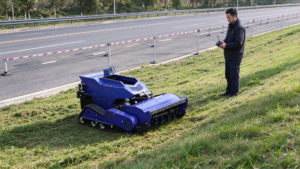
6. Evaluating AWY Remote Control Lawn Mowers for Roadside Maintenance
AWY offers remote control lawn mower configurations that B2B buyers can evaluate for suitable vegetation-maintenance applications.
The following model information provides an initial comparison. Roadside contractors should confirm the latest specifications and determine whether the intended work falls within each machine’s permitted operating conditions.
6.1 AWY-550H for More Compact Working Areas
The AWY-550H has a stated cutting width of 550 mm and a 224 cc gasoline engine.
Its listed features include:
- Dual 750 W brushless walking motors.
- Cutting-height adjustment from 20–150 mm.
- A stated remote-control range of up to 500 m.
- A stated maximum gradeability of up to 45°.
Contractors may consider evaluating this configuration where working width and access are important factors.
Before selecting it for roadside use, confirm the available clearance, vegetation type, ground conditions and the specific limitations associated with slope operation.
6.2 AWY-800S for Wider Grass-Cutting Tasks
The AWY-800S has a stated cutting width of 800 mm and a listed machine weight of 360 kg.
Published specifications include:
- 459 cc gasoline or diesel engine options.
- An 850 W brushless walking motor.
- A stated remote-control range of up to 500 m.
- A stated maximum gradeability of up to 55°.
- An approximate mowing-capacity figure of 1,500 m²/h.
This model may be worth evaluating for wider, suitable grass areas where its dimensions and weight are compatible with site access and ground conditions.
The published capacity is a reference figure, not a guaranteed roadside production rate. Actual output can vary with vegetation density, turning requirements, obstacles, slope and work-zone controls.
6.3 AWY-900 for Larger Cutting Width Requirements
The AWY-900 has a stated cutting width of 900 mm.
Published specifications include:
- LONCIN engine options of 452 cc, 608 cc and 764 cc.
- Two 1,500 W brushless walking motors.
- A stated remote-control range of up to 500 m.
- A stated maximum gradeability of up to 55°.
- Adjustable cutting height from 2–20 cm.
- Travel speed from 0–6 km/h.
- A 6 L fuel tank.
- An approximate stated mowing capacity of 2,000 m²/h.
Contractors may consider this model when comparing wider cutting coverage and different engine configurations for suitable roadside vegetation tasks.
Before purchasing, verify the latest machine dimensions, weight, cutting configuration, operating limits and transport requirements.
6.4 When to Consider Larger Models
AWY-1000S and AWY-1200S may also be relevant for contractors evaluating wider equipment for large, suitable vegetation-maintenance areas.
Request the latest specifications for these models and compare their overall dimensions, weight, cutting configuration and operating requirements with the actual job site.
A wider cutting deck does not automatically make a machine more suitable for narrow road verges or restricted access points.
6.5 Quick Model Comparison
| Evaluation factor | AWY-550H | AWY-800S | AWY-900 |
|---|---|---|---|
| Stated cutting width | 550 mm | 800 mm | 900 mm |
| Listed engine configuration | 224 cc gasoline | 459 cc gasoline or diesel options | LONCIN 452/608/764 cc options |
| Stated remote range | Up to 500 m | Up to 500 m | Up to 500 m |
| Stated maximum gradeability | Up to 45° | Up to 55° | Up to 55° |
| Initial evaluation focus | Compact working areas | Wider cutting coverage | Wider cutting width and engine options |
Specifications are listed reference figures and must be verified against current manufacturer documentation. Maximum gradeability must not be interpreted as a safe operating recommendation for every roadside slope.
7. How Contractors Can Plan Roadside Mowing Operations
A repeatable maintenance process can help contractors coordinate equipment, operators and work zones across multiple roadside locations.
Step 1: Review the Contract Requirements
Identify the areas to be maintained, the required vegetation height, the permitted working hours and any road authority requirements.
Confirm which tasks involve routine grass cutting and which require separate clearing or vegetation-control methods.
Step 2: Survey Each Work Area
Record the slope, ground conditions, vegetation, access width, drainage features and nearby utilities.
Identify hazards and establish the areas where mowing is prohibited or requires additional controls.
Step 3: Arrange the Work Zone
Coordinate traffic management and site access with the responsible authority or project manager.
Establish the necessary barriers, signs and exclusion zones before moving equipment into position. Follow local requirements and the approved work plan.
Step 4: Match the Machine to the Job
Select a mower based on cutting width, cutting system, terrain compatibility, machine weight and operating limits.
If the vegetation or surface conditions fall outside the manufacturer’s specifications, use an appropriate alternative method.
Step 5: Inspect and Operate the Machine
Follow the pre-operation checklist and verify that the remote-control system, emergency-stop functions and cutting components are in the required condition.
Maintain suitable visibility and control during operation. Stop if traffic, people, ground conditions or equipment behavior make the task unsuitable.
Step 6: Complete Post-Operation Checks
After mowing, inspect the machine according to the manufacturer’s instructions. Record any damage, abnormal behavior or maintenance requirements.
Secure the equipment before transport and follow the required shutdown and isolation procedures before cleaning or servicing cutting components.
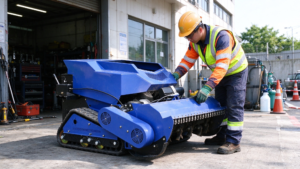
8. Cost Considerations for Roadside Maintenance Contractors
When evaluating equipment for a roadside maintenance contract, compare the full cost of ownership rather than relying on purchase price alone.
8.1 Initial Equipment Investment
Compare the machine, cutting configuration, remote-control equipment and included accessories.
If different engine or cutting options are available, request an itemized quotation to ensure that the specifications are comparable.
8.2 Transport and Mobilization
Roadside contractors may operate across a large geographical area.
Consider the cost and practicality of transporting the machine between work zones, including loading equipment, trailer requirements and storage.
Check whether the machine can access the locations included in the contract without requiring additional transport arrangements.
8.3 Maintenance and Replacement Parts
Review the service schedule and the availability of cutting components, tracks, filters and other model-specific parts.
For contractors managing a fleet, planned maintenance and replacement-part availability can influence equipment utilization and scheduling.
8.4 Labor and Work-Zone Requirements
Remote mowing does not remove the need for trained operators, traffic controls, inspections or site supervision.
Depending on the road and location, traffic-management requirements may represent a significant part of the overall work plan.
When assessing costs, include the actual time required for site preparation, traffic controls, mowing, transport and servicing.
8.5 Measure Actual Productivity
Published mowing-capacity figures should be treated as reference information rather than guaranteed production rates.
Record actual results under representative conditions, including vegetation density, slope, turning frequency and the time needed to establish a safe work zone.
These measurements can help contractors estimate the suitability of the equipment for future projects without assuming a fixed return on investment.
9. Buying Remote Control Mowers for Contractors, Dealers and Municipal Suppliers
B2B buyers should prepare a clear specification before requesting quotations.
9.1 Roadside Maintenance Contractors
Contractors should identify the most common roadside tasks within their service area.
If the work mainly involves flat grass verges, a different configuration may be appropriate than one used for suitable sloped embankments or rough vegetation.
Prepare representative site photographs and confirm the operating requirements before choosing a model.
9.2 Municipal Maintenance Service Providers
Municipal buyers may need to evaluate equipment for recurring maintenance across multiple road sections.
Consider the relevant public procurement requirements, local operating rules, documentation, training and after-sales support.
Technical specifications should be reviewed against the intended work rather than assuming that a single machine can cover every roadside application.
9.3 Equipment Dealers and Distributors
Dealers should understand the main roadside vegetation tasks in their target market and match equipment configurations to customer requirements.
Questions to discuss with the manufacturer include:
- Available cutting widths and engine configurations.
- Permitted vegetation types and operating conditions.
- Machine dimensions, weight and transport requirements.
- Spare-parts availability and service documentation.
- Warranty conditions and technical support.
- Applicable requirements in the destination market.
Clear documentation helps dealers present realistic equipment capabilities to contractors.
9.4 Rental Companies
Rental businesses may serve contractors with different levels of experience and a variety of site conditions.
Equipment selection should therefore consider operator instructions, maintenance procedures, parts availability and the ability to verify whether a customer’s intended application is appropriate.
Do not recommend a machine for slopes, vegetation or roadside environments beyond its stated capabilities.
For related B2B guidance, see:
Remote control lawn mowers for rental businesses
10. Frequently Asked Questions
Q1. Can remote control lawn mowers be used for roadside maintenance?
They may be suitable for designated roadside grass-cutting and vegetation-maintenance tasks when the machine, terrain and work zone meet the relevant requirements. Roadside work must follow applicable traffic-management rules and the manufacturer’s instructions.
Q2. Are tracked remote mowers suitable for road embankments?
Some tracked models may be suitable for certain embankments, but the decision depends on slope, surface stability, moisture, direction of travel and machine limitations. Advertised maximum gradeability is not a universal safe operating limit.
Q3. Can a remote mower operate beside a live highway?
Only where the activity is permitted and an appropriate work-zone plan and traffic controls are in place. Remote operation alone does not make roadside work safe or authorized.
Q4. Can remote control mowers cut tall roadside grass?
Some models are designed for taller grass and selected rough vegetation. Contractors should confirm vegetation height, density, cutting-system capability and other operating limitations before use.
Q5. Should I choose a flail mower or a rotary mower?
The choice depends on the vegetation and required finish. A flail mower may suit certain rough vegetation tasks, while a rotary configuration may suit other grass-cutting applications. Confirm the actual capabilities of the selected model.
Q6. How do I choose the right cutting width?
Measure the available working area and access points. Wider machines may suit open verges, while narrower models may be easier to position in restricted spaces. Overall machine dimensions and transport requirements should also be checked.
Q7. What hazards should contractors inspect before mowing?
Check for debris, rocks, exposed cables, utility infrastructure, unstable ground, drainage edges, holes and traffic exposure. Remove hazards or change the work plan before mowing begins.
Q8. What information is needed for an equipment quotation?
Provide the application, approximate area, vegetation type and height, slope information, ground conditions, access restrictions, quantity and destination country. Representative site photographs can help the supplier assess suitability.
Q9. Can AWY support bulk B2B purchasing?
B2B buyers can contact AWY to discuss available models, configurations and quotation requirements. Availability, shipping, warranty and after-sales support should be confirmed for the specific order and destination.
Q10. How can contractors assess whether a remote mower is cost-effective?
Compare purchase price, transport, servicing, parts, operating time and site-preparation requirements. Use actual results from representative tasks rather than assuming advertised productivity will be achieved at every roadside location.
11. Conclusion: Match Roadside Mowing Equipment to the Job
Remote control lawn mowers may be useful for maintaining suitable vegetation along road verges, selected embankments, drainage margins and transportation-property boundaries.
For roadside maintenance contractors, the right purchasing decision depends on the vegetation, terrain, available working space, traffic-management requirements and the manufacturer’s operating limits.
A machine that suits a broad, stable grass verge may not be appropriate for a narrow shoulder, an unstable embankment or a location with substantial woody vegetation. Contractors should assess each work area and choose equipment that matches the actual task.
Careful site planning, appropriate traffic controls, operator training and routine maintenance are essential parts of a professional roadside vegetation-management program.
Request a B2B Roadside Mowing Equipment Recommendation from AWY
AWY provides remote control lawn mower options for commercial vegetation-maintenance applications. If you are a road maintenance contractor, municipal service provider, equipment dealer or rental company, share your project requirements so suitable configurations can be evaluated.
Please include:
- Application: Road verge, embankment, drainage margin or roadside property.
- Area: Approximate square meters or hectares.
- Vegetation: Grass height, density and type.
- Terrain: Flat, uneven, sloped or soft ground.
- Access: Working width, access restrictions and transport limitations.
- Quantity: Number of machines required.
- Destination: Country or region for delivery.
Send your requirements and available site photographs to the AWY team to discuss suitable configurations, current specifications and a B2B quotation.
Choose equipment that matches the roadside conditions, supports your maintenance workflow and meets the requirements of the job.
Related Articles
- Remote Control Lawn Mower for Steep Slopes: A Complete Guide
- Remote Control Lawn Mower for Roadside Vegetation Management
- Remote Control Lawn Mower for Riverbanks and Embankments
- Remote Control Flail Mower vs Rotary Mower: Which Is Better?
- Crawler vs Wheel Remote Control Lawn Mower: Which Is Better?
- Remote Control Lawn Mower for Rental Business: A B2B Guide
- Remote Control Lawn Mower for Airports and Large Facilities
- Remote Control Lawn Mower for Industrial Sites