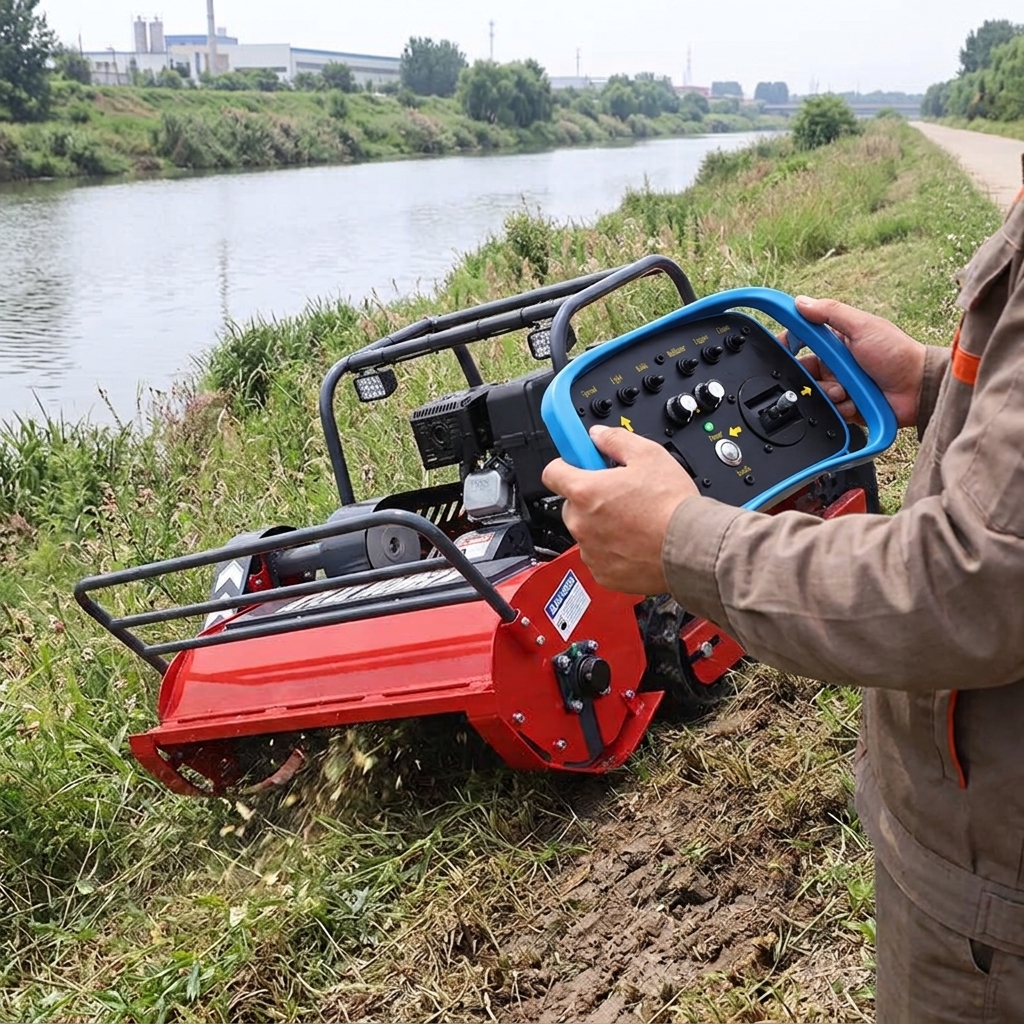
Maintaining vegetation along riverbanks, drainage channels, reservoirs and embankments can be a difficult task for conventional mowing equipment.
These areas often combine steep slopes, uneven surfaces, tall grass, weeds, wet ground and limited operator access. In some locations, the machine may need to work close to water while maintaining sufficient traction on sloped terrain.
For contractors and professional land-management companies, a remote control lawn mower for riverbanks can provide an alternative approach to conventional mowing equipment.
Instead of placing the operator directly on the mower, a remote-controlled machine allows the operator to control the mower from a separate position.
Tracked remote-controlled mowers are particularly relevant to embankment applications because their continuous tracks can provide ground contact across uneven surfaces.
This makes them suitable for considering applications such as:
- Riverbank vegetation management
- Reservoir embankments
- Irrigation channels
- Drainage channels
- Flood-control embankments
- Canal-side grass cutting
- Retention pond maintenance
- Agricultural waterway maintenance
- Municipal green infrastructure
- Industrial water-management areas
Why Is Riverbank Mowing Difficult?
Riverbanks are very different from ordinary lawns.
A typical riverbank may include several challenging conditions at the same time.
Steep Slopes
Embankments can have significant inclines.
A conventional riding mower may be difficult to operate safely on a steep slope, particularly when the surface is uneven or loose.
A remotely operated tracked mower can allow the operator to control the machine from a different position.
Uneven Ground
Riverbanks can contain:
- Exposed roots
- Stones
- Soil erosion
- Small holes
- Uneven vegetation
- Sloped surfaces
A machine intended for this environment needs appropriate traction and terrain capability.
Wet Ground
Waterways may create damp or soft soil conditions.
Wet ground can reduce traction and increase the risk of wheel or track slip.
Before operation, the operator should evaluate soil stability and the machine manufacturer’s operating requirements.
Dense Vegetation
Riverbanks are often exposed to rapid vegetation growth.
Grass, weeds and brush may become tall if mowing intervals are long.
This means the cutting system needs to match the vegetation conditions.
What Is a Riverbank Remote Control Mower?
A riverbank remote control mower is a remotely operated mowing machine designed to cut grass and vegetation in difficult outdoor environments.
Instead of an operator sitting on the machine, the mower is controlled through a wireless remote controller.
Typical remote functions may include:
- Forward movement
- Reverse movement
- Steering
- Travel speed
- Cutting engagement
- Cutting height
- Engine start/stop
- Emergency stop
The exact functions depend on the model.
For B2B buyers, it is important to request a complete control-function list before purchasing.
Why Use a Remote Control Mower for Embankments?
1. Remote Operation
The operator can control the mower while standing away from the cutting deck.
This can be useful when the machine is working on a slope, in a ditch or near a waterway.
The operator can maintain a clear view of the machine and surrounding area while controlling its movement.
Remote operation does not replace proper risk assessment, operator training or site-specific safety procedures.
2. Tracked Mobility
Crawler-style machines use continuous tracks instead of conventional tires.
This design can provide a larger ground-contact area.
For uneven or inclined surfaces, this can help provide traction and machine stability within the manufacturer’s specified operating conditions.
Common Riverbank and Embankment Applications
A remote-controlled mower can be considered for a variety of water-management environments.
Riverbanks
Riverbanks can require recurring vegetation maintenance.
Regular mowing can help keep grass and weeds under control while maintaining the appearance of public or managed waterways.
Flood-Control Embankments
Flood-control infrastructure may contain large grass-covered slopes.
Because these areas can be steep and difficult to access, specialized slope-capable mowing equipment may be considered.
Irrigation Channels
Agricultural irrigation networks can contain long grass-covered embankments.
A remote mower can potentially be integrated into regular vegetation-management operations.
Drainage Channels
Drainage channels may be narrow, sloped or difficult to reach with traditional mowing equipment.
Compact remote-controlled machines can be useful where access width is limited.
Reservoir Embankments
Reservoirs and water-storage facilities often contain maintained grass areas and sloped embankments.
Professional maintenance teams can evaluate remote-controlled equipment for recurring vegetation management.
Retention Ponds
Industrial and commercial properties may have retention ponds surrounded by grass slopes.
Remote mowing equipment can provide another option for maintaining these areas.
Choosing the Right Cutting System
The cutting system is one of the most important factors when selecting an embankment mower.
Riverbank vegetation can vary considerably.
A site may contain:
- Short grass
- Tall grass
- Weeds
- Thick stems
- Small brush
- Mixed vegetation
For routine grass cutting, a conventional rotary system may be suitable depending on the machine.
For heavier vegetation, a remote control flail mower for riverbanks can be considered.
Flail-style systems are commonly used for dense vegetation because multiple cutting elements work across the rotating rotor.
Before selecting the machine, buyers should provide the manufacturer with information about the vegetation.
For example:
Grass height: 80–120 cm
Vegetation: grass + weeds
Terrain: 35° embankment
Area: 50,000 m²
Required cutting width: approximately 800–1,000 mm
Detailed application information allows manufacturers to recommend a more appropriate configuration.
Remote Control Flail Mower vs Rotary Mower
How to Select a Remote Control Mower for River Slopes
A good purchasing process should begin with the site rather than the machine.
Step 1: Measure the Maximum Slope
Determine the steepest part of the embankment.
Slope angle can have a major influence on equipment selection.
AWY offers crawler remote-controlled mower configurations with published gradeability specifications reaching approximately 45°–55°, depending on the model and operating conditions.
Actual operating limits should always be confirmed with the manufacturer.
Step 2: Check Ground Conditions
Determine whether the terrain is:
- Dry
- Wet
- Soft
- Rocky
- Sandy
- Muddy
- Uneven
Ground conditions can affect traction and machine performance.
Step 3: Identify Vegetation
Measure approximate vegetation height and identify whether the site contains grass, weeds or brush.
Step 4: Measure Working Width
Narrow waterways may require a compact machine.
Large embankments may benefit from a wider cutting deck.
Step 5: Estimate Required Productivity
For commercial contracts, calculate the total mowing area and expected maintenance frequency.
This helps determine whether a 550 mm, 800 mm, 900 mm, 1,000 mm or 1,200 mm class machine is more appropriate.
Cutting Width and Productivity
Cutting width has a direct relationship with mowing productivity.
A wider deck can reduce the number of passes required across a large embankment.
However, larger machines can be less convenient in narrow or obstructed locations.
For example:
| Application | Potential Machine Direction |
|---|---|
| Narrow drainage channel | Compact mower |
| Small riverbank | 550 mm class |
| Medium embankment | 800 mm class |
| Large grass-covered slope | 900–1,000 mm class |
| Large commercial land area | 1,000–1,200 mm class |
These are general application considerations rather than fixed machine recommendations.
The final configuration should be based on terrain, vegetation and manufacturer specifications.
Gradeability Matters on Embankments
For a remote control mower for embankments, gradeability is a key specification.
A machine designed for flat lawns may not be appropriate for steep slopes.
Buyers should look for clearly documented information about:
- Maximum gradeability
- Track configuration
- Machine center of gravity
- Ground clearance
- Track width
- Travel speed
- Emergency stop system
The stated gradeability should not be treated as a universal operating limit.
Actual conditions such as wet grass, mud, loose soil, slope direction and obstacles can change operating performance.
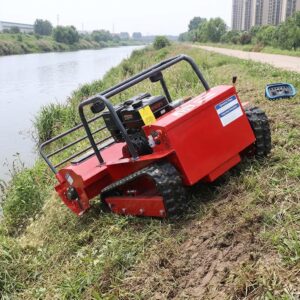
Remote Mowing Near Water
Working near rivers, canals and reservoirs requires additional attention.
Water itself is not the only hazard.
Other potential hazards include:
- Soft soil
- Hidden holes
- Slippery grass
- Unstable embankments
- Erosion
- Water channels
- Floating debris
- Nearby pedestrians
A remote-controlled mower can allow the operator to remain away from the machine, but it should still be operated according to the manufacturer’s instructions.
The operator should maintain adequate visibility and a suitable safety distance.
If the working area is close to public roads or public waterways, appropriate site-control procedures may also be necessary.
Remote Control Mower for Canal Maintenance
Canals can be particularly suitable for specialized vegetation-management equipment.
Canal banks may have long stretches of:
- Grass
- Weeds
- Brush
- Tall vegetation
At the same time, the bank itself can be steep.
A tracked remote mower can be considered for these environments when its dimensions, cutting system and gradeability match the site.
For agricultural water-management companies, canal maintenance may represent a recurring commercial application rather than a one-time mowing project.
Remote Control Mower for Drainage Channels
Drainage channels can present a different challenge.
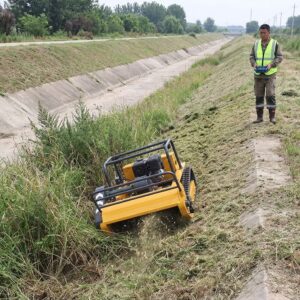
The working area may be narrow, and the machine may need to operate along a sloped surface.
Compact dimensions become especially important.
Before purchasing a machine, measure:
Channel width + slope angle + access point + vegetation height
This information can help determine whether the mower can physically enter the work area and operate effectively.
B2B Applications for Riverbank Mowing
Professional riverbank mowing can involve large areas and recurring maintenance schedules.
Potential customers include:
Municipal Maintenance Departments
Municipalities may manage:
- Rivers
- Drainage systems
- Public parks
- Flood-control areas
- Retention ponds
- Public embankments
Landscaping Contractors
Commercial landscaping contractors may add remote-controlled slope mowing to their service portfolio.
Water Management Companies
Companies responsible for canals, reservoirs and drainage infrastructure can use specialized vegetation-management equipment.
Agricultural Contractors
Agricultural service providers may maintain irrigation channels, farm waterways and drainage areas.
Infrastructure Maintenance Contractors
Infrastructure contractors may handle vegetation control around engineered embankments and managed land.
What B2B Buyers Should Consider
For commercial purchasing, the machine price is only one part of the decision.
Buyers should evaluate the complete equipment package.
Machine Performance
Consider:
- Cutting width
- Engine power
- Cutting height
- Gradeability
- Travel speed
- Remote-control distance
- Track configuration
Reliability
For contractors, machine downtime can affect project schedules.
Ask about:
- Engine brand
- Drive motors
- Spare parts
- Warranty
- Maintenance intervals
- Technical support
Transportation
If the machine will move between multiple project locations, consider:
- Machine weight
- Overall dimensions
- Loading method
- Packaging
- Trailer requirements
Parts Availability
For commercial fleets, spare-part availability can be an important purchasing factor.
Ask the manufacturer whether commonly replaced parts can be supplied separately.
AWY Remote Control Mowers for Difficult Terrain
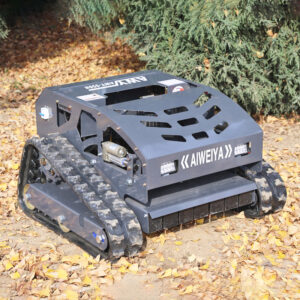
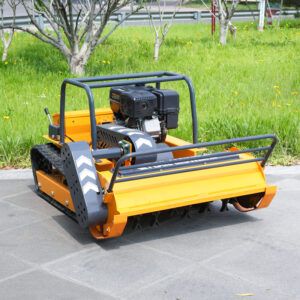
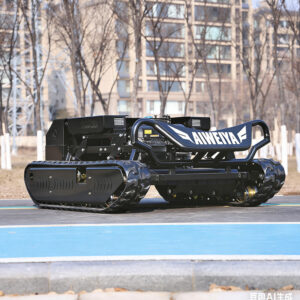
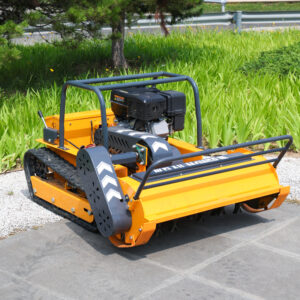
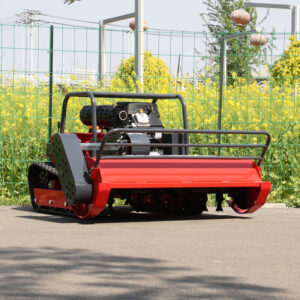
AWY provides multiple crawler remote-controlled mower configurations for different professional applications.
Depending on the project, buyers can evaluate different cutting widths and machine sizes.
AWY-550H
A compact crawler configuration suitable for applications where maneuverability and remote operation are important.
AWY-800S Series
An approximately 800 mm cutting-width class designed for professional vegetation management, including slopes, orchards, embankments and rough grass.
AWY-900 Series
A larger all-terrain configuration with a 900 mm cutting width and slope-oriented design.
AWY-1000S
A wider crawler mower configuration for larger grass areas, orchards, slopes and wild vegetation.
AWY-1200S
A heavy-duty, wider cutting configuration intended for larger professional mowing applications.
Maintenance After Riverbank Mowing
Waterway environments can expose equipment to moisture, mud, dust and vegetation debris.
After operation, inspect the mower according to the manufacturer’s maintenance schedule.
Important areas include:
- Tracks
- Cutting blades
- Cutting deck
- Engine
- Belts
- Drive motors
- Hydraulic components
- Electrical connections
- Remote controller
- Fasteners
Remove accumulated grass and soil where appropriate.
If the mower has operated in wet or muddy conditions, additional cleaning and inspection may be required.
How Often Should Riverbanks Be Mowed?
There is no universal mowing schedule.
Maintenance frequency depends on:
- Climate
- Rainfall
- Grass species
- Weed growth
- Seasonal conditions
- Environmental requirements
- Local regulations
- Flood-management practices
- Desired appearance
Some sites may require several mowing cycles per year, while others may have different vegetation-management schedules.
For contractors, it can be useful to estimate annual mowing area rather than evaluating a machine based only on a single project.
Remote Control Mower vs Conventional Mowing Equipment
Remote-controlled mowers are not intended to replace every type of mowing equipment.
Different machines can serve different environments.
| Working Condition | Equipment Consideration |
|---|---|
| Flat open lawn | Conventional mower may be suitable |
| Large agricultural field | Tractor-based equipment may be suitable |
| Steep grass embankment | Remote-controlled slope mower may be considered |
| Narrow drainage channel | Compact remote mower may be useful |
| Dense roadside brush | Heavy-duty cutting system may be considered |
| Difficult riverbank | Tracked remote mower may be evaluated |
The correct equipment depends on site requirements, operating conditions and local safety procedures.
Crawler vs Wheel Remote Control Lawn Mower
OEM Solutions for Distributors
For international distributors, customized configurations may be important.
Depending on the project, OEM/ODM options can include:
- Brand logo
- Machine color
- Cutting width
- Engine configuration
- Cutting system
- Remote-control system
- Safety configuration
- Product labeling
- Packaging
- Documentation
Distributors can provide their target market, application requirements and expected order quantity when discussing a customized project.
Questions to Ask Before Buying
Before purchasing a remote control mower for riverbanks, ask the manufacturer:
Terrain
- What is the maximum recommended slope?
- Can the machine operate on uneven terrain?
- What type of track system is used?
Vegetation
- What maximum grass height can the machine handle?
- Is a flail cutting system available?
- Can it cut weeds and light brush?
Operation
- What is the remote-control range?
- Can cutting height be adjusted remotely?
- What emergency-stop functions are included?
Commercial Supply
- What engine options are available?
- What certifications are available?
- Are spare parts available?
- Is OEM branding supported?
- What is the MOQ?
- What packaging is used for export?
These questions can help distributors and contractors compare equipment according to actual operating requirements.
Frequently Asked Questions
Can a remote control lawn mower cut riverbank grass?
Yes. Remote-controlled mowers can be configured for grass and other vegetation on riverbanks, provided that the machine’s cutting system and terrain capability match the site.
Are crawler mowers suitable for embankments?
Tracked remote-controlled mowers can be suitable for many sloped and uneven-terrain applications. The actual operating limit depends on the model, terrain and manufacturer’s specifications.
Can remote mowers work near water?
Some remote-controlled mowers can be used near rivers, canals and drainage systems. However, operators must evaluate ground stability, water proximity and other site-specific hazards before operation.
What cutting system is suitable for thick riverbank vegetation?
A flail cutting system may be considered for dense grass, weeds and tougher vegetation. The correct configuration depends on vegetation type and cutting requirements.
What cutting width should I choose?
The answer depends on the size of the working area and access conditions. Larger areas may benefit from wider cutting decks, while narrow channels may require a more compact machine.
Can riverbank mowers be customized?
For B2B projects, customization may include machine color, branding, cutting width, engine configuration and other specifications depending on the manufacturer.
Riverbank Mower Buying Checklist
Before requesting a quotation, prepare the following information:
Project Location:
Country / region
Terrain:
Flat / moderate slope / steep slope
Maximum Slope:
Approximate degree
Vegetation:
Grass / weeds / brush / mixed vegetation
Vegetation Height:
Approximate height in cm
Total Area:
Square meters or hectares
Working Width:
Required cutting width
Operating Frequency:
Weekly / monthly / seasonal / contract-based
Quantity:
Number of machines required
Target Market:
Europe / North America / Australia / other
Customization:
OEM logo / color / specifications
Providing this information allows the manufacturer to evaluate the project more efficiently.
Conclusion
A remote control lawn mower for riverbanks can be a useful solution for professional vegetation management in difficult waterway environments.
Riverbanks, canals, drainage channels and flood-control embankments often combine steep slopes, uneven ground, dense vegetation and restricted access.
For these conditions, buyers should focus on the complete machine configuration rather than a single specification.
The most important factors include:
- Gradeability
- Track traction
- Cutting system
- Cutting width
- Remote-control functions
- Machine dimensions
- Productivity
- Maintenance
- Spare parts
- Transportation
For contractors, municipalities, water-management companies and international distributors, the right machine should be selected according to the actual terrain and vegetation conditions.
Tell us your maximum slope, riverbank or embankment dimensions, vegetation type, grass height, required cutting width, project area, quantity and destination country to discuss a suitable remote-controlled mowing configuration.
Related Articles
- Remote Control Lawn Mower for Steep Slopes
- Remote Control Lawn Mower for Roadside Vegetation Management
- Remote Control Lawn Mower for Overgrown Grass
- Crawler vs Wheel Remote Control Lawn Mower
- Remote Control Flail Mower vs Rotary Mower
- Remote Control Lawn Mower for Farms
- Remote Control Lawn Mower for Golf Courses