
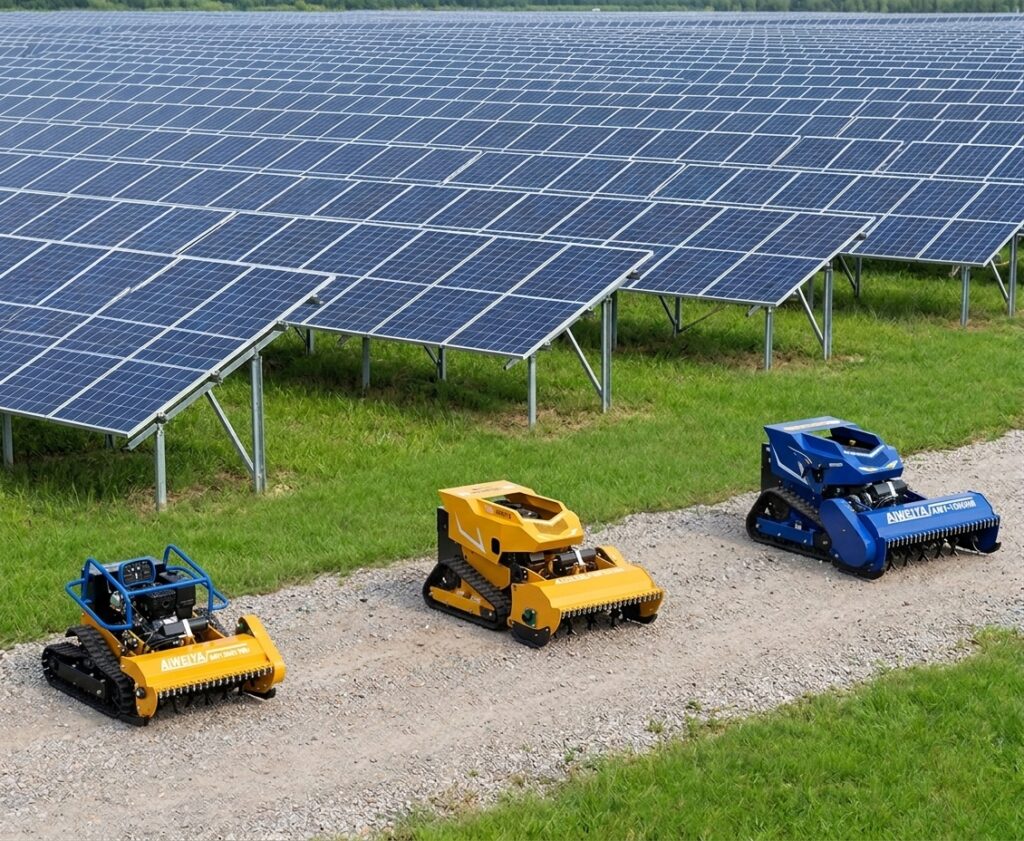
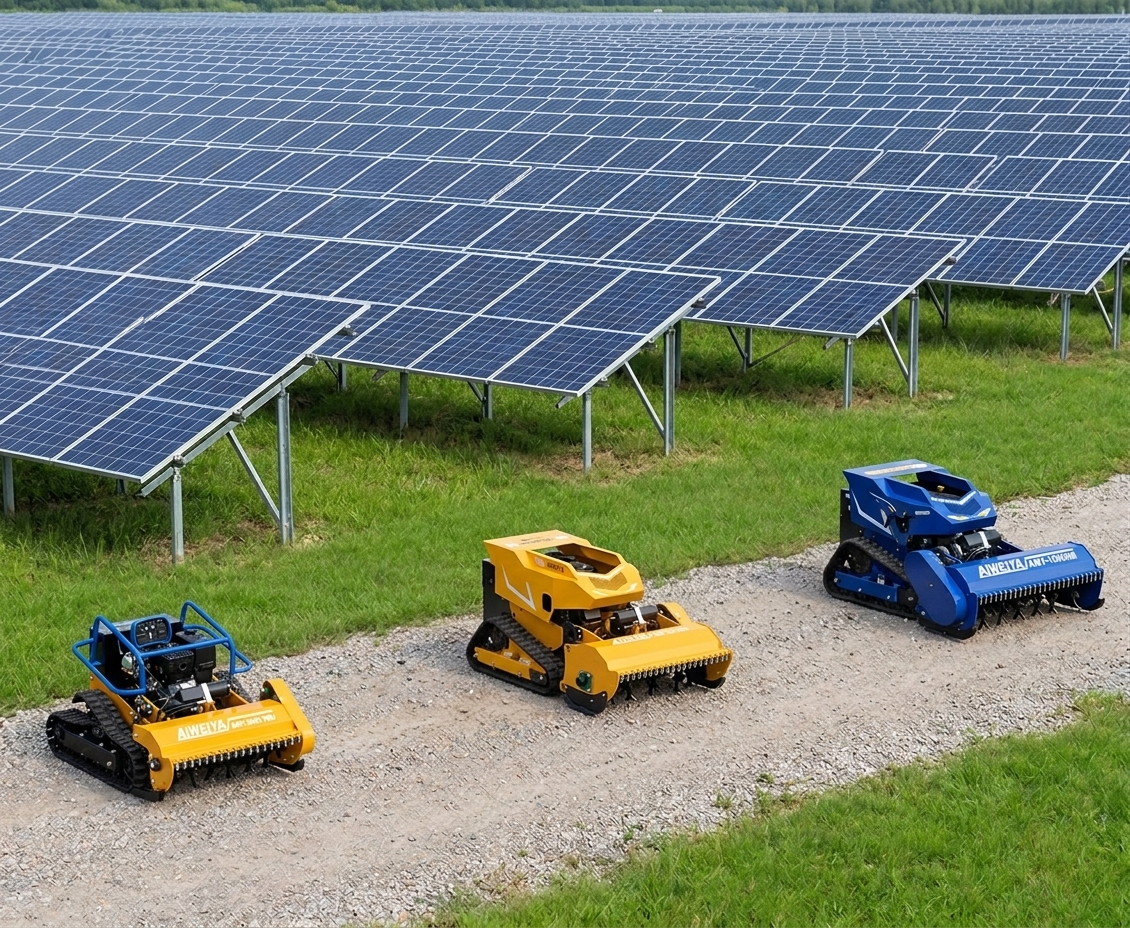
Solar farms require more than solar panels and electrical infrastructure.
Vegetation management is also an important part of maintaining a large photovoltaic site.
Grass, weeds and other vegetation can grow rapidly around solar panels, access roads, equipment areas and drainage channels. If vegetation becomes excessively tall, it can make maintenance work more difficult and may interfere with access to parts of the site.
For large solar farms, manually cutting vegetation can be time-consuming.
Conventional riding mowers and tractors may also have limitations when working around:
- Solar panel rows
- Narrow access corridors
- Uneven terrain
- Slopes
- Electrical equipment
- Drainage areas
- Fences
- Underground infrastructure
A remote control lawn mower for solar farms provides another option for professional vegetation management.
Remote operation allows an operator to control the mower from outside the machine, while crawler configurations can be considered for uneven or sloped photovoltaic sites.
For solar farm operators, EPC companies, O&M contractors and landscaping businesses, machine selection should focus on access width, cutting performance, terrain capability and operational efficiency.
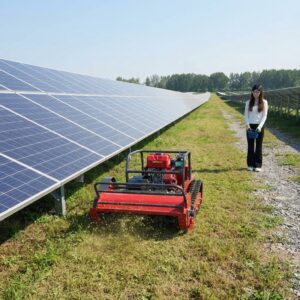
Why Is Vegetation Management Important for Solar Farms?
Solar farms can cover large areas.
A utility-scale project may contain thousands of solar panels arranged across extensive land.
Vegetation can grow:
- Between panel rows
- Along access roads
- Around perimeter fencing
- Near drainage channels
- Around maintenance areas
- Along equipment access routes
Regular vegetation management can make these areas easier for maintenance teams to access.
It can also help maintain the overall condition and appearance of the site.
However, solar farm mowing is not simply a matter of cutting grass as quickly as possible.
The equipment must work around valuable photovoltaic infrastructure.
This makes maneuverability and controlled operation important considerations.
What Is a Solar Farm Remote Control Mower?
A solar farm remote control mower is a remotely operated grass-cutting machine that can be used for vegetation management around photovoltaic installations.
The operator controls the mower using a wireless remote controller.
Depending on the machine, remote functions may include:
- Forward
- Reverse
- Steering
- Travel speed
- Cutting engagement
- Cutting height
- Engine start
- Engine stop
- Emergency stop
The exact functions depend on the model.
For professional solar farm applications, buyers should confirm the complete remote-control function list before purchasing.
Why Use a Remote Control Mower on Solar Farms?
1. Remote Operation Around Infrastructure
Solar farms contain expensive equipment.
Operators need to maintain appropriate control and visibility when mowing near panels, cables, inverters, transformers and other infrastructure.
Remote operation allows the operator to control the machine without sitting directly on it.
This can provide more flexibility when approaching areas that are difficult to access with conventional riding equipment.
2. Suitable for Uneven Solar Farm Terrain
Not every solar farm is built on perfectly flat land.
Photovoltaic projects may be constructed on:
- Agricultural land
- Former industrial land
- Rolling terrain
- Hillsides
- Semi-rural fields
- Sloped properties
A tracked remote mower can be considered when the terrain requires additional traction.
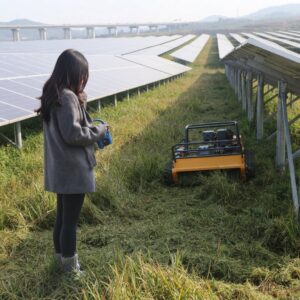
Where Can Remote Mowers Be Used on Solar Farms?
A professional remote mower may have several potential applications.
Between Solar Panel Rows
The spaces between panel arrays can become overgrown.
The available width should be measured before selecting equipment.
A machine that is too wide may not be able to move efficiently between rows.
Around Panel Perimeters
Vegetation can grow around the outer edges of photovoltaic arrays.
Compact equipment can be useful in areas where larger machinery has limited access.
Along Solar Farm Roads
Access roads and service paths require regular vegetation management.
A mower can be used to maintain grass along road edges where appropriate.
Around Fencing
Perimeter fencing can create narrow strips of vegetation.
These areas may require a compact mower configuration.
Drainage Areas
Solar farms may include drainage channels and sloped areas.
Tracked remote mowers can be considered where the terrain and machine specifications are compatible.
Around Maintenance Areas
Grass and weeds can also grow around buildings, service areas and other site infrastructure.
What Type of Mower Is Suitable for Solar Farms?
The correct mower depends on the solar farm’s terrain and vegetation.
A site with short grass and flat terrain may require a different machine from a site with tall weeds and steep slopes.
Important specifications include:
- Cutting width
- Machine width
- Cutting height
- Ground clearance
- Turning capability
- Remote-control range
- Gradeability
- Track configuration
- Cutting system
For larger sites, productivity should also be considered.
Cutting Width vs Solar Panel Row Spacing
One of the most important measurements is the distance available between solar panel rows.
Before purchasing equipment, measure the actual working corridor.
For example:
Available corridor width → machine width → required safety clearance → turning space
The machine should not simply fit through the gap.
There should also be sufficient clearance for safe operation and maneuvering.
For B2B buyers, it is useful to provide the mower manufacturer with:
- Minimum row spacing
- Maximum row spacing
- Access-road width
- Panel height
- Terrain slope
- Vegetation height
This information can help determine an appropriate mower size.
Remote Control Mower for Tall Grass Around Solar Panels
Solar farms may experience rapid vegetation growth during warm and rainy periods.
If mowing intervals become too long, operators may encounter:
- Tall grass
- Thick weeds
- Dense vegetation
- Small brush
- Overgrown access paths
A mower designed for professional vegetation management should be selected according to the expected vegetation conditions.
For heavier vegetation, buyers may consider a machine equipped with a suitable flail or heavy-duty cutting system.
Remote Control Lawn Mower for Overgrown Grass
Flail Mower vs Rotary Mower for Solar Farm Vegetation
The cutting system should match the maintenance requirements.
Rotary Cutting System
A rotary system can be appropriate for general grass cutting.
Potential advantages include:
- Simple grass mowing
- Efficient cutting
- Suitable for routine maintenance
Flail Cutting System
A flail system may be considered when vegetation is denser.
Potential applications include:
- Tall grass
- Weeds
- Tough vegetation
- Mixed grass and weeds
- Light brush
The correct choice depends on the actual vegetation and site-management requirements.
Remote Control Flail Mower vs Rotary Mower
Tracked vs Wheeled Mowers for Solar Farms
Solar farms can have different terrain conditions.
Tracked Remote Control Mower
Tracked machines can be considered for:
- Sloped solar sites
- Uneven ground
- Rough grassland
- Soft ground
- Difficult terrain
Wheeled Remote Control Mower
Wheeled machines can be considered for:
- Flat solar farms
- Open grass areas
- Wide access roads
- Relatively firm ground
For a project with mixed terrain, the buyer should evaluate where the mower will spend most of its operating time.
Crawler vs Wheel Remote Control Lawn Mower
Important Safety Considerations Around Solar Panels
Solar farms contain electrical equipment and valuable infrastructure.
Mowing operations should therefore be planned carefully.
Potential hazards include:
- Electrical cables
- Inverters
- Transformers
- Solar panel structures
- Uneven ground
- Metal structures
- Fencing
- Drainage channels
- Maintenance vehicles
Operators should follow the site’s safety procedures and any applicable electrical and workplace regulations.
The mower should also be operated according to the manufacturer’s instructions.
Before mowing near photovoltaic infrastructure, site managers should identify restricted areas and establish appropriate operating distances.
Managing Vegetation Without Damaging Solar Equipment
A professional mowing machine should be selected based on its ability to operate in the actual environment.
Operators should pay attention to:
Machine Width
Ensure the mower can pass through the available corridor.
Cutting Direction
Control the machine carefully around panel supports and other structures.
Cutting Height
Avoid unnecessarily aggressive cutting where the site requires a higher residual grass height.
Debris Management
Dense vegetation can generate debris during cutting.
The cutting system and operating method should be selected according to site requirements.
Operator Visibility
The operator should maintain a clear view of the mower and its surroundings.
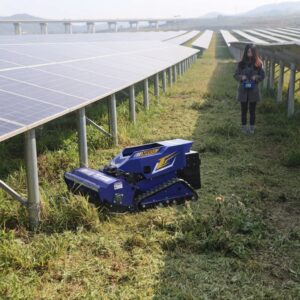
Productivity for Large Solar Farms
Large solar farms can cover hundreds of acres or extensive hectares.
For professional vegetation-management contractors, productivity becomes an important purchasing factor.
A simple way to evaluate equipment is to consider:
Cutting width × working speed × terrain × vegetation density
However, theoretical mowing capacity is not the same as real-world productivity.
Actual output can be affected by:
- Turning
- Obstacles
- Panel rows
- Transport
- Refueling
- Vegetation density
- Terrain
- Operator visibility
- Site access
For this reason, buyers should evaluate expected daily productivity under real site conditions.
Solar Farm Mowing Equipment for Contractors
Professional vegetation management around solar installations can be performed by several types of businesses.
Solar O&M Companies
Operations and maintenance companies may manage recurring vegetation-control work at photovoltaic sites.
Landscaping Contractors
Commercial landscaping companies can add solar farm mowing to their service portfolio.
Vegetation Management Contractors
Specialized vegetation contractors may provide scheduled mowing for large infrastructure sites.
Agricultural Contractors
Agricultural service providers may already have equipment and personnel suitable for large land-maintenance projects.
Renewable Energy Site Operators
Some large solar operators may maintain their own equipment fleet for routine vegetation control.
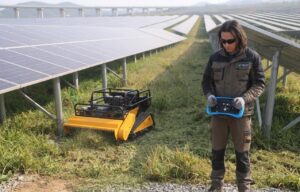
How Often Should a Solar Farm Be Mowed?
There is no single mowing schedule for every solar project.
Vegetation growth depends on:
- Climate
- Rainfall
- Temperature
- Grass species
- Soil conditions
- Site-management policy
- Seasonal growth
Some sites may require several maintenance cycles each year.
The objective is generally to maintain manageable vegetation rather than waiting until the site becomes severely overgrown.
For B2B contractors, understanding the annual maintenance schedule can help determine the required mower capacity.
What Specifications Should Solar Farm Buyers Compare?
When purchasing a mower for a photovoltaic site, consider the following.
1. Machine Width
Compare the machine’s overall width with the narrowest working corridor.
2. Cutting Width
A wider cutting deck may increase productivity in open areas.
3. Gradeability
Important for solar farms located on sloped land.
4. Cutting Height
Useful for adapting mowing to site-management requirements.
5. Remote-Control Distance
Consider the actual working environment rather than simply selecting the longest advertised range.
6. Drive System
Tracked or wheeled configuration should match terrain.
7. Cutting System
Select rotary or flail configuration according to vegetation.
8. Machine Weight
Weight can affect transportation and ground pressure.
9. Spare Parts
Commercial operators should understand spare-part availability before purchase.
10. OEM Options
Distributors may require customized branding and specifications.
AWY Remote Control Mowers for Solar Farm Applications
AWY offers several crawler remote-controlled mower configurations that can be evaluated for solar farm vegetation-management projects.
AWY-550H
The compact size can be considered for narrower access areas and smaller working corridors.
AWY-800S Series
The approximately 800 mm cutting width provides a balance between working width and maneuverability for professional vegetation management.
AWY-900
The 900 mm cutting width and all-terrain configuration can be considered for larger mowing areas and challenging terrain.
AWY-1000S
The 1,000 mm cutting width can provide broader coverage for larger grass areas.
AWY-1200S
The 1,200 mm class provides a wider working configuration for larger professional mowing applications.
For a solar farm project, machine selection should be based on actual row spacing, terrain, vegetation and access conditions.
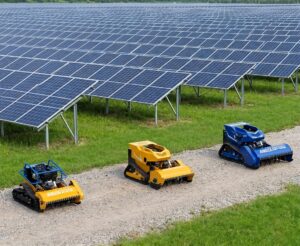
OEM Remote Control Mowers for Solar Farm Contractors
International distributors may require customized equipment for renewable-energy maintenance applications.
Potential OEM/ODM options can include:
- Brand logo
- Machine color
- Cutting width
- Engine configuration
- Cutting system
- Remote-control configuration
- Safety configuration
- Product labeling
- Packaging
- Documentation
For distributors supplying solar farm maintenance companies, customization can help create a dedicated equipment product line.
When requesting an OEM quotation, provide:
- Target market
- Application
- Required quantity
- Preferred cutting width
- Terrain conditions
- Vegetation type
- Branding requirements
AWY Remote Control Lawn Mower Solutions
Maintenance Requirements
Solar farm mowing equipment may operate in dusty, grassy and outdoor environments.
Routine inspection should include:
- Cutting blades
- Cutting deck
- Tracks
- Drive motors
- Engine
- Belts
- Hydraulic components
- Electrical connections
- Remote controller
- Fasteners
Grass and debris should be removed according to the manufacturer’s cleaning procedures.
Before each working shift, operators should inspect the machine and confirm that safety and remote-control functions operate correctly.
Transporting a Remote Control Mower Between Solar Sites
Solar farm maintenance contractors may service multiple projects.
Transportation therefore becomes an important consideration.
Before purchasing, evaluate:
- Machine weight
- Machine dimensions
- Loading method
- Trailer capacity
- Packaging
- Export requirements
- Spare-part transportation
A compact machine may be easier to move between projects, while a larger mower may offer greater productivity on large sites.
The best configuration depends on the contractor’s fleet and project portfolio.
Solar Farm Mower Buying Checklist
Before contacting a manufacturer, prepare the following information.
Solar Farm Size:
_____ hectares / acres
Panel Row Spacing:
_____ mm / meters
Minimum Access Width:
_____ mm / meters
Terrain:
Flat / rolling / steep
Maximum Slope:
_____ degrees
Vegetation Type:
Grass / weeds / brush / mixed
Vegetation Height:
_____ cm
Required Cutting Width:
_____ mm
Annual Mowing Frequency:
_____ times
Quantity Required:
_____ units
Target Market:
Europe / North America / Australia / Other
OEM Requirement:
Yes / No
Providing these details can help manufacturers evaluate the appropriate mower configuration.
Frequently Asked Questions
Can a remote control mower be used on a solar farm?
Yes. Remote-controlled mowers can be used for vegetation management around photovoltaic installations when the machine dimensions, cutting system and terrain capability match the site.
Can remote mowers cut grass between solar panels?
Potentially, depending on the spacing between panel rows and the mower’s dimensions. The minimum corridor width should be measured before selecting equipment.
Are tracked mowers suitable for solar farms?
Tracked mowers can be considered for solar farms with uneven or sloped terrain. The actual suitability depends on the machine specifications and site conditions.
What mower is suitable for tall grass around solar panels?
For tall grass and dense weeds, buyers can consider a mower with an appropriate heavy-duty cutting system. A flail configuration may be considered for tougher vegetation.
Can remote mowers work on solar farm slopes?
Some crawler remote-controlled mowers are designed for slope applications. Buyers should compare the machine’s published gradeability with the actual site conditions.
How wide should a solar farm mower be?
The mower width should be compatible with the narrowest working corridor between panel rows and other infrastructure. Sufficient clearance for safe operation should also be considered.
Can manufacturers provide OEM solar farm mowers?
Depending on the manufacturer, OEM/ODM customization may include branding, color, cutting width, engine configuration and other specifications.
How to Choose a Solar Farm Remote Control Mower
The selection process should start with the physical layout of the photovoltaic site.
A practical evaluation sequence is:
Panel Spacing → Access Width → Terrain → Vegetation → Cutting Width → Machine Width → Productivity → Remote Functions → Maintenance
For narrow panel corridors, compact equipment may be more appropriate.
For large open areas, wider cutting decks can improve productivity.
For sloped solar farms, tracked configurations can be evaluated.
For dense vegetation, the cutting system becomes especially important.
The machine should ultimately be selected according to the actual site rather than a single advertised specification.
Conclusion
A remote control lawn mower for solar farms can provide a practical option for professional vegetation management around photovoltaic installations.
Solar farms present a unique combination of large mowing areas, narrow panel corridors, infrastructure obstacles and, in some cases, uneven terrain.
For B2B buyers, the key considerations include:
- Machine width
- Panel row spacing
- Cutting width
- Gradeability
- Track or wheel configuration
- Cutting system
- Remote-control functions
- Productivity
- Maintenance
- Spare parts
- Transportation
Contractors, solar O&M companies, landscaping businesses and distributors can use these factors to define the equipment requirements before requesting a quotation.
If you are sourcing remote-controlled mowing equipment for a solar farm, provide your site area, panel row spacing, minimum access width, slope, vegetation type, grass height, required cutting width, quantity and destination market.
Request a Solar Farm Vegetation Management Solution
Related Articles
- Remote Control Lawn Mower for Steep Slopes
- Remote Control Lawn Mower for Overgrown Grass
- Crawler vs Wheel Remote Control Lawn Mower
- Remote Control Flail Mower vs Rotary Mower
- Remote Control Lawn Mower for Roadside Vegetation Management
- Remote Control Lawn Mower for Riverbanks and Embankments
- Remote Control Lawn Mower for Farms