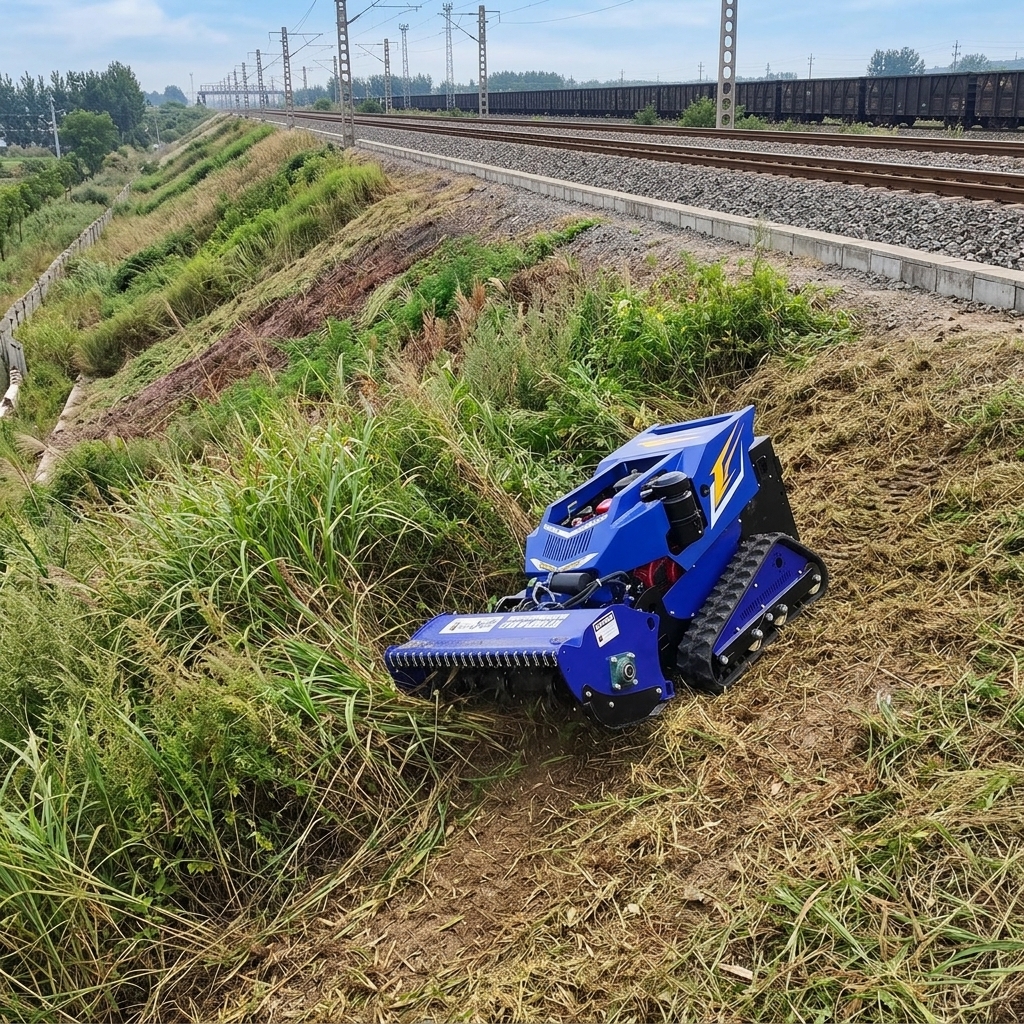
Railway vegetation management is an important part of maintaining railway corridors, embankments and surrounding infrastructure.
Grass, weeds, brush and other vegetation can grow along railway boundaries and embankments. In some locations, vegetation maintenance becomes difficult because of steep slopes, uneven terrain, narrow access routes and restricted working areas.
Traditional mowing equipment may not be suitable for every section of a railway corridor.
A remote control lawn mower for railway vegetation can provide another option for professional vegetation-management contractors and infrastructure maintenance companies.
Instead of requiring the operator to sit directly on the mower, a remote-controlled machine can be operated from a separate position.
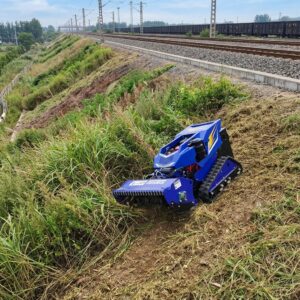
Tracked configurations can also be considered for uneven railway embankments and sloped terrain, provided that the machine is suitable for the specific working environment.
Potential applications include:
- Railway embankments
- Trackside grass areas
- Railway boundaries
- Access corridors
- Drainage slopes
- Station surroundings
- Maintenance compounds
- Industrial railways
- Freight railway infrastructure
- Railway vegetation-control projects
Why Is Railway Vegetation Management Challenging?
Railway corridors are not ordinary landscaping environments.
Maintenance teams may encounter a combination of:
- Steep embankments
- Uneven ground
- Tall grass
- Dense weeds
- Brush
- Drainage channels
- Sloped terrain
- Narrow access areas
- Fences
- Poles
- Signs
- Railway infrastructure
In addition, railway maintenance normally requires strict site-access and safety procedures.
Equipment must therefore be selected not only for cutting performance but also for its dimensions, maneuverability and suitability for the specific worksite.
What Is a Railway Remote Control Mower?
A railway remote control mower is a remotely operated vegetation-cutting machine that can be used in suitable areas around railway infrastructure.
The operator controls the machine using a wireless remote controller.
Depending on the model, the operator may be able to control:
- Forward movement
- Reverse movement
- Steering
- Travel speed
- Cutting operation
- Cutting height
- Engine start/stop
- Emergency stop
The exact functions vary by machine.
For professional railway work, buyers should verify the machine’s specifications and operating limitations with the manufacturer before deployment.
Why Consider Remote Control Mowers for Railway Maintenance?
1. Remote Operation
Remote operation allows the operator to control the mower without sitting directly on the machine.
This can be useful when mowing suitable areas around slopes or embankments.
The operator can position themselves where they have a clear view of the mower and the working environment.
However, remote operation does not remove the need for railway-specific safety procedures.
2. Crawler Traction
Railway embankments can contain significant slopes and uneven ground.
A tracked mower provides continuous track contact with the terrain.
For suitable sites, this can provide useful traction when working on difficult ground.
A crawler mower for railway embankments can therefore be considered when the terrain is beyond the practical operating conditions of conventional lawn equipment.
Where Can Remote Mowers Be Used Around Railways?
A remote-controlled mower may have several potential applications, depending on railway rules and site conditions.
Railway Embankments
Grass-covered railway embankments can require regular vegetation control.
Steep slopes may make conventional riding equipment unsuitable.
Trackside Areas
Certain vegetation-management zones alongside railway tracks may require regular mowing.
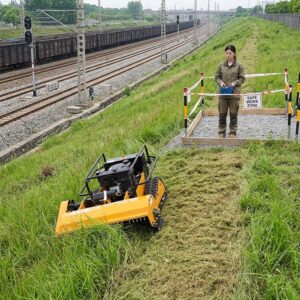
The exact distance from active tracks must be determined by the railway operator’s safety procedures.
Railway Boundaries
Grass and weeds can grow along fences and property boundaries.
Compact mowing equipment may be considered for these areas.
Drainage Areas
Railway drainage systems can contain grass-covered slopes and channels.
A compact remote mower may be suitable where its dimensions and operating specifications match the site.
Railway Maintenance Compounds
Railway depots and maintenance yards may contain open grass areas that require routine vegetation management.
Industrial Railways
Private industrial railways may have their own maintenance procedures and vegetation-control requirements.
Railway Embankment Mowing
One of the strongest applications for remote-controlled crawler mowers is embankment vegetation management.
Railway embankments can be:
- Steep
- Uneven
- Long
- Difficult to access
- Covered with tall grass
- Subject to erosion
A remote mower can be positioned on the embankment while the operator remains away from the machine.
Before operation, however, the contractor should evaluate:
- Slope angle
- Ground stability
- Soil condition
- Access points
- Railway traffic
- Required exclusion zones
- Machine operating limits
Gradeability Is an Important Specification
For a railway embankment mower, gradeability should be carefully evaluated.
Buyers should compare:
Actual site slope vs manufacturer’s recommended operating slope
AWY crawler mower models include configurations with published gradeability specifications of approximately 45°–55°, depending on the model.
This does not mean that every railway embankment at those angles is automatically suitable.
Actual conditions can change machine performance.
For example:
- Wet grass
- Loose soil
- Mud
- Side slopes
- Uneven terrain
- Surface erosion
can affect traction and stability.
Always use the manufacturer’s specified operating limits and the railway site’s safety procedures.
What Cutting System Is Suitable for Railway Vegetation?
Railway vegetation can vary from short grass to dense weeds and brush.
The cutting system should therefore match the vegetation.
Rotary Mowing
Rotary systems may be suitable for routine grass maintenance.
They can be considered when the vegetation is primarily grass and relatively manageable.
Flail Mowing
A remote control flail mower for railway vegetation may be considered for:
- Tall grass
- Dense weeds
- Tough vegetation
- Mixed vegetation
- Light brush
A flail system can provide a different cutting approach for rough vegetation-management applications.
Read: Remote Control Flail Mower vs Rotary Mower
Railway Vegetation and Tall Grass
Railway corridors may experience rapid vegetation growth during warm and wet seasons.
If maintenance intervals are extended, grass can become:
- Tall
- Dense
- Difficult to cut
- Mixed with weeds
- Mixed with small brush
The mower should therefore be selected based on the expected maximum vegetation condition rather than average grass height.
When requesting a quotation, contractors should provide photographs and approximate vegetation height whenever possible.
Tracked vs Wheeled Mowers for Railway Applications
The terrain should determine the drive configuration.
Tracked Remote Control Mowers
Tracked machines may be considered for:
- Railway embankments
- Slopes
- Uneven terrain
- Rough grassland
- Difficult-access areas
Continuous tracks can provide a large ground-contact area.
Wheeled Remote Control Mowers
Wheeled machines may be suitable for:
- Flat railway compounds
- Maintenance yards
- Open grass areas
- Level service areas
For railway contractors handling mixed terrain, a tracked mower may provide broader application flexibility, while wheeled equipment may be appropriate for specific flat areas.
Read: Crawler vs Wheel Remote Control Lawn Mower
Railway Safety Must Come First
Railway maintenance is a specialized working environment.
A mower should never be treated as ordinary landscaping equipment when operating near active railway infrastructure.
Before work begins, contractors should follow the railway operator’s rules for:
- Track access
- Work permits
- Isolation procedures
- Safe distances
- Traffic management
- Communication
- Worker positioning
- Equipment access
- Emergency procedures
The actual working area should be clearly defined before mowing begins.
Remote control should not be interpreted as permission to operate inside restricted railway zones.
Vegetation Management Near Railway Tracks
Vegetation around active railway tracks may have strict restrictions.
Depending on the railway operator, contractors may need to maintain defined clearance zones around:
- Rails
- Signals
- Overhead electrical systems
- Signaling equipment
- Communication infrastructure
- Switches
- Trackside cabinets
For this reason, a professional railway vegetation-management project should be planned with the railway infrastructure owner or authorized contractor.
A remote mower can be considered for appropriate vegetation zones where the equipment and operating method are approved.
Railway Drainage and Slope Maintenance
Drainage is important for railway infrastructure.
Vegetation may grow along:
- Drainage ditches
- Culverts
- Sloped channels
- Embankment toes
- Water-management areas
These locations can be difficult to reach using conventional mowing equipment.
A compact crawler mower may provide an option for selected drainage-maintenance areas.
Before operation, assess the channel width, slope, soil stability and access conditions.
Productivity for Railway Contractors
Railway vegetation-management contractors often work across long corridors.
Productivity therefore depends on more than cutting width.
Important factors include:
- Cutting width
- Travel speed
- Vegetation density
- Terrain
- Access points
- Transport time
- Refueling
- Turning
- Operator visibility
A wider mower can cover more ground per pass, but a compact machine may be more useful around narrow areas and obstacles.
The ideal equipment depends on the contractor’s project portfolio.
Remote Mowers for Railway Maintenance Contractors
Potential B2B users include:
Railway Maintenance Contractors
Companies responsible for railway infrastructure maintenance may use specialized vegetation-control equipment for suitable work zones.
Landscaping Contractors
Commercial landscaping companies may expand into railway vegetation-management contracts.
Infrastructure Contractors
Infrastructure maintenance businesses may need mowing equipment for embankments and surrounding managed land.
Industrial Rail Operators
Private rail networks may have their own vegetation-management requirements.
Government and Public Infrastructure Contractors
Public infrastructure projects can include vegetation management along railway corridors and associated land.
Choosing the Right Cutting Width
Cutting width should be selected according to the work area.
A compact mower may be preferable for:
- Narrow embankments
- Restricted access
- Small drainage areas
- Areas with many obstacles
A wider mower may be useful for:
- Long embankments
- Large grass areas
- Open maintenance zones
Before purchasing, measure the narrowest access area rather than only the average working width.
Remote Control Range
Remote-control distance is another specification to evaluate.
A railway contractor should consider the actual distance between:
- Operator
- Mower
- Work area
- Obstacles
A longer advertised range does not necessarily mean that the machine should always be operated at maximum distance.
Clear visibility and reliable control are more important than simply selecting the largest numerical range.
For commercial use, also confirm whether the remote controller provides:
- Emergency stop
- Low-battery warning
- Signal-status information
- Travel controls
- Cutting controls
AWY Remote Control Mowers for Railway Vegetation Applications
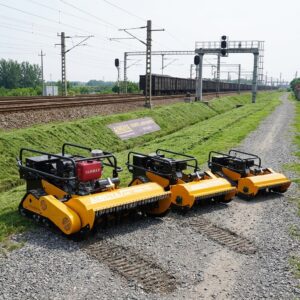
AWY offers several crawler remote-controlled mower configurations that can be evaluated for difficult-terrain vegetation management.
AWY-550H
A compact crawler configuration for applications where maneuverability and remote operation are important.
AWY-800S
An approximately 800 mm cutting-width class designed for professional grass and vegetation management.
AWY-1000S
A 1,000 mm cutting-width configuration for larger grass areas and professional vegetation maintenance.
AWY-1200S
A wider heavy-duty configuration for larger-scale mowing operations.
AWY-900
A larger all-terrain configuration with a 900 mm cutting width for demanding mowing applications.
For railway applications, final selection should be based on the specific worksite, access conditions, slope, vegetation and railway safety requirements.
OEM Solutions for Railway Contractors
International distributors may require customized remote-controlled mower configurations.
Potential OEM/ODM options may include:
- Company logo
- Machine color
- Cutting width
- Engine configuration
- Cutting system
- Remote-control configuration
- Safety configuration
- Product labeling
- Export packaging
- Documentation
For B2B customers, customization requirements should be discussed before production.
Distributors can provide:
- Target country
- Customer application
- Required quantity
- Preferred machine size
- Vegetation type
- Terrain
- Branding requirements
Explore: AWY Remote Control Lawn Mower Solutions
Maintenance Requirements
Railway vegetation-management equipment may operate in dusty, grassy and uneven conditions.
Routine inspection should include:
- Tracks
- Cutting blades
- Cutting deck
- Drive motors
- Engine
- Belts
- Hydraulic components
- Electrical connections
- Remote controller
- Fasteners
After mowing dense vegetation, remove accumulated grass and debris according to the manufacturer’s maintenance instructions.
Before every operation, check the remote-control system and emergency-stop function.
Transporting a Remote Control Mower
Railway contractors may work across multiple project locations.
Transport requirements should therefore be considered when selecting equipment.
Important factors include:
- Machine dimensions
- Machine weight
- Loading method
- Trailer capacity
- Export packaging
- Storage requirements
- Spare parts
A compact machine may be easier to transport, while a larger machine may provide higher productivity.
The right balance depends on the contractor’s work portfolio.
Railway Vegetation Mower Buying Checklist
Before contacting a manufacturer, prepare the following information.
Working Area:
Railway embankment / boundary / maintenance compound / drainage area
Maximum Slope:
_____ degrees
Vegetation Type:
Grass / weeds / brush / mixed
Vegetation Height:
_____ cm
Minimum Access Width:
_____ mm
Required Cutting Width:
_____ mm
Terrain:
Flat / uneven / steep
Working Frequency:
Weekly / monthly / seasonal
Estimated Area:
_____ m² / hectares
Quantity:
_____ units
Target Market:
Europe / North America / Australia / Other
OEM Requirement:
Yes / No
Providing these details can make equipment selection and quotation more efficient.
Frequently Asked Questions
Can a remote control lawn mower be used for railway vegetation management?
Yes, remote-controlled mowers can be considered for suitable railway vegetation-management areas, subject to the railway operator’s safety procedures and the machine’s operating specifications.
Can remote mowers work on railway embankments?
Tracked remote-controlled mowers can be suitable for some embankment applications. Actual suitability depends on slope, ground conditions, vegetation and the manufacturer’s operating limits.
Can a remote mower operate close to railway tracks?
Only in areas where its operation is permitted and controlled under the applicable railway safety procedures. Contractors should not assume that remote operation makes an area safe to enter.
What mower is suitable for tall railway grass?
A professional mower with an appropriate cutting system can be considered for tall grass. For dense vegetation, a flail configuration may be evaluated.
Are tracked mowers suitable for railway slopes?
Tracked mowers can be considered for sloped railway embankments because continuous tracks provide substantial ground contact. The actual gradeability must be checked against site conditions.
What cutting width should railway contractors choose?
The cutting width should match the working area and access restrictions. Narrow corridors require compact equipment, while open embankments can accommodate wider machines.
Can railway vegetation mowers be customized?
For B2B orders, OEM/ODM customization may include branding, color, cutting width, engine configuration and other specifications, depending on the manufacturer.
How to Choose a Railway Vegetation Management Mower
A practical purchasing process should follow the working environment.
Railway Rules → Access → Terrain → Vegetation → Machine Width → Cutting Width → Gradeability → Remote Functions → Productivity → Maintenance
First determine where the machine is permitted to operate.
Then measure the access width and slope.
Next identify the vegetation and required cutting performance.
Finally compare machine configurations according to productivity, transportation and maintenance requirements.
For contractors, this process can prevent the common mistake of selecting equipment based only on engine power or cutting width.
Conclusion
A remote control lawn mower for railway vegetation can provide an option for professional vegetation management in suitable areas around railway infrastructure.
Railway corridors can contain steep embankments, uneven terrain, tall grass, weeds, drainage channels and difficult-access areas.
For these environments, buyers should evaluate:
- Gradeability
- Track configuration
- Cutting system
- Cutting width
- Machine width
- Remote-control functions
- Productivity
- Transport
- Maintenance
- Spare parts
Most importantly, railway vegetation management requires site-specific safety planning. Equipment should only be used in areas and under operating procedures approved by the relevant railway infrastructure owner or responsible authority.
If you are sourcing remote-controlled mowing equipment for railway vegetation management, provide your terrain, maximum slope, vegetation type, grass height, minimum access width, required cutting width, project area, quantity and destination market.
Request a Railway Vegetation Management Solution
Related Articles
- Remote Control Lawn Mower for Steep Slopes
- Remote Control Lawn Mower for Overgrown Grass
- Crawler vs Wheel Remote Control Lawn Mower
- Remote Control Flail Mower vs Rotary Mower
- Remote Control Lawn Mower for Roadside Vegetation Management
- Remote Control Lawn Mower for Riverbanks and Embankments
- Remote Control Lawn Mower for Solar Farms