Solar farms are often constructed in open environments such as abandoned land, hillsides, grasslands, and coastal areas. These locations usually have strong vegetation growth, making weed management a major challenge for solar power operators. When weeds become overgrown, they can block sunlight from reaching the photovoltaic modules, reducing energy output. In dry seasons, dead vegetation can also create serious fire risks.
However, vegetation maintenance in solar fields is not as simple as traditional mowing. Narrow gaps between solar panels, uneven landscapes, and the presence of electrical equipment make manual or conventional mowing methods inefficient and potentially dangerous. Remote-controlled (RC) mowers provide a safer and more effective solution by allowing operators to maintain vegetation while staying away from hazardous areas.
Step 1: Understand Site Challenges and Select the Proper RC Mower
Solar panel arrays are usually installed with limited clearance between support structures, leaving very little room for large agricultural machinery. Traditional lawn mowers and tractors often cannot access these restricted areas, while manual trimming requires workers to operate in uncomfortable positions and increases exposure to electrical hazards.
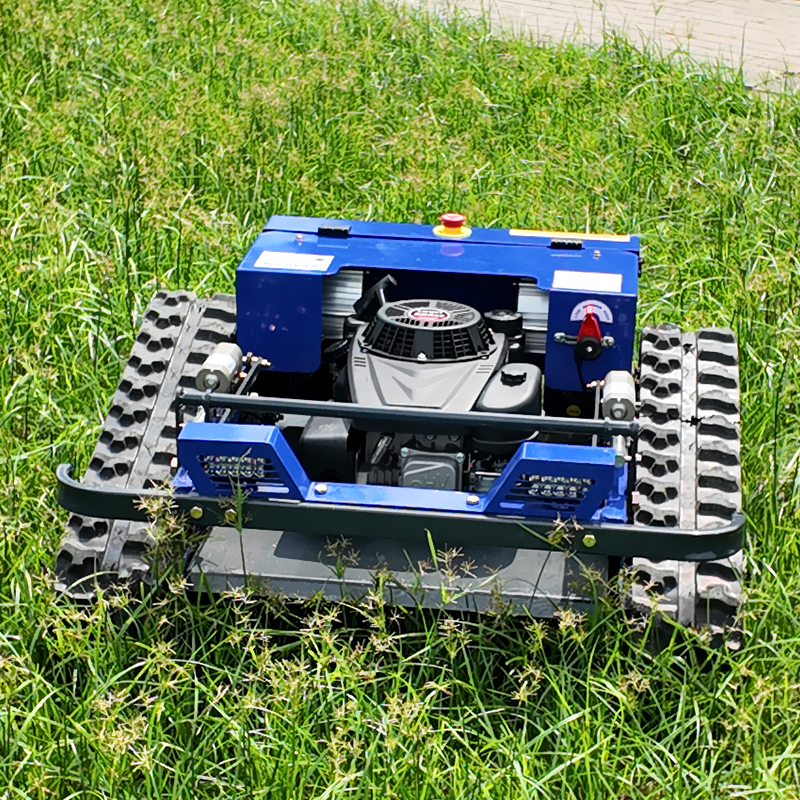
A compact, low-height tracked RC mower is an ideal choice for solar farm maintenance. Its small body design allows it to move easily beneath photovoltaic panels, while crawler tracks provide excellent stability and reduce ground pressure. This makes the equipment suitable for challenging environments such as muddy wetlands, uneven terrain, rocky areas, and sloped ground.
Many professional RC mowers are designed to handle steep gradients, making them capable of working efficiently on hillside solar installations where conventional equipment may struggle.
Step 2: Conduct Safety Checks Before Operation
Before beginning weed-cutting operations, a complete inspection of the working area and equipment should be performed.
First, operators should remove large stones, metal scraps, cables, and other hard debris around the solar panel supports. These objects may damage mower blades or affect machine performance during operation.
The mower itself should also be checked carefully, including:
- Track condition and tension
- Blade installation and sharpness
- Battery or fuel status
- Remote-control connection and signal stability
- Emergency stop and braking functions
For solar farms located on slopes, confirming that the automatic braking system works properly is especially important to prevent accidental movement or machine sliding.
Step 3: Keep Operators Away from Dangerous Areas Through Remote Control
One of the biggest advantages of RC mowers is the separation between workers and operating equipment.
Instead of entering narrow spaces beneath solar panels, operators can control the mower remotely from a safe position outside the panel rows. With a long-distance remote-control system, the machine can travel underneath modules, cut weeds, and navigate around obstacles without requiring workers to crawl into restricted areas.
This operating method greatly reduces risks associated with solar farm maintenance, including:
- Contact with electrical equipment
- Slips and falls on uneven terrain
- Physical injuries caused by manual trimming
- Accidental damage to solar panel structures
The mower can also adjust direction flexibly, allowing it to work around support columns and other obstacles while maintaining safe clearance from the panels.
Step 4: Use Mulching to Reduce Maintenance and Fire Risks
Modern RC mowers can perform mulching operations by cutting weeds into small pieces instead of simply removing vegetation. These fine clippings naturally decompose and return nutrients to the soil, reducing the need for additional cleanup.
Mulching also helps prevent the accumulation of dry grass and plant material, which can become a potential fire hazard during hot and dry periods. Regular mowing during peak growing seasons keeps vegetation under control, improves airflow around solar panels, and helps maintain stable power generation efficiency.
Conclusion
RC mower technology offers a practical solution for modern solar farm vegetation management. By allowing machines to operate in difficult areas while keeping operators in safe locations, these systems improve efficiency, reduce labor requirements, and lower long-term maintenance costs.
With one operator and one remote-controlled mower, large solar installations can achieve safer and more convenient weed control. For solar farm owners and maintenance teams, adopting RC mowing equipment is an effective way to improve operational safety while protecting energy production performance.